
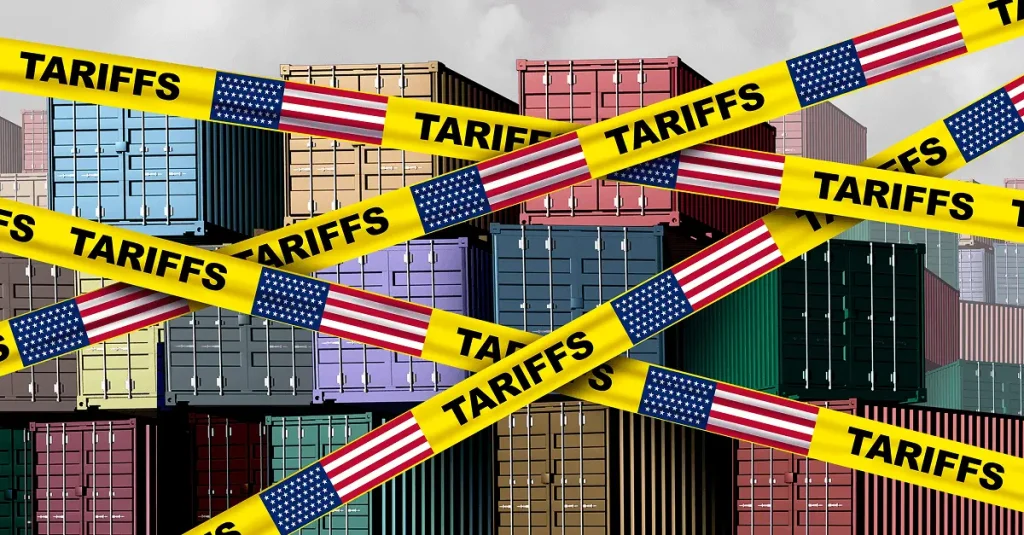
Are rising operational costs due to new trade policies eating into your profits? While tariffs may be dictated by forces beyond your control, your business’s response doesn’t have to be. Demand response offers a smart, actionable way to build resilience, cut energy expenses, and shield your margins. In this guide, we explore how demand response can fortify your finances against the 2025 U.S. tariff surge.
Commercial and industrial businesses know the sting of market volatility all too well. Supply chain disruptions, material shortages, and geopolitical tensions are constant hurdles, especially for those relying on imports from key partners like China, Mexico, and Canada.
The 2025 trade environment has turned up the heat. The Trump administration’s aggressive tariff rollout—including 25% duties on non-USMCA-compliant imports from Canada and Mexico starting March 4, a 10% tariff on Canadian energy and potash, and a universal 10% tariff on most global imports from April 5, with steeper rates up to 50% on nations like China—has spiked costs for critical inputs like electronics, steel, and aluminum. These policies, aimed at shrinking the U.S. trade deficit, are forcing companies to rethink strategies to stay competitive in a globalized economy.
The Cascading Impact of Tariffs on Your Operations
Navigating this trade storm makes long-term planning feel like a gamble. Businesses are scrambling—reassessing suppliers, postponing projects, renegotiating contracts, or passing costs to customers. Tariffs are driving up expenses across the board, from raw materials to construction inputs, potentially inflating commercial lease rates as building costs climb.
Energy costs are also under threat. While electricity hasn’t been directly hit yet, tariffs on Canadian and Mexican energy imports—key for regions like the Northeast—are raising alarms. In Q1 2025, the Federal Energy Regulatory Commission (FERC) approved tariff frameworks for the New York Independent System Operator (NYISO) and ISO New England (ISO-NE), preparing to collect duties on Canadian electricity if mandated. This could add $70 million to $180 million in annual costs for energy users in these regions. Economic forecasts suggest these trade policies could push household expenses up by $1,500 annually, with energy prices likely to follow if import duties expand.
How Demand Response Counters Tariff Pressures
In this unpredictable trade climate, agility is your greatest asset. Controlling costs you can influence—like electricity usage—offers immediate relief. While retooling supply chains or infrastructure takes years, demand response delivers fast, tangible savings using existing assets.
Utility or grid-sponsored demand response programs pay businesses to reduce or shift energy use during peak grid demand. Simple actions—like adjusting HVAC, dimming lights, or pausing non-critical operations—yield big benefits:
Earn cash for every kilowatt-hour you save during grid stress events.
Gain insights into energy patterns to drive ongoing efficiency and lower bills.
Optimize operations by avoiding high-cost peak hours.
By strategically managing energy with demand response, you turn a fixed cost into a revenue stream, maintaining productivity while cutting expenses.
Turning Tariff Chaos into Opportunity
The 2025 tariff wave is undeniably disruptive, but it’s also a chance to get ahead. Tariffs may be unavoidable, but your response is your superpower. Demand response empowers you to manage risks, optimize costs, and position your business as a leader in efficiency and sustainability.
Partnering with a trusted demand response expert like NextG Power ensures you maximize these benefits. As the global leader in demand response, NextG Power offers tailored curtailment plans, expertise across U.S. ,Canadian and worldwide energy markets.
In a volatile business landscape, demand response shouldn’t add complexity—it should be simple, profitable, and low-risk. With about 20 years of global expertise, NextG Power delivers reliability and value, letting you focus on your core operations while we handle the rest.
NextG Power stands out by:
Uncovering new demand response opportunities.
Clearly outlining your earning potential with transparency.
Maximizing revenue streams for clients.
Protecting against penalties for underperformance.
Our customer-first approach, backed by cutting-edge technology and unmatched experience, makes NextG Power the top choice for businesses navigating the evolving energy landscape.
Contact our team today to discover how demand response can boost your bottom line—and how much you can earn.