
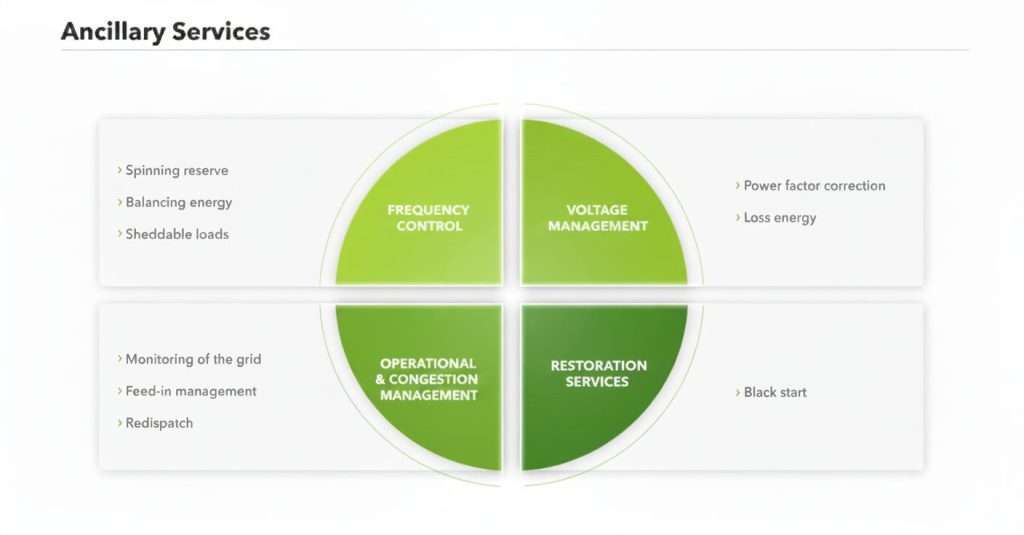
Keeping the lights on is more complex than simply generating power. Behind the scenes, a symphony of precise adjustments known as ancillary services works tirelessly to ensure the grid remains stable, safe, and reliable. But what are these critical services?
In short, ancillary services are the specialized tools and processes that grid operators use to maintain the delicate balance of the electrical grid. They ensure that fundamental parameters like frequency and voltage stay within strict limits, manage congestion on power lines, and even help restart the system after a major outage.
Let’s break down the four key categories of these essential grid services.
1. Frequency Control: Keeping the Grid in Sync
The grid’s frequency (50 Hz in Europe, 60 Hz in North America) is like its heartbeat. It must be kept incredibly stable. If generation and consumption fall out of balance, the frequency changes, which can lead to equipment damage or even widespread blackouts. Ancillary services for frequency control include:
Spinning Reserve: This isn’t a service that’s actively called upon but rather a physical buffer. The kinetic energy stored in the rotating masses of large power plant generators acts like a flywheel, providing instant inertia to counteract tiny imbalances.
Balancing Energy (Frequency Reserves): When a significant imbalance occurs, grid operators activate balancing energy. This is typically divided into tiers based on reaction speed:
Primary Reserve (FCR): Reacts within seconds to stabilize the frequency.
Secondary Reserve (aFRR): Takes over within minutes to relieve the primary reserve and restore frequency to its target value.
Tertiary Reserve (mFRR): Activated within 15 minutes to handle longer-lasting imbalances and free up the secondary reserve.
Sheddable Loads: Sometimes, the quickest solution is to reduce demand. Large industrial consumers can agree to temporarily power down their operations in exchange for payment, providing a powerful tool to rebalance the grid almost instantly.
2. Voltage Management: Maintaining Power Quality
Voltage is the “pressure” that pushes electricity through the grid. It must be kept within a safe range to protect your appliances and ensure efficient transmission. This is managed through reactive power compensation.
Power Factor Correction: Grid operators manage voltage by injecting or absorbing reactive power using specialized equipment like capacitors and reactors. This ensures the voltage remains strong and stable from the power plant all the way to your home.
3. Restoration Services: Rebooting the Grid After a Blackout
If the grid collapses, how does it come back online? Power plants themselves often need electricity to start up. This is where Black Start Capability comes in.
Black Start: Certain power plants, like hydroelectric dams or specific gas turbines, can start up independently without an external power source. These units are critical for re-energizing the grid section by section, eventually providing power to larger plants that need it to restart, like nuclear or coal facilities.
4. Operational & Congestion Management: Keeping the Power Flowing
With the rise of renewable energy, managing the physical flow of electricity across the grid has become more complex. These ancillary services prevent bottlenecks.
Redispatch: If the grid operator forecasts a congestion problem on a power line, they can instruct power plants on one side of the bottleneck to reduce output while plants on the other side increase theirs. This manages the flow without changing the total amount of energy generated.
Feed-in Management: When the grid is overloaded by too much renewable generation (e.g., on a very windy day), grid operators may need to curtail, or temporarily shut off, wind or solar farms to maintain stability.
Ancillary services are the silent heroes of our modern power system. They are fundamental to integrating renewable energy, preventing outages, and ensuring that every time you flip a switch, the power is there—stable and reliable. Understanding them is key to understanding how we keep the grid of the future secure.
Контакт our energy expert for a free consult.