
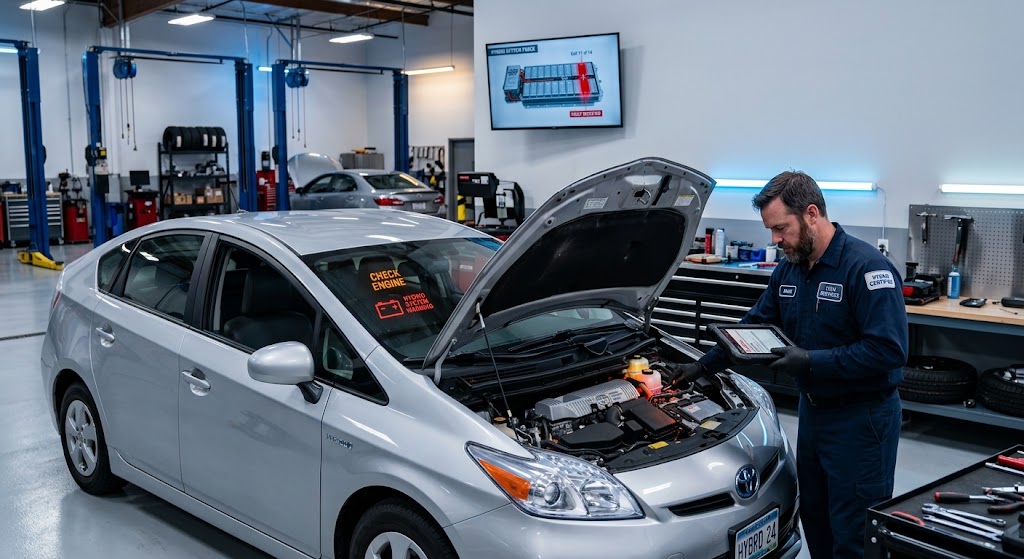
If your check engine light is on and you’re seeing a hybrid battery error code, you’re not alone. Hybrid vehicles are designed to alert you early when something isn’t right, but those codes can be confusing. Understanding what these codes mean can help you take action before a small issue turns into a major (and expensive) problem.
What Are Hybrid Battery Error Codes?
Hybrid battery error codes are diagnostic trouble codes (DTCs) generated by your vehicle’s onboard computer. These codes indicate issues with the high-voltage battery system, including:
Battery cell imbalance
Voltage irregularities
Temperature issues
Internal battery degradation
When one of these problems is detected, your vehicle stores a code and may trigger warning lights such as the Check Engine Light, Hybrid System Warning Light, or Reduced Power/Limp Mode.
Common Hybrid Battery Error Codes (And What They Mean)
P0A80 – Replace Hybrid Battery Pack
This is the most well-known and most common hybrid battery code. It means one or more modules inside the battery pack have degraded to the point where the battery can no longer function properly. You’ll likely notice reduced fuel efficiency, loss of power, and frequent engine cycling. This code rarely resolves itself and typically indicates a failed hybrid battery, so it’s best to start planning for replacement.
P0A7F – Battery Pack Deterioration
Similar to P0A80, but often appears earlier in the failure process. This code means the battery is weakening and losing capacity. You may notice reduced battery performance, more frequent engine operation, and lower fuel economy. You may still have some time before complete failure, but battery replacement is likely in your future. Addressing the issue sooner can help you avoid unexpected breakdowns.
P0AFA – Hybrid System Voltage Low
This code means the hybrid system is not seeing the voltage it expects from the hybrid battery and related components. On many hybrid vehicles, this code can prevent the vehicle from starting. Possible causes include a failed component inside the hybrid battery (such as a relay box or wire harness), problems with the main vehicle wiring harness, charging system issues, or internal battery problems. Have the system properly diagnosed, as external wiring and related components can also trigger this code.
P0A0F – Engine Failed to Start
The vehicle is unable to start because the hybrid system does not have enough power available to initiate the engine start sequence. This condition can be related to a discharged hybrid battery, hybrid battery faults, or other system issues. The Engine Fail to Start issue should be diagnosed and resolved first, and the hybrid battery will need to be charged before further testing can be completed. If there are no hybrid battery trouble codes present after charging, the hybrid battery may still be serviceable. However, if fault codes are present, the battery may require replacement.
P0AC0 – Hybrid Battery Pack Current Sensor Issue
The hybrid system is having trouble monitoring battery current or reading battery performance data correctly. This can affect how the vehicle manages charging and discharging of the hybrid battery. This code can be caused by a faulty current sensor, wiring concerns, battery control components, or issues within the hybrid battery itself. A proper diagnosis is recommended to identify the root cause before replacing any components. P0AC0 can prevent the vehicle from starting in some situations.
Why These Codes Matter
Hybrid batteries do not typically fail all at once. Instead, they gradually degrade over time. Early warning codes give drivers an opportunity to address issues before they become more serious. Ignoring hybrid battery codes can lead to reduced fuel economy, poor vehicle performance, increased repair costs, unexpected breakdowns, and potential damage to other hybrid system components. The sooner a problem is diagnosed, the more options you’ll have.
Can You Fix a Hybrid Battery Without Replacing It?
In some situations, minor battery-related concerns can be repaired. However, for major codes such as P0A80 and P0A7F, replacement is usually the most reliable solution. Temporary fixes or battery reconditioning may delay the problem, provide limited improvement, or fail to restore full battery performance. If the battery has experienced significant degradation, replacement is often the best long-term solution.
Signs Your Hybrid Battery Is Failing
Even before a code appears, you may notice warning signs such as battery charge levels fluctuating rapidly, the engine running more frequently than normal, decreased fuel economy, reduced power during acceleration, or warning lights on the dashboard. Eventually, if a hybrid battery problem exists, a diagnostic trouble code will typically appear.
What to Do Next
If you’re seeing a hybrid battery error code, don’t ignore it. These issues rarely resolve themselves and usually become worse over time. Get a proper diagnosis to confirm the exact code and identify the root cause before replacing parts. Then, explore replacement options, as not all hybrid batteries are created equal and replacement costs can vary significantly depending on the provider and battery type.
A Smarter Way to Replace Your Hybrid Battery
For a reliable solution, consider NextG Power’s HEV lithium-ion battery for hybrid replacement or upgrade. With no towing, no waiting rooms, and no guesswork, it’s a straightforward path to getting your vehicle back on the road.
If your vehicle is showing a hybrid battery error code, don’t wait until you’re stranded on the side of the road—Contáctanos today to find the right replacement battery for your hybrid.
Keywords: hybrid battery error code, hybrid battery, P0A80, P0A7F, P0AFA, P0A0F, P0AC0, hybrid battery replacement, hybrid battery degradation, check engine light, hybrid system warning, diagnostic trouble codes, DTC, HEV lithium ion battery, hybrid battery repair, hybrid battery failure