
Commercial property owners are facing three pressures at once: rising electricity prices, tighter grid connection rules, and tenants and customers who increasingly expect cleaner energy. Solar panels alone only solve part of the problem. A PV system generates power when the sun is available, but many commercial buildings peak in the morning and evening, or run process loads that don’t line up with the solar curve. Adding battery storage lets the property capture solar energy when it’s generated and use it when it’s worth more.
This guide is for factory owners, warehouse operators, hotel and retail property managers, and installers evaluating commercial solar plus battery storage.
What Solar Plus Battery Storage Actually Solves
A well-designed system can address several commercial goals. Before sizing anything, decide which matters most:
-
Reducing demand charges by shaving short peaks
-
Increasing self-consumption of on-site solar generation
-
Providing backup power during outages
-
Cutting diesel generator running hours at remote sites
-
Meeting a corporate sustainability or reporting target
-
Future-proofing the property for growing EV charging loads
Different goals lead to different system sizes. A system optimized to shave a demand peak is not the same as one sized to run a factory through a full production shift during a grid outage. Clarity on the primary objective keeps the design focused and the return on investment clearer.
Start With the Electricity Bill and Load Profile
Design should begin with data, not a panel count. Collect:
-
Twelve months of electricity bills, including demand charges and time-of-use periods
-
Interval load data if the utility provides it
-
A list of large loads and their typical operating hours
-
Existing generator capacity and transfer switch arrangement
-
Roof area, orientation, shading, and structural capacity
-
Available land for ground-mounted arrays, carports, or containerized equipment
For a first review, a twelve-month interval profile is the single most useful document. It shows both total energy consumption and exactly when peak demand occurs. Without it, it’s easy to oversize or undersize the battery and miss the real opportunity.
Understand Export Limits and Grid Rules
Many commercial sites cannot simply export unlimited solar power to the grid. The local network operator may impose an export limit, require a connection study, or restrict reverse power flow entirely. When export is limited, commercial solar plus stockage de batterie becomes more valuable: instead of curtailing solar output when site load is low, the system charges the battery and uses the energy later.
Confirm the following before finalizing the design:
-
Maximum allowed export capacity
-
Whether a zero-export control is required
-
Grid connection application process and timeline
-
Required protection and islanding functions
-
Metering and settlement arrangement
These are regulated, market-specific questions. Confirm them early with the local network operator or a qualified electrical consultant — leaving them until after equipment is ordered usually creates expensive redesigns.
Choose the Right System Architecture
Commercial solar-plus-storage projects usually fall into a few practical architectures.
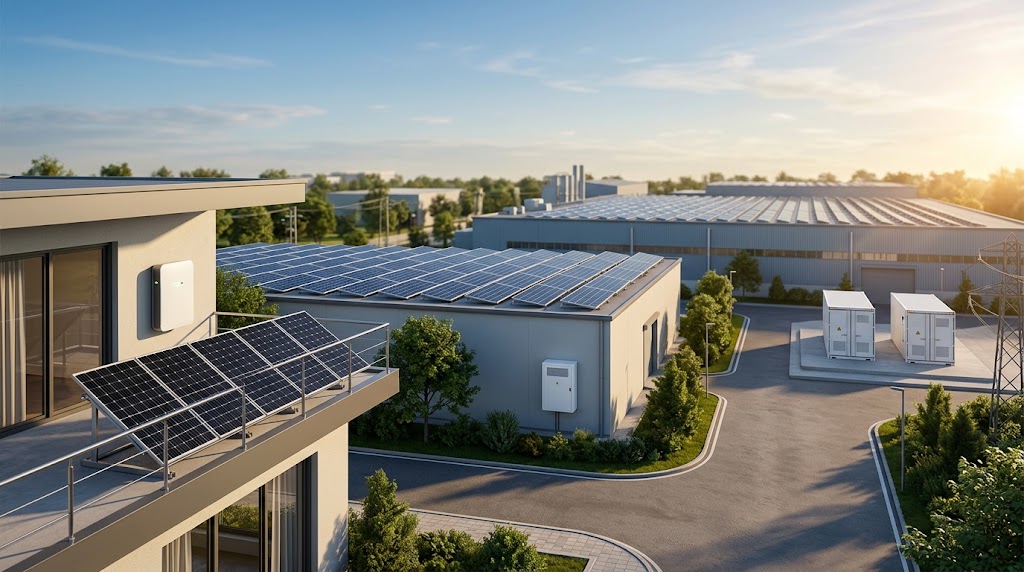
Small-scale: balcony or compact rooftop solar with a hybrid system
For small commercial units, retail shops, and residential-style buildings, a balcony or compact rooftop array paired with an all-in-one hybrid inverter and battery can cut electricity costs with relatively light installation work. NextG Power offers balcony solar panels in the 100 W to 400 W range and residential-style all-in-one systems with single-phase or split-phase hybrid inverters from roughly 1 kW to 12 kW and more, paired with battery capacities from about 1 kWh to 32 kWh and more. This class suits limited roof space but is not sized for heavy industrial loads.
Mid-scale: rooftop PV with a C&I battery cabinet
Factories, warehouses, hotels, and larger commercial buildings often use a string or three-phase inverter architecture with an outdoor battery cabinet. The cabinet approach keeps the battery and power conversion equipment in a compact, factory-integrated enclosure — reducing indoor space requirements and simplifying site installation while still delivering meaningful self-consumption and demand management.
Large-scale: ground or rooftop array with a containerized system
When the site needs multi-megawatt-hour storage or a larger power block, a containerized system with an integrated power conversion system and transformer becomes more practical than a large number of separate cabinets. Larger installations also open the door to grid services or energy trading where the local market allows it.
Size the Battery for the Actual Use Case
Battery capacity should be sized against a specific duty, not simply against the solar array size. Useful sizing questions include:
-
How much solar energy is currently exported or curtailed?
-
What self-consumption rate is the target?
-
What peak demand should be shaved, and for how long?
-
How long must the site run during a grid outage?
-
Is there an EV charging load that will grow in the next few years?
A factory that must ride through a full production shift will need far more energy capacity than a system designed only for daily peak shaving. Matching the battery to the real use case avoids both underperformance and unnecessary capital cost.
Review the Financial Case Carefully
A commercial solar plus stockage de batterie investment case should include more than headline electricity savings. Include:
-
Capital cost of solar, storage, inverters, and installation
-
Reduction in demand charges and time-of-use energy cost
-
Value of avoided diesel or generator fuel where applicable
-
Availability of tax credits, grants, or incentive programs
-
Ongoing maintenance, monitoring, and battery replacement reserve
-
Expected system life and degradation assumptions
Incentive programs and tax rules change and vary by country. Confirm eligibility with a qualified local adviser before presenting any payback figure.
Common Design Mistakes to Avoid
Projects often run into trouble for predictable reasons:
-
Sizing the battery from the solar array instead of the load
-
Ignoring the export limit until after the design is fixed
-
Assuming the battery can support the full site load during an outage
-
Forgetting that the battery must recharge before the next peak
-
Overlooking the space, weight, and clearance needs of outdoor equipment
-
Failing to check grid connection and protection requirements early
Each can be resolved during design — but becomes expensive once equipment has been ordered and installed. Property owners who treat solar plus storage as a single system rather than a collection of products tend to see better results: lower operating costs, improved resilience, and progress on sustainability goals without new operational headaches.
If you’re planning a commercial solar plus battery storage project, send NextG Power a twelve-month electricity bill, a description of the site load, your roof or land constraints, and the primary goal, so the sales and engineering team can review the data and recommend a suitable system architecture.
Mots-clés: commercial solar plus battery storage, factory rooftop solar storage, C&I solar storage system, balcony solar with battery, solar self consumption battery, commercial battery storage ROI, solar plus storage sizing, hybrid inverter commercial, energy storage for commercial property, NextG Power solar storage