
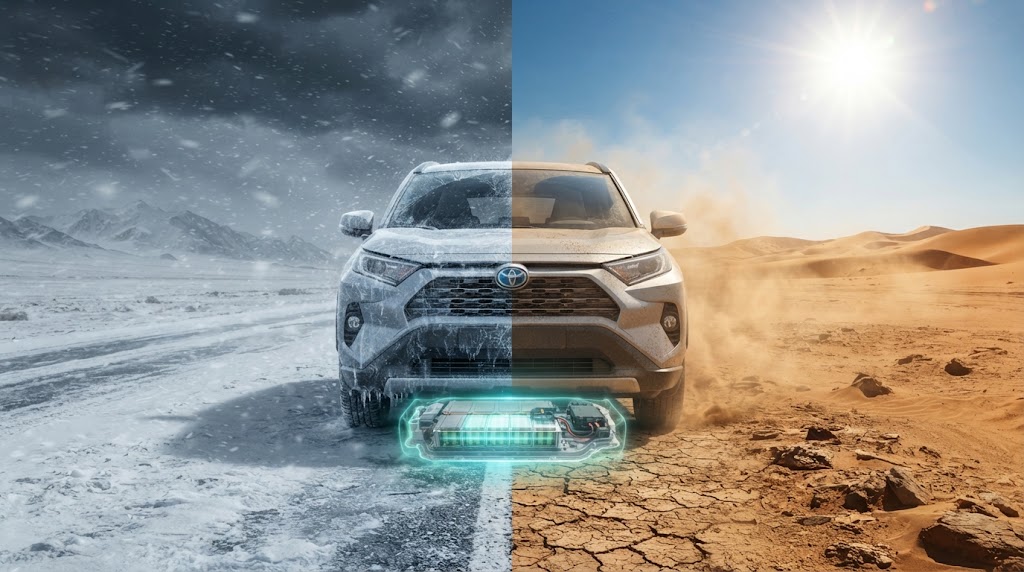
A Climate That Tests Every Component
Central Asia and Mongolia occupy one of the harshest climate belts on the planet. This isn’t a region of mild transitions. It’s a place of brutal swings. January nights in Ulaanbaatar can hold at -30°C for weeks on end. By July, the asphalt in Tashkent and Ashgabat radiates heat long after sunset, pushing battery enclosures past 50°C even when the air itself is only in the low forties.
Vehicles here don’t face occasional extremes. They face a yearly rhythm of punishment, and every component must earn its place. That’s the environment NextG Power Lithium-Ion HEV Batteries were engineered to master.
Why Factory NiMH Packs Fall Short
Most factory hybrid batteries rely on nickel-metal hydride chemistry. In gentle climates, they perform adequately. In the steppes, they struggle on both ends of the thermometer.
In deep cold, NiMH cells experience sharp spikes in internal resistance. Voltage sags. Motor-Generator 1 has to work harder just to reach starting RPM. Drivers hear the starter groan, watch the dashboard lights flicker, and wonder whether the engine will catch at all.
In extreme heat, the same chemistry degrades rapidly. Capacity fades. Cooling fans run at maximum, noisy and constant. The familiar P0A80 code appears, fuel economy drops, and the pack’s usable life shortens with every scorching summer.
Replacing a worn NiMH pack with another NiMH pack simply restarts the same countdown. That’s not a solution. It’s a delay.
Flawless Starts at -30°C
Cold cranking is where NextG Power Lithium-Ion HEV Batteries separate themselves from the pack.
At -30°C, an aging NiMH battery can drop voltage so sharply that the hybrid system hesitates or refuses to start cleanly. On the open steppe, that hesitation isn’t just inconvenient. Help can be hours away, and temperatures keep falling after sunset. A vehicle that won’t start is a genuine safety risk.
NextG Power HEV packs maintain high-amperage discharge even in that kind of cold. Advanced lithium-ion chemistry keeps internal resistance low and voltage stable, so Motor-Generator 1 receives the current it needs instantly. The combustion engine spins up to starting speed without hesitation. No long crank. No voltage collapse. No cold-weather error codes triggered solely because the battery can’t keep up.
It starts the first time, every time. In this region, that’s not a luxury. It’s basic peace of mind.
Surviving the +55°C Summer Heat
Heat is equally unforgiving, and it arrives from every direction. When ambient temperatures hit 40°C, direct sunlight and road heat push the battery enclosure well past 50°C. NiMH cells respond by accelerating degradation and demanding maximum cooling. Thermal throttling reduces available power. Fans grow louder and more frequent. Over successive summers, the pack loses capacity permanently.
NextG Power Lithium-Ion HEV Batteries are rated to operate safely and efficiently up to +55°C without the same level of throttling. The cells handle elevated temperatures with far less capacity loss, and the cooling system works less aggressively. Drivers notice quieter operation and more consistent hybrid assist, even on the hottest days in Central Asia.
The result is a battery that doesn’t force your vehicle into survival mode every summer. Performance stays closer to design intent, and the pack’s long-term health improves.
Lighter, Smarter, and Built for Real Traffic
Temperature tolerance is only part of the story. NextG Power Lithium-Ion HEV Batteries weigh more than 40% less than the heavy OEM NiMH blocks they replace. That reduction improves overall vehicle efficiency and eases stress on suspension and brakes over rough steppe roads.
Charge acceptance is faster too. In stop-and-go traffic through Ulaanbaatar, Almaty, or Tashkent, the pack recovers energy more quickly during regenerative braking. Drivers spend more time in electric mode, burning less fuel and enjoying quieter operation in congested city centers.
These gains compound over years of ownership. A lighter, more efficient HEV battery pack that handles both deep cold and extreme heat simply lasts longer and costs less to run.
Matching the Durability Your Toyota Already Has
Toyota hybrids earned their reputation across Central Asia and Mongolia because the rest of the vehicle handles the climate. Engines, transmissions, and chassis are proven. The weak link has always been the hybrid battery’s inability to match that durability across the full temperature range.
Upgrading to a NextG Power Lithium-Ion HEV Battery closes that gap. Cold starts become reliable. Summer heat no longer triggers constant warnings or rapid capacity loss. Drivers regain the efficiency and quiet operation the hybrid system was designed to deliver. Installation is straightforward for qualified technicians familiar with these platforms, and the pack integrates with existing hybrid controls without special driving adaptations.
Leaving Temperature Anxiety Behind
The steppes don’t offer mild seasons as a default. They demand equipment that can move from deep freeze to desert heat without failure. Factory NiMH batteries were a compromise that worked in gentler climates. Here, they become a recurring source of frustration and expense.
NextG Power Lithium-Ion HEV Batteries remove that compromise. Rated from -30°C to +55°C, lighter than the original packs, and capable of faster energy recovery, they turn the hybrid system into a true year-round partner rather than a seasonal liability.
Your car was built to endure the steppes—now your battery can too. Upgrade to NextG Power’s -30°C to +55°C rated Lithium-Ion HEV Batteries and leave battery temperature anxiety behind. Contactez-nous today.
Mots-clés: NextG Power Lithium-Ion HEV Batteries, HEV battery Mongolia, extreme temperature HEV battery Central Asia, Toyota hybrid battery upgrade, -30°C cold cranking HEV battery, +55°C heat resistant lithium-ion HEV, steppe climate hybrid battery, NiMH replacement Central Asia, Ulaanbaatar hybrid battery, Kazakhstan lithium-ion HEV pack