
Containerized battery energy storage systems are becoming a common procurement format for utility-scale, commercial, and remote power projects. Instead of buying batteries, PCS, controls, and thermal equipment separately and assembling them on site, buyers can receive a pre-integrated power block that is closer to plug-and-play.
This guide is written for overseas distributors, EPC contractors, energy consultants, and project developers who are comparing containerized BESS offers. It explains the main configuration differences, the product families to inspect, and the datasheet questions that matter before a buyer signs an offer.
What Is a Containerized BESS?
UN containerized BESS is an energy storage system built inside a standardized shipping-container-like enclosure. The battery racks, power conversion system, fire suppression, cooling, monitoring, and auxiliary power are integrated by the manufacturer before delivery.
The main advantages are faster site installation, reduced field engineering risk, standardized system architecture, and easier transport.
The trade-offs are that the buyer must match the container equipment to the site grid, ambient conditions, load profile, space constraints, and transport route.
20ft vs 40ft: Beyond the Size Difference
The physical size is not the only difference. The power class, energy capacity, battery voltage level, cooling method, and integration topology usually change together.
Earlier industry assumptions that 20ft containers could only accommodate up to 1 MWh are now outdated. With high-energy-density LFP cells (e.g., 314 Ah), 20ft containers can now achieve 5~7 MWh+ capacities, making them viable for large-scale projects as well.
| Configuration | Typical Dimensions (mm) | Typical Capacity Range | Applications clés |
|---|---|---|---|
| 20ft Container | ~6058 × 2438 × 2896 | 2000 kWh – 5~7 MWh+ | Medium C&I, utility-scale with high density |
| Conteneur de 40 pieds | ~12192 × 2438 × 2590 | 3 MWh – 7 MWh+ | Large utility-scale, high-power applications |
Example configurations (based on current market data – always request the latest datasheet):
20ft Air-Cooled: Up to 750 kW / 1,446 kWh
20ft Liquid-Cooled: 3.0 – 5.0 MWh (e.g., 5.015 MWh with 314 Ah cells)
40ft Air-Cooled: 1.5 MW / 3.87 MWh
40ft Liquid-Cooled: Up to 6.9 MWh+
Select a configuration based on your project’s power-to-energy ratio, grid voltage, cooling requirements, and logistics constraints – not simply by container size.
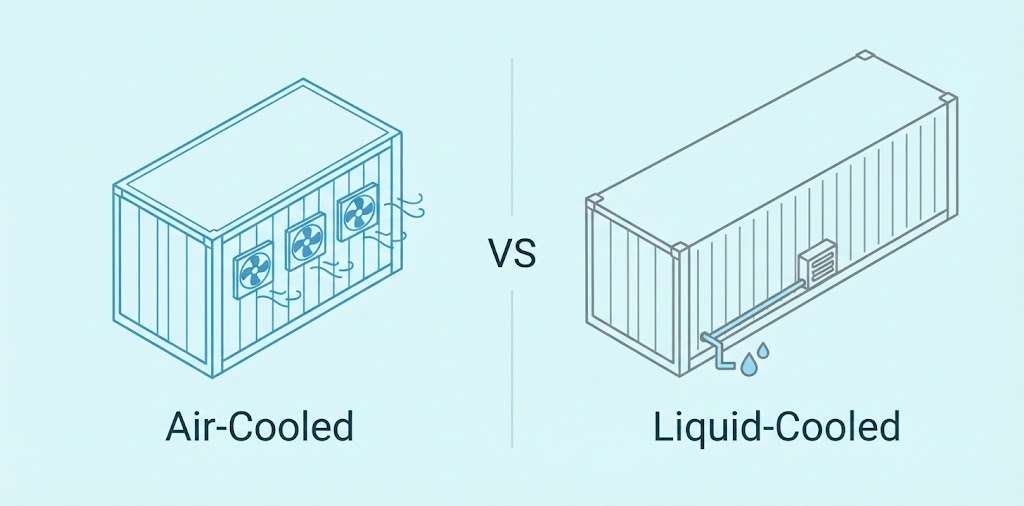
Air Cooling vs Liquid Cooling: Making the Right Choice
Cooling affects system layout, battery temperature uniformity, factory integration level, and in some configurations, container height and weight.
| Aspect | Refroidi par air | Refroidi par liquide |
|---|---|---|
| Idéal pour | Moderate energy density, moderate ambient temperatures | High energy density, tight thermal control, long cycle life |
| Avantages | Lower cost, simpler maintenance | Better temperature uniformity, higher density, extended lifespan |
| Trade-offs | Less uniform cooling, limited density | Higher cost, more complex maintenance |
| Typical operating range | -20°C to 50°C | -25°C to 55°C |
Decision factors:
Battery chemistry and charge/discharge profile
Ambient temperature range at project site
Site maintenance capability
Space constraints
Key Datasheet Fields to Compare
A professional comparison is built from the datasheet, not from a headline capacity number alone. When comparing across suppliers, verify these 10 critical fields:
| # | Field | What to Check |
|---|---|---|
| 1 | Rated Power (kW) | AC output power from PCS/inverter |
| 2 | Usable/Rated Energy (kWh) | Battery energy rating used in commercial offer |
| 3 | Nominal Voltage & DC Range | Impacts PCS compatibility and system architecture |
| 4 | AC Output Voltage/Frequency | Must match grid interface (e.g., 400V/50Hz, 690V, or MV transformer) |
| 5 | System Efficiency | Compare round-trip efficiency on the same measurement basis |
| 6 | Operating Temperature & Altitude | High ambient/altitude may require derating |
| 7 | Protection Class | Typically IP54, IP55; anti-corrosion ratings like C3/C4/C5 |
| 8 | Dimensions & Max Weight | Affects shipping, crane, road transport, and foundation |
| 9 | Protocoles de communication | Modbus TCP, IEC 104, RS485, CAN, Ethernet |
| 10 | Fire Suppression & Monitoring | Type (aerosol + water spray), detection strategy, UL 9540A compliance |
Example reference data (from publicly available 2026 market materials – always confirm with the current technical datasheet for the exact quoted model):
| Configuration Type | Energy (kWh) | Power (kW) | Cell/Cooling |
|---|---|---|---|
| 20ft Liquid-Cooled | 5,015 | – | LFP 314 Ah |
| 20ft Liquid-Cooled (Model A) | 3,440 | – | LFP |
| 20ft Liquid-Cooled (Model B) | 4180 | – | LFP |
| 20ft Air-Cooled Integrated | 1,446 | 750 | Refroidi par air |
| 40ft Air-Cooled | 3440 – 4180 | 1,500 – 2,000 | Refroidi par air |
| 40ft Liquid-Cooled | Up to 7MWh+ | – | LFP |
Questions to Ask Before Sizing
Before comparing quotes, send suppliers a technical context form. At a minimum, include:
1. Project Fundamentals
Country, city, grid voltage, frequency, and applicable standards
Use case: peak shaving, frequency regulation, solar firming, backup, islanding, or revenue stacking
2. Load & Performance Requirements
Monthly load profile (for C&I behind-the-meter projects)
Expected discharge duration: 2-hour, 4-hour, or longer
Desired power-to-energy ratio
3. Site Conditions
Ambient temperature data (min/max/average)
Installation altitude
Land area, access routes, weight limits, noise constraints
Transport route from port to site (including bridge heights, road weight limits)
4. Service Scope
Delivery only, supervised installation, or full EPC
Commissioning responsibility and checklist requirements
The more project-specific data you provide, the easier it is for the integrator to recommend the correct configuration.
Transport and Project Handover Planning
A 20ft or 40ft BESS is heavy, specialized cargo. Confirm these items early:
| Article | Checkpoint |
|---|---|
| Logistics | Port of loading, destination port, shipping method |
| Cargo specs | Exact dimensions, weight, overweight/out-of-gauge constraints |
| Site readiness | Crane/roll-off requirements, foundation, grounding, power interface |
| Commissioning | Who performs it? What checklist will be used? |
| Documentation | Invoice, packing list, datasheets, installation manual, test reports, warranty terms |
Transport is not an afterthought. The wrong port, an unexpected bridge height, insufficient crane capacity, or an underspecified foundation can delay your project more than the battery cells themselves.
What This Means for You
Selecting the right containerized BESS is not about picking the biggest container or the highest headline capacity. A smart procurement decision comes down to four key actions:
| Step | Action |
|---|---|
| 1. Define your project parameters | Grid voltage, discharge duration, ambient conditions, site logistics |
| 2. Compare datasheets, not just marketing claims | Focus on the 10 critical fields – power, energy, voltage, efficiency, cooling, protection, weight, communications, fire safety |
| 3. Match cooling to your needs | Air-cooled for simpler, lower-cost projects; liquid-cooled for high-density, high-cycle-life requirements |
| 4. Plan transport and commissioning early | Confirm port, route, crane capacity, and documentation before the container ships |
The BESS market is evolving rapidly. The same 20ft footprint that once held 1 MWh now fits 5~7 MWh+. Today’s best-value configuration may be yesterday’s “premium” option. A thorough, datasheet-driven evaluation – not a quick glance at capacity – is what separates a successful project from a costly mismatch.
Ready to Specify Your Containerized BESS?
If you already have a project in mind – with a load profile, site conditions, and target discharge duration – don’t rely on generic quotes.
Here’s what to do next:
Check your BESS Project demand – Power, battery capacity, applications etc.
Send it to our sales team – include your project country, requirements, ambient data, and logistics constraints.
Receive a proposal – we will match your parameters against our current product portfolio and provide a configuration recommendation with full technical specifications.
Contactez-nous aujourd'hui to start your project evaluation. Our engineering team will review your parameters and recommend a containerized BESS configuration tailored to your site, your grid, and your budget – before you make any purchase decision.
Mots-clés
containerized BESS configuration guide, 20ft BESS container specifications, 40ft BESS container system, liquid cooled BESS container, air cooled BESS container, BESS datasheet questions, 5 MWh BESS container, BESS transport checklist, battery storage system for commercial projects, utility scale BESS container supplier, LFP battery container, containerized energy storage system buyer guide, BESS cooling comparison, BESS procurement checklist