
The Energy Wake-Up Call
What if your facility’s power bill dropped 40% next year? What if a grid outage didn’t cost you a single minute of production downtime? For commercial and industrial operators in 2026, these aren’t hypotheticals—they’re measurable outcomes delivered by LFP C&I microgrid BESS systèmes.
The era of passive energy consumption is over. Businesses that continue relying exclusively on an aging, volatile grid are leaving money on the table and exposing themselves to unacceptable operational risks. The alternative? A self-sustaining microgrid powered by long-lifespan Batteries LFP that pays for itself within years and protects your operations for decades.
Lithium Iron Phosphate (LFP) systèmes de stockage d'énergie par batterie have matured from early-adopter novelty to mainstream essential. And in 2026, the economics, technology, and regulatory environment have aligned to make commercial microgrid LFP battery deployments one of the smartest capital investments available to any energy-intensive business.
Why LFP Wins in 2026: Safety, Longevity, and Chemistry
Not all batteries are created equal. The LFP advantage for stationary storage comes down to three critical factors:
Exellent Cycle Life: Today’s premium LFP cells deliver 6,000 to 10,000 cycles at 80% depth of discharge. For a facility cycling daily, that’s 16 to 27 years of reliable service. Compare this to NMC alternatives that typically require expensive replacement after 3,000 to 5,000 cycles—roughly year six or seven of operation.
Thermal Stability: LFP’s olivine crystalline structure resists thermal runaway even under extreme conditions. Unlike NMC batteries that can enter dangerous exothermic reactions above certain temperatures, LFP cells simply stop operating. For industrial environments with dust, heat, and demanding duty cycles, this safety margin is non-negotiable.
No Cobalt, No Conflict: LFP contains no cobalt, eliminating supply chain concerns and ethical sourcing issues that plague other lithium-ion chemistries. This simplifies procurement and strengthens ESG credentials.
By 2026, manufacturers have refined LFP production to achieve energy densities approaching 200 Wh/kg at the cell level—closing the gap with NMC while maintaining the safety and longevity advantages that matter most for stationary applications.
PV + LFP BESS Hybrid Architecture: The Self-Sustaining Ecosystem
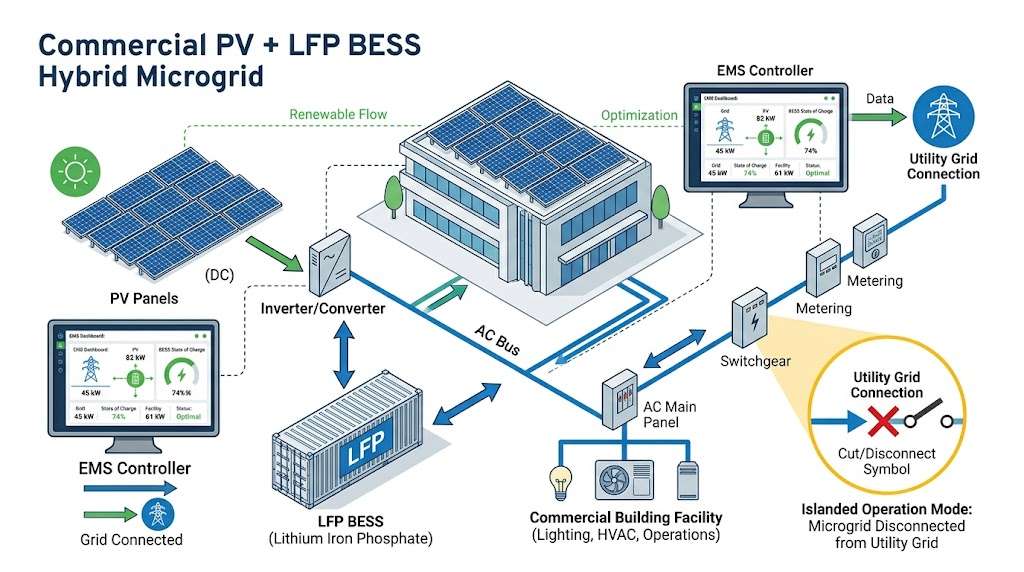
True energy independence requires generation and storage working in concert. The PV + LFP BESS hybrid architecture achieves exactly this, creating a closed-loop system that minimizes grid dependency while maximizing renewable utilization.
System Components
A typical C&I hybrid installation comprises:
Solar PV Arrays: Sized to cover 60-100% of annual facility consumption, often deployed on rooftops, carports, or adjacent land.
LFP Battery Storage: Containerized or cabinet-style systems ranging from 200 kWh to 10 MWh+, featuring integrated battery management systems (BMS), power conversion systems (PCS), and thermal management.
Energy Management System (EMS): The intelligent brain that orchestrates everything—forecasting solar generation, load patterns, and utility rates to optimize dispatch decisions in real-time.
How It Works Together
During daylight hours, solar generation powers facility loads directly. Any excess is diverted to charge the LFP BESS. When the sun sets or clouds reduce generation, the battery discharges to cover the shortfall. The grid becomes a backup rather than a primary supply.
Modern systems feature liquid cooling (improving round-trip efficiency to 93%+) and modular designs that allow capacity expansion as operations grow. An all-in-one approach—exemplified by integrated solutions like the Fox ESS G-MAX PLUS—consolidates inverters, batteries, and thermal management into a single footprint, reducing installation complexity and footprint.
Real-World Impact
A 2 MW solar array paired with a 4 MWh LFP BESS at a California food processing facility reduced grid purchases by 62% in the first year. The system shaves afternoon peak demand (avoiding $12,000 monthly demand charges) and captures solar energy that would otherwise be curtailed. At current utility rates, the project achieves a 3.2-year payback with projected lifetime savings exceeding $4.5 million.
Two Modes, One System: On-Grid Efficiency Meets Off-Grid Resilience
The most sophisticated LFP C&I microgrid BESS systems seamlessly operate in two distinct modes, each serving a strategic purpose.
On-Grid Mode: The Profit Engine
Connected to the utility, the system generates daily returns through:
Peak Shaving: Demand charges typically account for 30-50% of a C&I electricity bill. The BESS monitors real-time draw and discharges to prevent load from exceeding a preset threshold. The utility never sees the spike, and demand charges disappear.
Time-of-Use Arbitrage: Charge overnight at $0.05/kWh, discharge during afternoon peaks at $0.22/kWh. A medium-sized factory consuming 5,000 kWh during peak hours daily can capture over $300,000 annually from this spread alone.
Demand Response Participation: Grid operators increasingly compensate commercial customers who can reduce load during stress events. With a BESS, you can participate without disrupting operations—simply dispatch battery power instead of curtailing production.
Off-Grid/Islanded Mode: The Resilience Shield
When the grid fails, the microgrid automatically island—disconnecting from the utility within milliseconds. In this mode, the LFP BESS serves as the grid-forming source, maintaining voltage and frequency stability while supporting critical loads.
Advanced systems feature black-start capability, allowing the microgrid to restart from a complete shutdown without external power. For facilities where every minute of downtime costs thousands of dollars, this capability is invaluable.
The transition between modes is seamless. Operators won’t notice the switch, but the savings and protection are dramatic.
Resilience During Grid Outages: The Cost of Downtime
Grid reliability is deteriorating across North America and Europe. Extreme weather events are more frequent and intense. Aging infrastructure struggles under peak loads. And cyber threats target utilities with increasing sophistication.
For C&I facilities, the cost of a grid outage extends far beyond lost production:
Food processing: Spoiled inventory and violated cold chain requirements
Data centers: Corrupted data and SLA penalties
Manufacturing: Damaged in-process materials and missed delivery deadlines
Healthcare: Patient safety risks and regulatory violations
UN commercial microgrid LFP battery system turns this vulnerability into a competitive advantage. Properly sized storage can sustain critical loads for 4 to 48 hours, depending on capacity and load profile. When paired with solar, the system can operate indefinitely during extended outages, recharging batteries daily from renewable generation.
Case in Point
A Texas manufacturing facility installed a 1.5 MW / 3 MWh LFP BESS in 2024. During Winter Storm Uri’s aftermath, the facility operated autonomously for six consecutive days while surrounding plants remained dark. The avoided downtime alone justified the entire system cost. Subsequent monthly savings in demand charges and arbitrage now deliver a 34% annual return on the remaining investment.
ROI Through Energy Cost Optimization: The Numbers That Matter
The business case for LFP C&I microgrid BESS deployment is more compelling than ever. Battery pack prices have fallen a lot, while LFP’s extended cycle life dramatically improves the levelized cost of storage (LCOS).
ROI Drivers
Direct Energy Savings: Peak shaving plus TOU arbitrage typically reduce total electricity spend by 30-50%. For a facility spending $500,000 annually on electricity, that’s $150,000-$250,000 in yearly savings.
Demand Charge Elimination: Facilities with high peak loads can eliminate demand charges entirely. A plant with a 1,000 kW peak and a $15/kW demand charge pays $180,000 annually just in demand fees. A properly sized BESS can zero this out.
Incentive Programs: The Investment Tax Credit (ITC) offers 30% off system costs for qualifying projects. State and utility programs add further incentives, often covering 40-60% of upfront investment.
Resilience Value: Quantify the cost of a single outage. For many manufacturers, one major event pays for the entire system.
A Concrete Example
A 2 MW / 4 MWh LFP BESS installation (including PV) costs roughly $2.5 million after incentives. Annual savings from peak shaving, arbitrage, and demand response total $750,000. Payback: 3.3 years. Over a 15-year system life, net savings exceed $8 million.
Future-Proofing Your Facility
By 2026, the trajectory is clear. Utilities will continue raising rates and imposing stricter demand charges. Renewable mandates will accelerate. And grid volatility will only increase.
Installing an LFP C&I microgrid BESS today means you’re not just solving current energy challenges—you’re positioning your business for whatever comes next. Modular systems expand easily. Software updates add new optimization algorithms. And LFP’s chemistry ensures your investment remains productive for 15+ years.
Agissez aujourd'hui
The technology is proven. The economics are compelling. And the risks of inaction are growing daily. Whether you operate a data center, manufacturing plant, cold storage facility, or corporate campus, the question isn’t whether you should adopt microgrid storage—it’s how soon you can start.
Schedule a energy audit and feasibility study today. The path to energy independence starts with a single conversation—and every month of delay is another month of paying for power you could be generating and storing yourself.
Mots-clés: LFP C&I microgrid BESS 2026, commercial microgrid LFP battery, LFP BESS, C&I microgrids, PV hybrid BESS, energy independence, microgrid resilience, BESS ROI, peak shaving, TOU arbitrage, demand charge reduction, LFP battery storage, commercial energy storage, industrial microgrid