
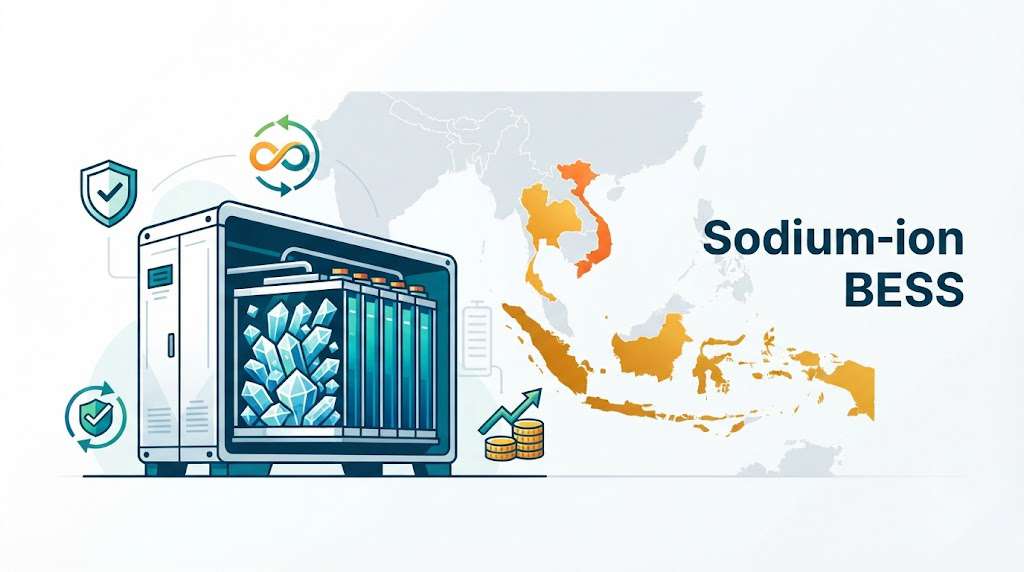
The promise of sodium-ion batteries has captured the imagination of energy storage developers worldwide. Abundant materials, enhanced safety, and the potential for lower costs make sodium-ion an attractive alternative to lithium-ion technology. For emerging markets like Vietnam, Thailand, and Indonesia—where cost sensitivity is paramount—sodium ion BESS emerging markets represents an opportunity to build energy storage without the geopolitical and supply chain risks associated with lithium.
However, the economic reality in 2026 is more complex than early projections suggested. Despite significant progress, sodium-ion batteries currently cost more than lithium iron phosphate (LFP) batteries, the incumbent technology in stationary storage. Understanding this gap—and the trajectory toward closing it—is essential for project developers and energy planners in Southeast Asia.
The Real Cost Picture in 2026
Multiple industry sources confirm that sodium-ion batteries have not yet achieved cost parity with LFP. A 2026 report from Chinese research firm indicates sodium-ion cell prices currently range from $0.7 to 0.9 per Wh ($700–900/kWh), which is higher than LFP cells in the $0.5–0.7 per Wh range. A securities industry analysis similarly notes that sodium batteries currently offer “no significant economic advantage” and maintain higher selling prices than LFP due to limited material scale and production yield challenges.
Benchmark Mineral Intelligence, a respected market research firm, has gone further, stating that sodium-ion has “become more expensive than LFP” . The reason is simple: an LFP oversupply in recent years has driven LFP prices below $65/kWh, making it difficult for sodium-ion producers to compete on price alone.
Even Bernstein’s optimistic projections, which show sodium-ion cell costs declining, acknowledge that costs still exceed LFP levels.
Cell-level cost estimates from current industry data show sodium-ion at $65–70/kWh, while LFP remains slightly lower at $50–65/kWh depending on sourcing and volume. The gap is small in some analyses, but significant in others—and the consensus is clear: sodium-ion is not yet cheaper.
Why Sodium-Ion Remains Compelling
Despite this cost premium, sodium-ion offers compelling advantages that make it a strategic choice for emerging markets.
Material abundance is the most frequently cited benefit. Sodium is approximately 1,200 times more abundant than lithium and can be extracted from seawater. Raw material costs reflect this abundance: sodium hydroxide trades at $300–800 per metric ton, while lithium hydroxide commands roughly $78,000 per metric ton. This structural cost advantage is real—it simply hasn’t translated into lower cell prices yet due to limited production scale.
Safety performance is another differentiator. Sodium-ion batteries offer a lower risk of thermal runaway compared to LFP, reducing the need for expensive fire suppression systems and insurance premiums. This is particularly valuable in industrial settings and dense urban environments.
Cycle life is improving rapidly. Leading producers report sodium-ion cycle life exceeding 12,000 cycles —significantly longer than LFP’s 6,000–10,000 cycles. For stationary storage applications where lifetime cost matters more than upfront cost, this durability advantage can offset higher initial prices.
Temperature performance is also superior. Sodium-ion batteries retain 85–90% of capacity at -20°C, while LFP drops to 60–70%. In Southeast Asia’s tropical climate, this matters less than in northern markets, but it demonstrates the technology’s versatility.
Deployment Realities in Vietnam, Thailand, and Indonesia
In 2026, sodium-ion deployment across Southeast Asia remains in early stages, with cost considerations affecting adoption rates. The three markets present different opportunities:
Vietnam has made the most regulatory progress, with frameworks now recognizing standalone BESS. However, project developers are carefully evaluating sodium-ion against lower-cost LFP alternatives, with decisions often favoring LFP for immediate cost sensitivity. Sodium-ion interest persists for projects where safety or cycle life outweigh upfront cost.
Thailand’s industrial and commercial (C&I) sector has begun pilot projects pairing sodium-ion with rooftop solar. These pilots are focused on validating performance claims rather than achieving cost savings, with full commercial deployment expected only after cost parity is reached.
Indonesia’s microgrid opportunity remains compelling due to sodium-ion’s safety characteristics and ability to handle partial cycling. The country’s abundant sodium resources also support long-term localization plans, even if immediate costs favor LFP.
The Path to Cost Parity
Industry projections consistently point to 2028 as the year sodium-ion achieves cost parity with LFP. By 2030, some analysts expect sodium-ion to undercut LFP by $10–15/kWh as production scales and supply chains mature.
Key drivers of cost reduction include:
Scale: As production capacity grows beyond 50 GWh, manufacturing efficiencies will drive costs down
Energy density improvements: Current sodium-ion cells at 160–175 Wh/kg are approaching LFP levels; further gains will reduce per-kWh packaging costs
Material innovation: Advances in hard carbon anodes and cathode formulations could reduce raw material costs by 20–30%
Supply chain localization: Domestic production in Southeast Asia could eliminate tariff costs and reduce logistics expenses
Some industry leaders remain more cautious, expressed skepticism that sodium-ion will achieve the dramatic cost reductions claimed by Chinese producers, noting that “some LFP cell cost are about $50/kWh now,” making competition “really tough”.
What This Means for Project Developers
For organizations evaluating storage projects in Southeast Asia, the 2026 landscape requires careful analysis:
LFP remains the cost leader for projects where upfront price is the primary concern
Sodium-ion offers strategic advantages in safety, cycle life, and supply chain resilience
Total cost of ownership analysis is essential—a higher upfront cost may be justified by longer cycle life and reduced safety infrastructure
Future cost reductions should be factored into financing models; sodium-ion projects initiated today may benefit from declining cell prices over their operational lifetime
The 60 GWh storage agreement between CATL and HyperStrong, signed in April 2026, signals that major players are betting on sodium-ion’s long-term viability. But for now, the technology remains at a cost disadvantage that Southeast Asian developers cannot ignore.
The Road Ahead for Southeast Asia
The story of sodium-ion BESS in emerging markets is not one of immediate cost leadership, but of strategic positioning for the future. Vietnam, Thailand, and Indonesia are right to evaluate this technology alongside LFP, understanding that the material abundance driving sodium-ion’s long-term potential will eventually translate into cost advantages.
Early adopters in the region are gaining valuable operational experience with sodium-ion systems, positioning themselves to scale deployment rapidly when cost parity arrives. The safety benefits and longer cycle life already make sodium-ion attractive for specific applications, even at a price premium. And the supply chain resilience offered by domestically available sodium resources aligns with regional energy security goals.
For project developers and industrial operators, the smart approach in 2026 is to include sodium-ion in portfolio evaluations, conduct thorough total-cost-of-ownership analyses for specific applications, and prepare for the cost crossover that industry experts project for 2027–2028.
Your Next Step
The technology is ready. The economics are improving. And the strategic case for sodium-ion grows stronger with each passing quarter. Whether you are evaluating backup power for an industrial facility in Thailand, a microgrid for an Indonesian island, or grid-scale storage for Vietnam’s renewable integration, sodium-ion BESS deserves a place in your analysis.
Request a total-cost-of-ownership comparison for your specific load profile today to determine whether sodium-ion’s long-term advantages justify its current premium.
Mots-clés: sodium ion BESS emerging markets 2026, sodium battery Southeast Asia, sodium-ion cost vs LFP, BESS Vietnam Thailand Indonesia, sodium-ion cycle life, sodium-ion safety advantages, sodium ion battery price 2026, sodium-ion cost parity 2027, CATL Naxtra 2026, sodium-ion BESS deployment, stationary storage cost comparison, emerging markets energy storage