
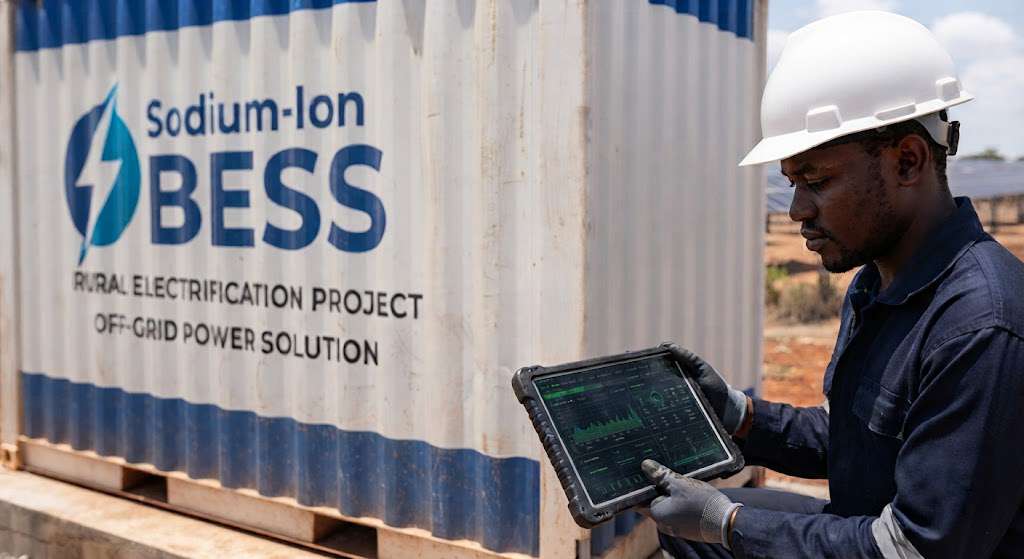
The Energy Problem That Refuses to Go Away
For every village in sub-Saharan Africa that finally received a solar panel array, there was a bitter truth waiting at sunset: when the sun went down, so did the lights. Diesel generators filled the gap—expensive, polluting, and logistically nightmarish in regions where roads wash out with every rainy season.
For every mining camp in the DRC or telecom tower in the Andes, the calculation was the same. Lithium-ion batteries promised clean storage but delivered thermal management headaches, supply chain anxieties, and degradation in extreme environments.Liquid cooling LFP BESS fix the headaches, but there still another way.
The commercial-scale arrival of sodium ion off-grid BESS is rewriting the rules of remote power. This is not a laboratory curiosity. This is deployment at scale, and it is happening right now across Africa, Latin America, and beyond—even as cell prices remain higher than lithium iron phosphate alternatives.
Sodium-Ion Technology: What Makes It Different in 2026
The chemistry is straightforward: sodium replaces lithium as the charge-carrying ion. But the implications are profound.
Sodium is the sixth most abundant element on Earth. It is found in seawater, common salt, and virtually every continent. Unlike lithium, which is concentrated in a handful of countries (Australia, Chile, China, Argentina), sodium is available everywhere. That geographic diversity translates directly into supply chain security—a critical factor when you are budgeting a multi-year off-grid installation far from reliable logistics.
The Current Cost Reality: Sodium Costs More Than LFP
Let’s be direct about the numbers. In 2026, sodium-ion cell prices currently range from $0.70 to $0.90 per Wh ($700–900/kWh). LFP cells, by comparison, trade at $0.50 to $0.70 per Wh ($500–700/kWh) .
| Metric | Sodium-Ion (2026) | LFP Lithium-Ion |
|---|---|---|
| Cell price per Wh | $0.70–$0.90 | $0.50–$0.70 |
| Cell price per kWh | $700–900 | $500–700 |
| Manufacturing scale | 50+ GWh capacity | 1,000+ GWh capacity |
| Production yields | Maturing | Optimized |
On a pure cell-cost basis, sodium-ion is 30–40% more expensive than LFP today. This is a significant premium, and project developers must account for it.
Why Sodium Costs More
The price gap stems from structural factors:
Lack of economies of scale: LFP production has ramped up over a decade; sodium-ion is still scaling
Lower production yields: Manufacturing processes are less mature, affecting unit costs
Hard carbon anode costs: Specialized materials for sodium-ion anodes remain expensive, though falling
Energy density penalty: Sodium’s lower energy density (120–160 Wh/kg vs. LFP’s 170–185 Wh/kg) means more cells are needed for the same energy
The Rapidly Changing Trajectory
The premium won’t last. The market expects convergence soon:
CATL expects sodium-ion to reach cost parity with LFP by the end of 2027
By 2028, total system costs are projected to match LFP equivalents
By 2030, analysts forecast sodium-ion will achieve a $10–15/kWh cost advantage over LFP
Where Sodium Wins: Performance That LFP Cannot Match
Despite the current cost premium, sodium-ion offers compelling advantages for off-grid applications that can justify the higher upfront investment:
| Paramètre | Sodium-Ion (2026) | LFP | plomb-acide |
|---|---|---|---|
| Operating Temp Range | -40°C to +70°C | -20°C to +55°C | 5°C to +40°C |
| Cycle Life (80% DOD) | 10,000–15,000 | 6,000–10,000 | 500–1,000 |
| Capacity at -20°C | 85–90% | 60–70% | Poor |
| Thermal Runaway Risk | Very Low | Moderate | None (toxic) |
| Lifetime (daily cycling) | 20+ years | 10–15 years | 2–3 years |
Temperature Resilience
In the Sahara, where daytime temperatures exceed 45°C, sodium-ion batteries maintain stable performance without active cooling. In Mongolia’s winter, where temperatures plunge below -30°C, they deliver 85–90% of rated capacity. LFP systems in these environments require expensive heating or cooling systems that consume power, add complexity, and create failure points.
Longer Life Means Fewer Replacements
The 10,000–15,000 cycle life translates to 20+ years of daily cycling. In a remote village microgrid, that means one battery investment per generation. LFP delivers 6,000–10,000 cycles (10–15 years). Lead-acid? Just 2–3 years.
In remote locations where replacements are logistically complex and expensive, longevity is a decisive advantage that offsets the higher upfront cell cost.
Safety in Remote Settings
Sodium-ion chemistry is inherently safer than lithium-ion. Thermal runaway risk is very low, even under abuse conditions. Sodium cells do not enter thermal runaway until temperatures exceed 200°C. For remote clinics, schools, and community centers where firefighting resources are limited, this is a critical advantage.
Real-World Deployments: Africa and Rural LATAM
The proof is in the projects, and 2026 has been a landmark year.
Africa’s Energy Transformation
In July 2026, Alsym Energy and ERITY announced a groundbreaking 9 GWh partnership to deploy sodium-ion BESS across mining and community operations in Africa, the Middle East, and the United States. This is industrial-scale deployment that will replace thousands of diesel generators with clean, non-flammable energy storage.
In Kenya, the Rural Electrification Authority has approved sodium-ion systems for 200 new health clinics and schools in 2026 alone. These installations run vaccine refrigerators, lighting, and basic medical equipment through the night and during cloudy periods. Early reports show diesel consumption down by 80% at the first 50 installations, with maintenance costs reduced by more than half.
Tanzania’s telecom sector has pivoted decisively. Airtel Tanzania announced in March 2026 that it is retrofitting 1,200 remote cell towers avec sodium-ion storage, replacing lead-acid batteries that required replacement every 18–24 months. The new systems come with 10-year warranties and are expected to last 15 years in service.
Rural LATAM: From the Andes to the Amazon
Peru’s Andean highlands present extreme conditions: villages at 4,000 meters above sea level, freezing nights, intense solar radiation, and thin air that complicates diesel engine operation. Traditional batteries struggle; sodium-ion systems thrive.
The Inter-American Development Bank is funding a $150 million initiative in 2026 to deploy hybrid solar + sodium-ion microgrids across rural Peru, Bolivia, and Colombia. The first 50 systems, installed in Q2 2026, are already demonstrating 95% of rated capacity at -10°C, a performance level LFP cannot match without expensive heating systems.
In the Brazilian Amazon, Comunidades Energéticas has installed 80 microgrids in riverine communities previously dependent on diesel barges. The maintenance interval has stretched from monthly to annual—a transformative change for communities that can take days to reach by boat.
Hybrid Solar + Storage Microgrids: The Practical Formula
No single technology solves the off-grid puzzle. The most successful 2026 deployments combine solar PV + sodium ion off-grid BESS + smart controls, with diesel generators reserved for emergency backup.
The economics are compelling. A typical hybrid system in rural Africa achieves a levelized cost of energy (LCOE) of $0.18–$0.25 per kWh, compared to $0.40–$0.70 per kWh for diesel-only systems.
System designers exploit sodium-ion’s unique characteristics:
No thermal management: -40°C to +70°C range eliminates cooling and heating systems
Flexible state of charge: Full 0–100% cycling without significant degradation
High power capability: C-rates up to 3C for motor and pump starts
Simplified controls: Less complex battery management due to stable chemistry
Modern energy management systems incorporate weather forecasting, load prediction, and community usage patterns to optimize battery cycling. Some automatically shift energy-intensive activities to peak solar hours, reducing storage demands.
Resilience in Extreme Environments: Hard Data
The resilience advantage is measurable and meaningful for remote operators.
Temperature Performance
In the Sahara, where daytime temperatures exceed 45°C, sodium-ion batteries maintain stable performance without active cooling. In Mongolia’s winter, where temperatures plunge below -30°C, they deliver 85–90% of rated capacity. LFP systems in these environments require expensive heating or cooling systems that consume power, add complexity, and create failure points.
Grid-Forming Capability
In a striking 2026 demonstration, a distributed sodium-ion storage system in rural China performed a “black start” of a section of the power grid, restoring electricity in just over two minutes after a simulated failure. The system operated as a standalone microgrid for hours, proving that sodium-ion can handle grid-forming duties that were once the exclusive domain of diesel generators.
For remote communities, this translates directly into reliability. When tropical storms knock out connections, the sodium-ion microgrid keeps running. When extreme heat drives cooling demand, the batteries don’t derate. When maintenance is months away, the system keeps cycling without failure.
Cost and Maintenance: The Total Ownership Advantage
The upfront cost of a sodium-ion BESS in 2026 is significantly higher than LFP—$700–900/kWh vs. $500–700/kWh—but the total cost of ownership tells a different story.
Maintenance Savings
Sodium-ion systems require:
No cooling systems in most climates,upgraded version with air cooling or liquid cooling base on difference applications
No heating systems in cold climates
Fewer cell balancing requirements
Less frequent inspections due to longer warranties
A South African mining operator reported that its sodium-ion microgrid requires 4 maintenance visits per year, versus 6-12 for its previous lithium system. Annual maintenance costs dropped from $45,000 to $18,000 for a 2 MW installation.
Diesel Savings
The financial case is strongest when diesel displacement is factored in. A typical village microgrid with 50 kW of solar and 200 kWh of sodium-ion storage can reduce diesel consumption by 70–90%. At current diesel prices in remote Africa ($1.20–$1.80 per liter), annual savings can exceed $30,000—enough to offset the higher upfront cost of sodium-ion over 5–8 years.
Replacement Frequency
The 10,000–15,000 cycle life translates to 20+ years of daily cycling. In a remote village microgrid, that means one battery investment per generation. Compare to LFP’s 6,000–10,000 cycles (10–15 years) or lead-acid’s 500–1,000 cycles (2–3 years).
Lower replacement frequency means:
Reduced logistics costs for shipping new batteries
Less disruption to community power supply
Fewer disposal/recycling challenges
Predictable long-term budgeting
Défis et considérations
Sodium-ion is not perfect for every application.
Current cost premium: At $700–900/kWh vs. LFP’s $500–700/kWh, sodium-ion represents a significant premium. For projects that must minimize upfront capital expenditure, LFP may still be the preferred choice in 2026. However, with parity expected by late 2027 and a cost advantage projected for 2030, the window for this concern is closing rapidly.
Energy density remains lower than LFP—typically 120–160 Wh/kg versus 160–190 Wh/kg for LFP. For stationary off-grid storage, where space is generally available, this is rarely a constraint.
Recycling infrastructure is still developing. While sodium-ion batteries are easier to recycle than lithium-ion due to simpler chemistry, collection and processing networks are not yet widespread in Africa or LATAM. However, manufacturers have announced take-back programs in 2026, and recycling pilot projects are starting in Kenya and Brazil.
The 2026 Verdict: A Technology Whose Time Is Coming
The question is no longer whether sodium-ion works for off-grid and remote power systems. The question is when the cost equation will tip decisively in its favor.
Today, sodium-ion cell costs $700–900/kWh, while LFP cell is priced at $500–700/kWh. That is a significant premium. But the trajectory is clear: costs are falling fast, and parity is expected by late 2027 or 2028. By 2030, sodium-ion is projected to achieve a $10–15/kWh cost advantage over LFP.
For rural communities in Africa and LATAM, sodium ion off-grid BESS represents something transformative: energy independence without the diesel dependency.
For mining camps, telecom towers, and agricultural operations, it means lower lifetime costs, less maintenance, and greater reliability.
For the climate, it means reduced emissions in some of the hardest-to-decarbonize sectors.
The data is in. The systems are deployed. The results are measurable. And with cost parity on the horizon, the barriers to adoption are falling fast.
Your Next Step
The sodium-ion wave is building, and it is already powering communities, camps, and operations across the globe. Whether you are electrifying a rural clinic in Kenya, modernizing a mining microgrid in the DRC, or bringing first-time power to a village in Peru, the tools are available today—and the economics are improving by the month.
Contactez notre équipe for a customized feasibility assessment that includes system sizing, cost modeling, and deployment timelines for your specific off-grid or remote project. We will help you evaluate whether sodium-ion is the right choice today—and when it will be the obvious choice tomorrow.
Mots-clés: sodium ion off-grid BESS, sodium ion BESS, remote sodium battery storage 2026, sodium battery Africa, sodium ion LATAM, off-grid solar storage, sodium ion microgrid, non-flammable battery, sodium battery safety, renewable energy storage, sodium ion battery cost, extreme temperature battery, sodium battery cycle life, off-grid power solutions, sodium battery maintenance, sodium ion hybrid solar, microgrid resilience, remote power systems 2026, sodium ion mining, rural electrification sodium battery, Alsym Energy ERITY, sodium ion telecom tower, sodium ion cold climate, sodium ion hot climate, BESS Africa, BESS LATAM, sodium vs LFP cost, sodium ion total cost ownership, off-grid energy independence, sodium ion cycle life, sodium ion temperature range