
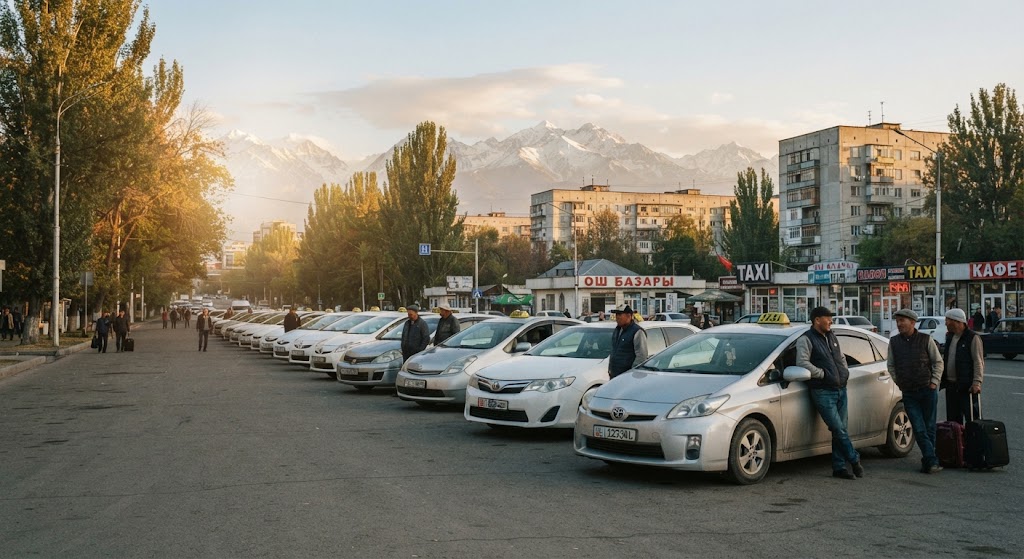
Walk through Bishkek’s Osh Bazaar at dawn and the taxi rank tells a story no press release ever could. Row after row of silver and white Toyota Priuses sit with engines silent, their drivers leaning against the doors, waiting for the first fares. Many of these cars are a decade old. Some have rolled past 400,000 kilometers. Not a single government EV charging station in sight. Not one subsidy banner. Just thousands of used Japanese imports doing exactly what they were built to do: work, day after day, year after year.
This is how Toyota hybrids Central Asia became the region’s default vehicle—not through marketing campaigns or climate policy, but through fifteen years of brutal, unglamorous, real-world proof.
A Region That Skipped the EV Debate Entirely
While Europe and North America argued about charging networks and range anxiety, Central Asia made a quieter and more practical calculation. Pure electric vehicles struggle when temperatures hit –30°C. They struggle on 3,000-meter mountain passes with no charging infrastructure for hundreds of kilometers. They struggle when the nearest authorized service center is a six-hour drive over a washed-out gravel road.
Hybrids do not.
Kyrgyzstan, Kazakhstan, Uzbekistan, and Tajikistan now host one of the densest hybrid vehicle populations per capita anywhere in the world. Most of these cars arrive used, shipped from Japanese and South Korean auctions through ports in Georgia or Russia, then driven or trucked inland along corridors that still echo the old Silk Road. The typical workhorse is a Gen 2 or Gen 3 Prius (2004–2015) or a Camry Hybrid—proven platforms with parts availability that has grown organically across the region. No automaker planned this outcome. The market simply chose the machines that kept running.
The Brutal Driving Environment of Central Asia
The region’s climate and geography punish ordinary cars. Summers in the lowland cities regularly climb past 40°C. Winters in the high valleys drop below –30°C for weeks at a time. Secondary roads turn into washboard gravel after every spring thaw. High-altitude passes demand reliable power delivery and cooling. Fuel quality fluctuates wildly—today’s gasoline may be clean, tomorrow’s may contain water or contaminants that destroy sensitive direct-injection turbo engines.
Modern European and Korean turbocharged engines often fail under these conditions. Carbon buildup, high-pressure pump failures, and turbocharger problems are common and expensive. Toyota’s hybrid system, by contrast, seems almost engineered for exactly this kind of abuse.
Why the Toyota Hybrid System Survives Where Others Fail
The e-CVT has almost nothing to break. Traditional automatic transmissions rely on friction clutches, torque converters, or dual-clutch packs—all of which wear out. The Toyota Hybrid System uses a planetary gearset with no belts and no friction clutches. Power splits mechanically between the gasoline engine and the electric motors. There is remarkably little that can fail.
Cold starts that kill ordinary cars. At –25°C a standard 12-volt starter grinds slowly, drains the battery, and frequently gives up. In a Toyota hybrid the high-voltage motor-generator (MG1) spins the gasoline engine to operating speed in a fraction of a second. The engine fires cleanly every time. This single engineering detail explains why hybrids consistently outsell diesels during Almaty and Bishkek winters.
Fail-safe by design. When a hybrid battery eventually degrades—often past 250,000 or 300,000 kilometers—the car does not become scrap. It simply continues as a conventional gasoline vehicle. Drivers still reach their destination. In a region where a tow truck can cost a week’s wages, that redundancy is worth more than any brochure specification.
The Economics That Made the Conquest Inevitable
Ride-hailing fleets on Yandex Go and the informal shared taxis that link cities across the region discovered the numbers early. A Prius or Camry Hybrid routinely cuts fuel consumption by 40–50 percent compared with older gasoline sedans. For a driver who once spent half of every week’s earnings on fuel, the difference is transformative. A tank that lasted one day now lasts two or three.
Resale value adds another layer of security. Local currencies have suffered repeated devaluations. A well-maintained Toyota hybrid holds its value far better than almost any other vehicle on the market, functioning as a liquid asset that roughly tracks hard-currency benchmarks. Many families treat their cars as savings accounts on wheels.
The Ecosystem Nobody Planned
Mechanics across the region have learned hybrid diagnostics. Independent battery reconditioning shops have opened in Bishkek, Almaty, and Tashkent. Specialized importers focus on low-mileage Japanese auction cars. A complete aftermarket supply chain now supports vehicles that no official Toyota dealer network ever prioritized for the region.
That organic infrastructure is the real competitive moat. It means a hybrid with a problem in a small town along the old Silk Road route can usually be repaired locally, affordably, and relatively quickly.
Quick Answers for Curious Readers
Are Toyota hybrids reliable in extreme cold? Yes. The high-voltage motor-generator starts the engine far more effectively than a conventional 12V starter, which is why hybrids dominate winter taxi fleets in Almaty and Bishkek.
What happens when the hybrid battery dies? The car continues to run as a standard gasoline vehicle. It loses some fuel efficiency but remains fully drivable—a critical advantage in remote areas.
Why not just buy an EV? Charging infrastructure outside major cities is sparse, and range drops sharply in extreme cold. Hybrids offer fuel savings without the range anxiety.
Practicality Beats Hype Every Time
Toyota never ran a splashy Central Asia hybrid campaign. The company did not need to. The cars simply proved themselves on mountain passes, in prolonged –30°C cold snaps, and against fuel of wildly inconsistent quality. Drivers calculated the savings. Fleet operators ran the numbers. Mechanics adapted. The market followed.
In developing economies, real-world reliability and measurable fuel savings still outweigh brand-new, fragile technology every single time. The hybrid fleet continues to grow, quietly rewriting the automotive map of Central Asia one dependable kilometer after another.
If you would like to replace or upgarde the original NiMH batteries to lithium ion batteries, contact our team today! We supply HEV batteries for Toyota/Lexus HEVs.
キーワード: Toyota hybrids Central Asia, Toyota Prius Central Asia, hybrid vehicles Central Asia, Toyota Camry Hybrid, Central Asia automotive market, hybrid taxi Central Asia, Toyota Hybrid System, THS reliability, fuel economy Central Asia, overland travel Central Asia, e-CVT, cold start hybrid, hybrid battery degradation, Yandex Go hybrid fleet, used Japanese imports Central Asia