
When a hybrid battery starts fading, you notice it before any warning light appears. Electric assist feels weaker. Fuel economy slips. The engine kicks in more often than it used to. At that point, you face a decision that didn’t exist a decade ago: you no longer have to replace your pack with the same old chemistry.
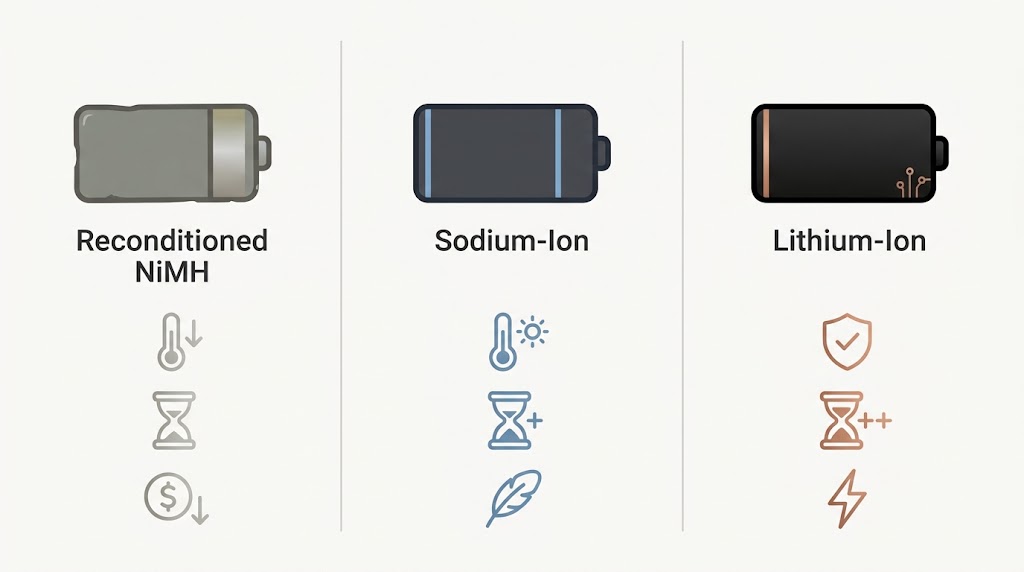
Three technologies now compete for your money — reconditioned nickel-metal hydride (NiMH), sodium-ion, and lithium-ion. Each has a genuinely different personality when it comes to heat, lifespan, cost, and long-term value. This hybrid battery comparison walks through all three so you can match the right pack to your climate, your mileage, and how long you actually plan to keep the car.
Reconditioned NiMH: Cheap Up Front, Costly Over Time
Nickel-metal hydride is the veteran of the hybrid world. It stores and releases energy through electrochemical reactions between nickel-based materials and a hydrogen-absorbing alloy. In a hybrid, it works alongside the gasoline engine to assist acceleration, allow brief low-speed electric driving, and capture energy through regenerative braking.
Reconditioned NiMH packs are rebuilt versions of original equipment. They keep the same form factor, install plug-and-play, and cost the least of the three options. The chemistry is non-flammable, which is a genuine safety strength.
The problems show up in the details. Optimal operating temperature runs from 32°F to 104°F, with an outer limit of −4°F to 131°F. High heat is brutal on NiMH cells — capacity fades faster and internal resistance climbs. Expected service life after reconditioning is only two to four years. Reserve power is lower than a fresh OEM pack, and warranty coverage is typically just one year, even if mileage is unlimited.
For a driver in a mild climate who plans to sell the car in two years, that math can work. For anyone in a hot state or racking up high annual mileage, it’s a short-term patch on a long-term problem.
Sodium-Ion: The Heat-Resistant Value Play
Sodium-ion is the newest chemistry in this hybrid battery comparison, and it directly targets NiMH’s biggest weakness. Instead of lithium or nickel, these cells move sodium ions between electrodes. The result is a pack that shrugs off both extreme heat and extreme cold.
Operating range stretches from −4°F to 140°F, and high-heat performance is rated excellent. That single spec matters more than any marketing claim, because heat is what kills hybrid batteries early. Sodium-ion is also roughly 33% lighter than original equipment, which slightly improves overall vehicle efficiency. Reserve power runs about 29% higher than the stock pack. Expected lifespan is five to seven years — roughly double a reconditioned NiMH pack. The chemistry is non-flammable, installation stays plug-and-play with a prismatic module design, and warranty coverage typically extends to four years with unlimited mileage.
Cost sits between the two extremes, and that’s exactly the point. Sodium-ion is positioned as the best long-term value for owners who intend to keep driving their hybrid for years rather than months.
Lithium-Ion: Maximum Lifespan and Performance
Lithium technology powers most modern hybrids, plug-in hybrids, and full EVs. Energy moves through lithium ions traveling between a graphite anode and a cathode that varies by chemistry — common variants include lithium-ion, lithium iron phosphate, nickel-manganese-cobalt, and nickel-cobalt-aluminum.
In a conventional hybrid, the lithium pack is smaller than an EV battery but does the same job: assist acceleration, enable low-speed electric driving, recover braking energy, and cut fuel consumption. Higher energy density means more power for less size and weight.
Temperature management is more sophisticated. The optimal window is narrower, roughly 59°F to 95°F, but active battery-management systems and air or liquid thermal controls keep cells safe across a −4°F to 131°F operating range. A new lithium hybrid pack commonly lasts eight to fifteen years or more, supporting 300,000–600,000-plus miles depending on driving style and climate. Safety features include continuous monitoring of voltage, temperature, and current, overcharge and deep-discharge protection, cell balancing, and thermal management. Everything is governed by the BMS rather than simple plug-and-play modules. For drivers who want the longest service life and the strongest performance upgrade, a purpose-built HEV lithium-ion replacement — such as NextG Power’s HEV pack — is the premium choice.
Side-by-Side Comparison
| Funkcja | Reconditioned NiMH | Sodium-Ion | Lithium-Ion (New) |
|---|---|---|---|
| Optimal temp range | 32–104°F | 32–104°F | 59–95°F |
| Operating temp range | −4–131°F | −4–140°F | −4–131°F (with thermal mgmt) |
| High-heat performance | Poor to moderate | Excellent | Managed by BMS & cooling |
| Weight vs OE | Same | ~33% lighter | Varies, usually lighter |
| Expected lifespan | 2–4 years | 5–7 lat | 8–15+ years |
| Reserve power | Reduced | ~29% more | Higher energy density |
| Bezpieczeństwo | Non-flammable | Non-flammable | BMS + thermal systems |
| Typical warranty | 1 year unlimited | 4 years unlimited | Often longer manufacturer coverage |
| Instalacja | Plug-and-play | Plug-and-play | BMS-managed |
| Najlepszy dla | Lowest short-term cost | Balanced long-term value | Maximum life & performance |
Which One Should You Actually Buy?
Three honest recommendations, based on your situation:
Choose reconditioned NiMH only if you need the lowest possible purchase price, live in a mild climate, and plan to keep the vehicle for two years or less. Go in knowing the lifespan is short and heat tolerance is weak.
Choose sodium-ion if you want the best overall value. It fixes the heat problem that shortens NiMH life, adds roughly 29% more reserve power, cuts weight by a third, and doubles expected lifespan — all backed by a four-year unlimited-mileage warranty.
Choose lithium-ion if you want maximum longevity and the best performance. Eight to fifteen years of service, advanced BMS protection, and superior energy density justify the higher upfront cost for owners planning to keep the car long-term. And due to the material of lithium ion cells drops a lot than years ago, lithium ion have the best value and performance.
Before buying, confirm compatibility with your specific hybrid model, read the warranty terms carefully, and buy from a supplier that stands behind the product. Proper installation is essential for reliable operation.
A well-chosen hybrid battery restores the electric assist you remember, improves fuel economy, and delivers years of dependable driving. Match the chemistry to your climate, your annual mileage, and your ownership horizon, then commit.
Ready to upgrade your customer’s hybrid with a battery that actually lasts? Skontaktuj się z nami today for a recommendation.
Słowa kluczowe: hybrid battery comparison, sodium-ion hybrid battery, lithium-ion hybrid battery, reconditioned NiMH battery, hybrid battery replacement, NiMH vs lithium vs sodium, hybrid battery lifespan, hybrid battery heat performance, best hybrid battery upgrade, sodium-ion vs lithium-ion, NextG Power HEV lithium, prismatic hybrid battery, hybrid battery warranty