
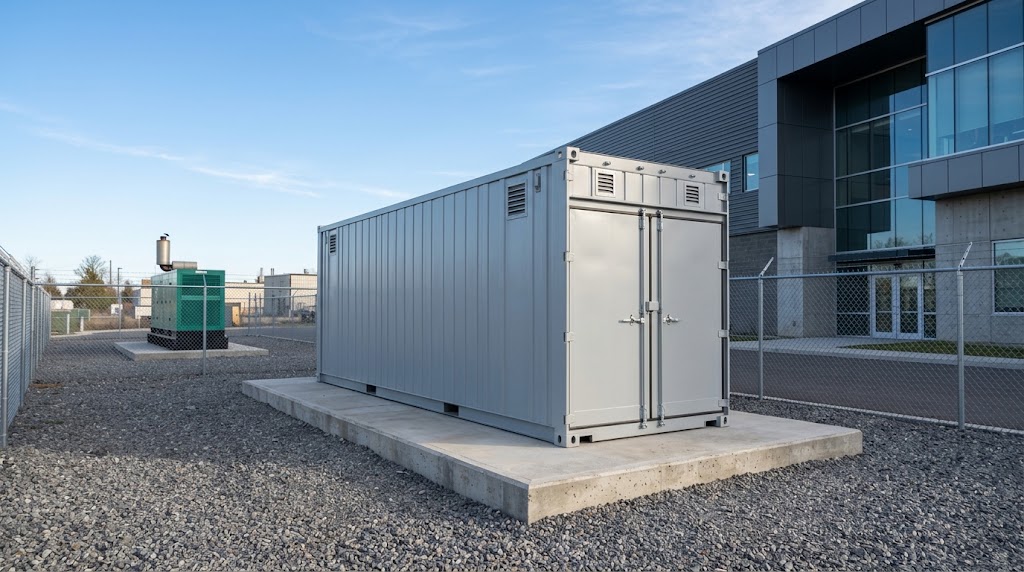
Data centers have leaned on batteries for decades. The uninterruptible power supply sits quietly in almost every critical facility, ready for the moment the grid falters. So why are more operators now adding systemy magazynowania energii akumulatorowej alongside their existing UPS and generator fleets?
The short answer: the battery’s job has grown. A traditional UPS battery bridges a brief gap. A well-designed BESS does that and much more—shifting energy across hours, trimming demand charges, supporting the grid where markets allow, and smoothing the way generators come online. This FAQ breaks down the practical differences in plain language for facility managers, consultants, and developers comparing architectures without getting buried in marketing claims.
Is a Data Center BESS the Same as a UPS?
No. They solve different problems and are engineered to different standards.
A UPS carries the critical IT load for a short transition window—typically seconds to a few minutes—until generators start, stabilize, and the transfer switch completes its work. Its core job is ride-through and power quality.
A BESS is typically sized for longer duration and handles additional tasks:
-
Peak shaving and demand-charge reduction
-
Load shifting between high- and low-tariff periods
-
Integrating on-site solar or other renewables
-
Providing grid services where the utility or market allows
-
Delivering extended ride-through well beyond a conventional UPS battery
Many modern facilities keep both. The UPS protects servers and networking gear with fast response and high power quality. The BESS handles the broader energy and resilience strategy. Treating them as interchangeable is one of the fastest ways to end up with the wrong system.
What Does C-Rate Mean, and Why Does It Matter?
C-rate tells you how quickly a battery charges or discharges relative to its energy capacity. A 1C rate on a 100 kWh battery means 100 kW. A 10C rate on the same battery means 1,000 kW.
High C-rate capability matters when you need a lot of power in a short time—bridging the gap while generators start, riding through a voltage sag, or supporting a sudden load spike. Low C-rate systems suit multi-hour energy shifting better.
A battery optimized for high-power UPS duty is rarely the best choice for long-duration energy arbitrage, and the reverse holds true. Always check the datasheet for continuous power rating, how long that power can be sustained, and cycle-life assumptions at the intended depth of discharge. Vague claims about “high performance” without these numbers are useless for real design work.
Can a BESS Work Together with Generators?
Yes. Several common architectures use the battery to help generators rather than replace them.
The BESS can absorb part of the load during generator startup, smooth the operating point once engines are running, and reduce total start-stop cycles over a year. Some designs also provide black-start capability, helping a site recover after a complete outage.
When both systems share a facility, several engineering points need clear answers:
-
Generator step-load acceptance and the exact load-transfer sequence
-
Protection coordination between battery inverters, generators, and switchgear
-
Control logic deciding when the battery charges or discharges while generators run
-
Realistic fuel-savings calculations based on the actual load profile
-
Clean mode transitions between grid-tied, islanded, and generator-supported operation
These are site-specific decisions. A battery that performs well in one data center can create problems in another if control and protection details aren’t worked out carefully.
Does Every Facility Need Both UPS Batteries and a BESS?
Not necessarily. If the only requirement is a short, reliable bridge to the generators, a conventional UPS architecture may be enough. Once the operator also wants to manage demand charges, shift energy across tariff periods, or join grid services, a dedicated BESS starts to make economic sense.
Some sites install high-C-rate battery racks that handle short, high-power events while still offering modest energy capacity. Others separate the functions: keep the existing UPS for IT protection and add a longer-duration BESS for energy management. The right mix depends on the site’s resilience targets and the revenue streams actually available.
Fire Safety and Code Requirements
Fire-safety rules for systemy akumulatorowe in data centers come from the building code, the fire code, and the local authority having jurisdiction—not from the battery manufacturer’s brochure.
Typical questions that need clear answers:
-
What thermal-runaway test data exists for the exact configuration proposed?
-
What separation distances, detection, suppression, and ventilation measures are required?
-
Is a hazard-mitigation analysis needed for this installation?
-
Are there local amendments that go beyond the national standard?
Always confirm requirements with the authority having jurisdiction and a qualified fire-protection engineer. Product certification helps, but it doesn’t replace a project-specific review.
How Does Adding a BESS Change the Risk Profile?
It can move risk in both directions. Extra ride-through and reduced generator stress improve resilience. At the same time, the battery introduces new failure modes to manage—thermal events, protection coordination, and control-system reliability.
A professional project treats the BESS as a critical system: its own design review, commissioning plan, acceptance testing, and ongoing maintenance program. Treating it as an optional add-on to the electrical room is a common and expensive mistake.
If you are planning a data center BESS project, send NextG Power the critical load, the required runtime, the generator configuration, and the site constraints so the sales and engineering team can review the data and recommend a practical system architecture.
Słowa kluczowe: BESS for data centers FAQ, data center battery storage, UPS vs BESS, high C-rate LFP UPS, data center power backup, generator and battery storage, BESS black start, AI data center power, energy storage for data centers, NextG Power data center BESS