
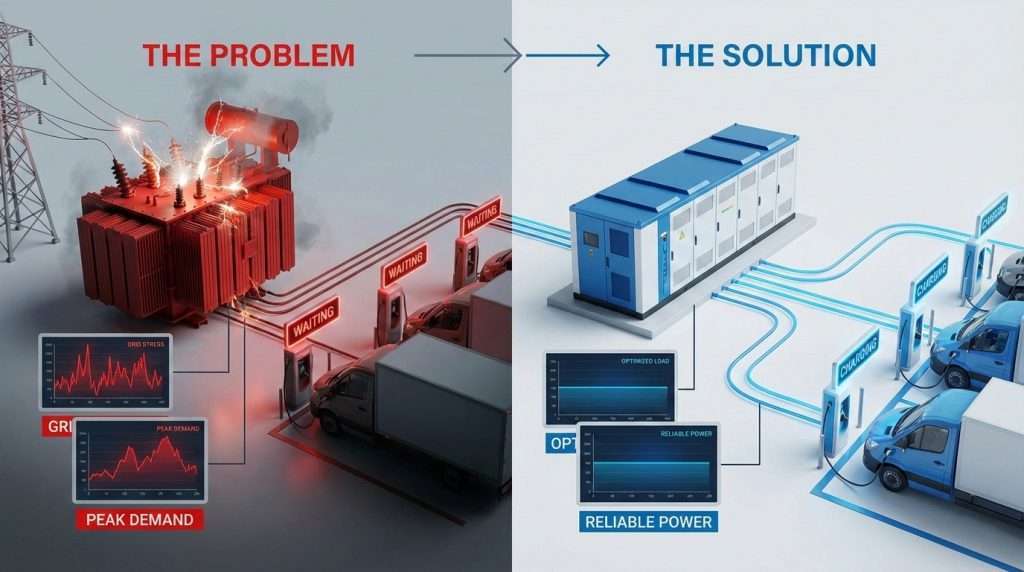
The electric vehicle revolution is accelerating, especially for commercial and municipal fleets. The commitment is clear: transition to EVs, install charging stations, and lead the sustainable future. But for many facility managers and fleet operators, a daunting, hidden obstacle emerges just as the project gains momentum. You’ve planned for the vehicles and the chargers, only to be told that powering them requires a massive, unexpected investment—not in the EVs themselves, but in the electrical grid connection to your site.
This is the new pain point of fleet electrification. Adding a charging station of just 10 DC fast chargers can instantly double a facility’s peak power demand. The local utility’s response is often a stark ultimatum: to support this new load, you must fund a costly upgrade to the transformers and distribution infrastructure, a capital expenditure (CAPEX) that can soar into the millions. Suddenly, the ROI on your electrification project is jeopardized by an astronomical grid upgrade bill.
This challenge is known as the “grid constraint.” It’s a physical and financial bottleneck. Utilities are tasked with ensuring grid stability, and a sudden, massive spike in demand from a single site can overwhelm local infrastructure. The traditional solution—reinforcing the grid—is slow, expensive, and places the financial burden entirely on the end-user. Furthermore, even if the upgrade is completed, your operation may then face significantly higher monthly demand charges based on that new, higher peak.
There is, however, a smarter, more future-proof strategy that sidesteps this gridlock entirely. The solution lies not in upgrading the grid, but in intelligently managing your site’s power profile through a technology perfectly suited for the task: a System magazynowania energii akumulatorowej (BESS). This approach is called EV charging peak shaving, and it’s transforming how high-power EV fleets are powered.
What is EV Charging Peak Shaving?
Peak shaving is the practice of reducing the maximum amount of power (kilowatts) drawn from the grid during a billing period. In the context of EV fleets, the goal is to deliver fast, reliable charging to vehicles without creating a massive, short-term spike in grid demand.
Here’s how it works with an on-site battery (BESS):
Trickle Charge the Battery: The BESS charges slowly and continuously from the grid 24/7, drawing a low, steady amount of power that stays well within your site’s existing grid capacity.
Blast Power to EVs on Demand: When multiple fleet vehicles plug in simultaneously and demand high-power fast charging, the system seamlessly supplements grid power with stored energy from the battery. The combined power flow meets the high demand of the chargers, but the draw from the grid remains flat and controlled.
Return to Baseline: Once the charging session peaks pass, the BESS quietly recharges at a gentle rate, ready for the next surge.
Think of it like a reservoir. Instead of demanding a catastrophic flood of water from the town aqueduct all at once (overwhelming the pipes), you fill a large storage tank slowly over time. When you need to fill a fleet of trucks quickly, you open the spigot from both the aqueduct I your tank, achieving the needed flow rate without ever stressing the main supply.
The Tangible Benefits of BESS for EV Fleets
Deploying a BESS for EV charging peak shaving delivers direct financial and operational benefits:
Avoid Multi-Million-Dollar Grid Upgrades: This is the primary advantage. By keeping your peak grid demand below the threshold that triggers a required upgrade, you can defer or eliminate this enormous capital expenditure entirely. Your existing grid connection becomes sufficient.
Slash Peak Demand Charges: Utilities charge commercial customers not just for total energy (kWh) but for their highest 15-30 minute peak demand (kW) each month. A BESS actively shaves these peaks, leading to substantially lower monthly electricity bills.
Unlock Charging Speed & Reliability: You are not compromising on charging performance. Vehicles still receive the fast, high-power charging they require for operational readiness. The BESS ensures reliability by providing backup power that can keep chargers operational during brief grid interruptions.
Future-Proof Your Investment: As your fleet grows and you add more chargers, the same BESS can be scaled or its software optimized to manage an even larger load, protecting you from future grid constraints and charges.
The path to fleet electrification shouldn’t be blocked by outdated infrastructure or prohibitive upgrade costs. EV charging peak shaving with an on-site system akumulatorowy offers a sophisticated, economical, and scalable solution. It allows you to take control of your power profile, protect your bottom line from unpredictable costs, and accelerate your sustainability goals on your own terms.
Ready to see how a BESS can solve your fleet’s grid constraint and calculate your potential savings? Kontakt our energy solutions team for a custom feasibility analysis today.
Keywords: EV charging peak shaving, BESS for EV fleets, battery energy storage system, EV fleet charging, grid upgrade avoidance, peak demand management, fleet electrification, demand charge reduction, commercial EV charging, grid constraints.