
Imagine powering a luxury resort, a critical mining operation, or an agricultural project hundreds of miles from the nearest reliable power line. In the vast, sun-drenched landscapes of the Middle East, this isn’t just a hypothetical—it’s a daily challenge for many businesses. Reliance on expensive, polluting, and logistically complex diesel generators has long been the default, but a smarter, more sustainable solution is taking hold: the remote business microgrid.
For enterprises operating in off-grid or weak-grid scenarios across the region, achieving energy independence is no longer a distant dream but a practical, profitable reality. This guide delves into how tailored microgrid systems are providing the key.
The Energy Challenge: Beyond the Grid’s Reach
The Middle East presents a unique paradox: abundant energy resources alongside significant energy access challenges in remote areas. Grid extension over harsh terrains—be it desert, mountain, or coastal islands—is often prohibitively expensive and technically daunting. Even where grid connections exist, they can be unreliable (“weak-grid”), with frequent outages or voltage fluctuations that jeopardize business continuity, damage sensitive equipment, and inflate operational costs.
For a remote business, this dependency creates uncertainty. The constant drumbeat of diesel fuel costs, supply chain risks, noise pollution, and carbon emissions becomes a heavy burden. This is precisely where microgrids for remote business offer a transformative alternative, turning a vulnerability into a strategic advantage.
Blueprint for Independence: Designing Your Microgrid
A modern microgrid for a remote site is a sophisticated, integrated energy system. The most effective and common design for the Middle East combines three core components:
Solar Photovoltaics (PV): The region’s most abundant resource. A solar array forms the primary generation source, capturing the intense sunlight to provide clean, low-cost power.
Battery Energy Storage: The critical enabler. Batteries store excess solar energy produced during the day for use at night, ensuring a 24/7 power supply. They also provide instant backup during cloud cover or when switching power sources.
Backup Diesel Generator: The proven reliability. The generator acts as a secure backup during extended periods of low sun or unusually high demand, ensuring uninterrupted power.
The art of the design lies in right-sizing each component—calculating the optimal solar array size, battery capacity (in kilowatt-hours), and generator rating to meet the specific load profile of the business while minimizing lifetime cost.
Smart Brains for the System: Control Strategies That Maximize Savings
The hardware is powerful, but the real intelligence lies in the microgrid’s control system. Advanced controllers are the “brains” that decide, in milliseconds, where to draw power from. The goal is simple: maximize renewable energy use. Strategies include:
Renewable-First Dispatch: The controller prioritizes solar PV, only dipping into magazynowanie baterii when solar is insufficient.
Generator Optimization: The generator is activated only when batteries are depleted to a certain level or during peak demand, and it runs at its optimal, fuel-efficient load.
Load Management: For some businesses, non-critical loads can be automatically shed during low-generation periods, further preserving battery life.
This smart orchestration slashes diesel run-hours by 70-90%, directly translating to lower fuel costs, reduced maintenance, and a smaller carbon footprint.
Cost Analysis vs. Grid Extension
The decision often comes down to economics. How does a microgrid stack up against the traditional approach of extending the central grid?
Grid Extension: Costs are enormous and linear—every additional kilometer of high-voltage line over rugged terrain adds capital expense. There are also ongoing tariffs and, frequently, connection fees.
Standalone Microgrid: While the initial capital investment in solar, batteries, and controls is significant, it is a known, fixed cost. The long-term operational costs are drastically lower, dominated by minimal maintenance and vastly reduced fuel. For sites more than a few kilometers from the grid, the microgrid often achieves a lower Levelized Cost of Energy (LCOE) over a 20-year lifespan, with the added benefit of price predictability and control.
Case Study: Energy Oasis at a Red Sea Resort
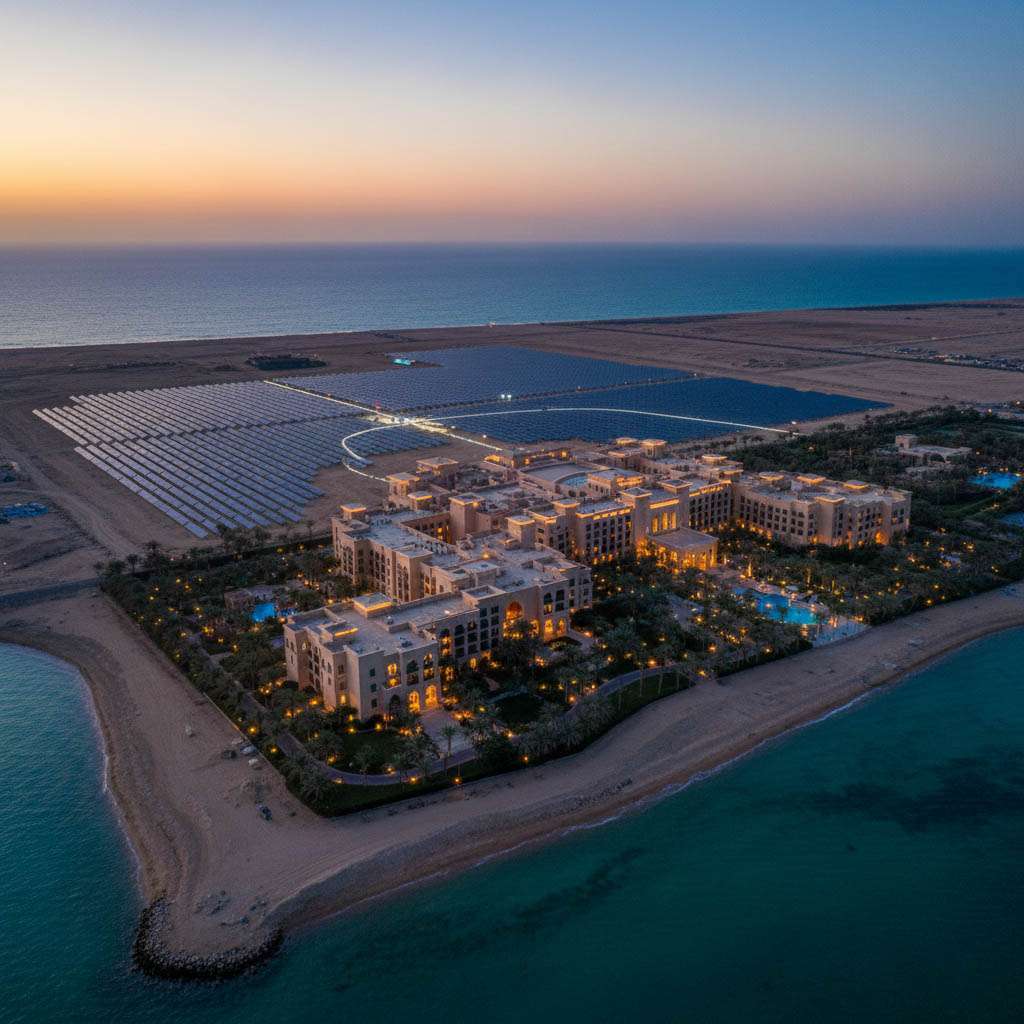
Consider a luxury eco-resort on a remote Red Sea island. Their challenge: provide 24/7 power for desalination, air conditioning, and amenities, previously relying solely on diesel barges.
Their solution was a hybrid microgrid for remote business: a 1MW solar farm, a 2 MWh system magazynowania baterii, and the existing diesel generators integrated as backup.
The results were transformative:
Renewable Penetration: Solar now provides over 85% of the resort’s annual electricity.
Fuel Savings: Diesel consumption dropped by 82%, saving hundreds of thousands of dollars annually and insulating the business from fuel price volatility.
Sustainability Leadership: The resort dramatically reduced its noise and carbon emissions, bolstering its brand as a true eco-destination.
Reliability: Power quality improved, eliminating the surges and outages common with generator-only systems.
This project is a beacon, proving that energy independence in the Middle East is not only feasible but also commercially superior for remote operations.
The Path Forward
For business leaders and project developers in the region’s remote corners, the microgrid represents more than just power—it represents progress, resilience, and control. By leveraging local solar resources with smart technology, businesses can secure their operational future, lock in energy costs, and build a sustainable brand. The journey to niezależność energetyczna starts with a practical, well-designed system tailored to the unique rhythm of your business and the relentless sun of the Middle East.
Słowa kluczowe: microgrids for remote business, energy independence in the Middle East, remote business microgrid, microgrid design, hybrid solar system, off-grid power, renewable energy Middle East, microgrid cost analysis, Red Sea resort microgrid, energy independence