
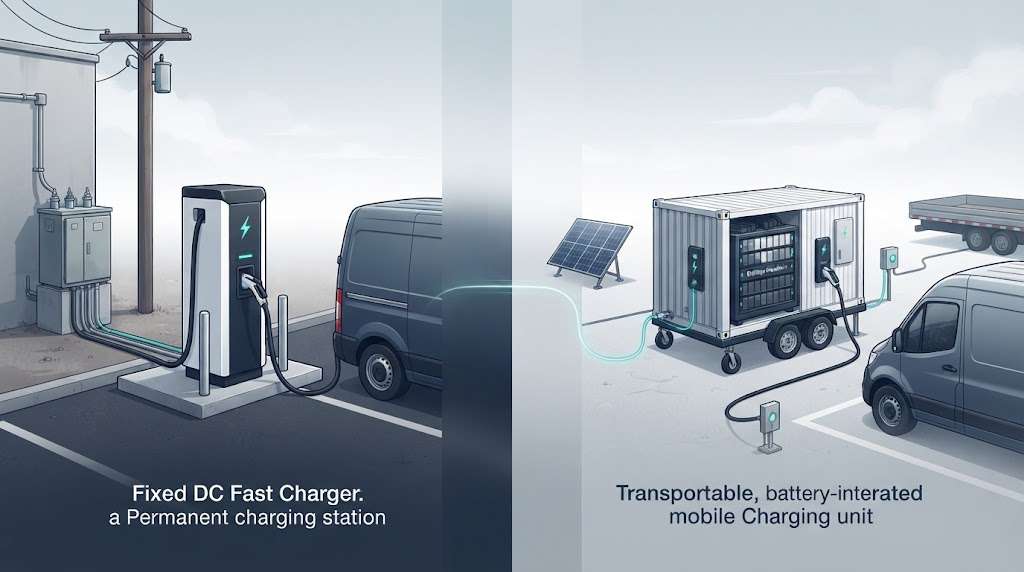
A fleet manager in one city waits eleven months for a transformer upgrade. A project developer in another needs charging running in six weeks for a temporary site. Both are asking the same question — should I install a fixed DC fast charger or bring in a mobile EV charging station? — but the right answer for each is completely different.
That is the trap in this decision. People search for a winner. What they actually need is a filter.
This comparison gives you that filter. We will look at how each system pulls power, what site conditions favor each one, how long deployment really takes, and which numbers decide whether the project pays back. By the end, you should be able to look at your own site and know which direction makes sense.
What a Fixed DC Fast Charger Actually Is
A fixed DC fast charger is permanent infrastructure. It pulls AC power from the utility, converts it to DC inside the cabinet, and sends that power to vehicles at a rated output. You see this architecture in public charging hubs, highway corridors, fleet depots, and workplace parking.
The tradeoff is everything that has to happen before the first session. You need reliable grid capacity at the point of connection, electrical design, permits, trenching or conduit, pad construction, and often a transformer or service panel upgrade. Utility review alone can stretch a timeline by months.
When the grid is strong, though, a fixed charger is hard to beat. It delivers its full rated power directly from the utility, session after session, with predictable maintenance and no battery degradation to model.
What a Mobile EV Charging Station Actually Is
A mobile EV charging station packages battery storage and charging output into one transportable unit. Inside, you typically find battery modules, a power conversion system, charging connectors, thermal management, and controls.
As a concrete reference point, systems in the NextG Power MEV-A Series are published with integrated battery energy around 418 kWh or 522 kWh and EV charging outputs of 400 kW or 320 kW. Because the unit can be relocated, it suits temporary demand, construction sites, fleet pilots, emergency response, and sites still waiting on a permanent grid upgrade.
The key word is transportable. This is not a permanent asset. It is capacity you can move when the project moves.
Grid Dependency: Where the Two Architectures Split
This is the difference that decides most projects.
A fixed DC fast charger expects the site to supply the full charging load in real time. If the transformer, service panel, or upstream network cannot handle that peak, you pay for a grid upgrade before reliable charging starts. That upgrade can cost more than the chargers themselves and can take longer than the entire installation.
A mobile station with its own battery flips the equation. It draws power slowly from the grid — or from solar, a generator, or another source — stores it, and then releases high-power charging from stored energy. The instantaneous grid draw drops dramatically.
Here is the part buyers miss: this does not make mobile charging cheaper or identical in continuous output. It changes what you need to compare. Look at available grid import, the actual charging profile your vehicles require, and total energy delivered in kWh. The number on the charging gun tells you very little on its own.
Deployment Speed: Months vs Weeks
A fixed installation follows a predictable but long path: electrical design and permits, trenching or conduit, pad construction, possible transformer or panel upgrades, utility review and approval, then installation and commissioning. Each step depends on the one before it, and utility timelines are rarely in your control.
A mobile station still needs permits, site access, safety checks, and commissioning. But it skips most of the permanent civil work. When a project cannot wait for a utility upgrade, a battery-equipped mobile unit can begin controlled charging operations while the permanent infrastructure catches up.
That overlap is often worth more than the equipment cost difference. Revenue starts earlier. Fleet operations start earlier. And if the permanent installation is delayed again, you are still charging.
Which Option Fits Which Operating Scenario
Fleet depots with predictable daily schedules — vehicles return to the same spots and need to be ready for the next shift — usually favor fixed chargers. Utilization is high, the location is stable, and the grid investment is justified over years.
Mobile stations tend to fit better when:
Demand moves between locations by season or project phase.
There is no long-term lease or land control.
Fixed work is delayed by approvals.
A temporary event needs high-power charging for a few days.
Emergency or disaster response requires movable capacity.
A fleet wants to test real-world charging patterns before committing to permanent infrastructure.
One caution worth repeating: mobile equipment does not automatically replace a high-utilization fixed depot. A large fleet operating hundreds of vehicles from one location is normally better served by a planned fixed system, possibly with battery buffering added where the grid is constrained. Mobile works best as a bridge, a pilot, or a movable asset — not as a permanent substitute for high-throughput infrastructure.
Charging Output: What the Datasheet Will Not Tell You
Buyers frequently ask whether a “400 kW” rating means the unit delivers 400 kW continuously. Sometimes it does. Sometimes it does not. The rating alone does not answer the question.
Check these values before comparing anything:
Rated EV charging output in kW.
Number of guns and how power splits among them.
DC voltage and current ranges.
Whether output comes from the battery, the grid, or a combined system.
Usable battery energy in kWh before the station itself needs recharging.
Overall system efficiency during charge and discharge cycles.
The NextG Power MEV-A series, for example, lists multiple gun configurations and a DC output range from 200 V to 1000 V. Those numbers help match equipment to your vehicle mix. But the final choice still depends on your full daily load profile — how many vehicles, how much energy each needs, and when they need it.
Payback: The Inputs That Matter More Than Sticker Price
Comparing the cost of the charger alone is the most common mistake in this category. The relevant inputs over the expected service life are:
Planned utilization — sessions per day and average kWh per session.
Energy source and cost — grid tariffs, time-of-use rates, on-site solar, or generators.
Grid upgrade cost avoided — this single line item can change the entire payback case for a mobile or battery-buffered approach.
Operating costs — energy losses, maintenance, insurance, staffing, and redeployment logistics.
Revenue or value — charging fees, avoided fleet downtime, possible grid services, or lease income from temporary use.
Expected equipment life — battery cycle life, charger service life, and replacement assumptions.
Early illustrative models are useful for discussion. But any serious quotation should rest on project-specific data and written assumptions from the supplier. If those assumptions are not in writing, the payback number is a guess.
What to Send Before Requesting a Quote
A clear operating brief helps suppliers respond with something useful instead of a generic datasheet:
Country, voltage, frequency, and available grid import at the site.
Vehicle types and typical session lengths.
Daily number of sessions, energy needed, and time-of-day pattern.
Number of charging guns required.
Whether the system should accept AC, solar, or generator input.
How long the station will stay and whether it must remain movable.
Space, access roads, crane, and foundation limits.
Required communication, payment, and reporting functions.
Security, fire protection, and environmental rating demanded by the project.
The Decision Comes Down to Constraints, Not Technology
Choosing between a fixed DC fast charger and a mobile EV charging station is not about which technology is better. It is about which constraint is binding on your project. Strong grid access and long-term, high utilization point toward fixed chargers. Grid limits, tight timelines, temporary demand, or the need to relocate later point toward mobile.
If you are weighing a mobile EV charging station vs fixed charger for your fleet, venue, or project, prepare a one-page summary of your site and vehicle profile, then request a technical comparison built on your actual grid import, vehicle mix, and daily energy target. Skontaktuj się z nami now.
Słowa kluczowe: mobile EV charging station vs fixed charger, battery buffered EV charging, mobile EV charging for fleets, temporary EV charging solution, EV charger battery energy storage, DC fast charger site selection, fleet charging infrastructure 2026, mobile charging station payback, EV charging with limited grid, mobile EV charging station supplier