
Food and beverage facilities operate on razor-thin margins and non-negotiable timelines. Production lines must run. Cold storage temperatures must hold. Dock schedules don’t pause because the grid is strained. Yet month after month, facilities teams face a line item that feels frustratingly unpredictable: demand charges.
In many utility territories, demand charges penalize facilities not for total energy consumption, but for the highest spikes in power draw during short intervals. For food and beverage operations—where refrigeration, freezing, compressed air, conveyors, and processing loads constantly overlap—those spikes happen daily. They are often a natural byproduct of simply doing business.
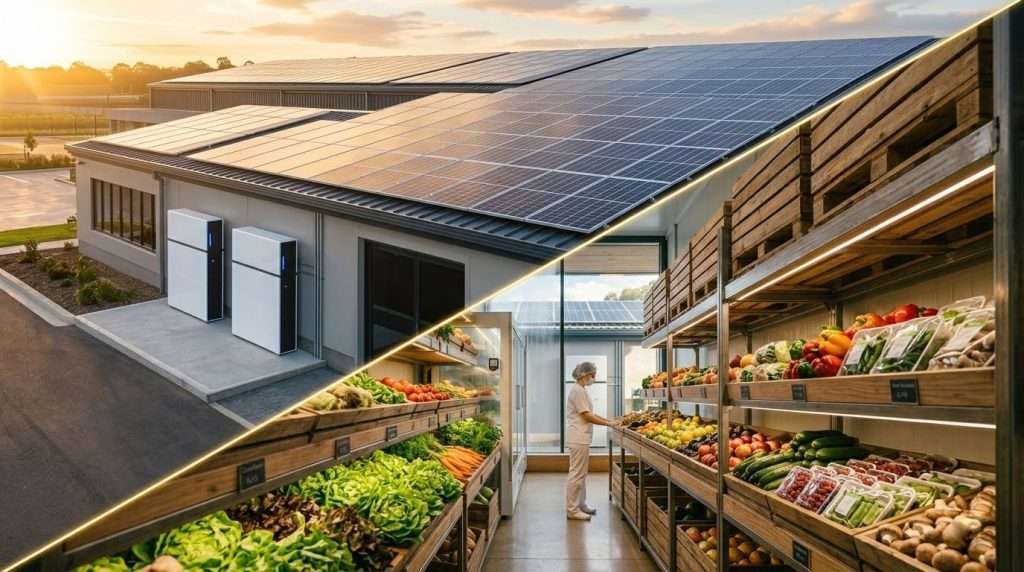
This is why solar plus storage for food and beverage facilities has moved beyond a sustainability checkbox. When designed and deployed correctly, it becomes a practical, hands-on tool for load shaping, peak reduction, and cost stabilization—all without compromising food safety, temperature integrity, or production throughput.
Why Demand Charges Hit Food & Beverage Facilities Hardest
Food and beverage sites are among the most energy-intensive in the commercial and industrial sector. Cold storage runs 24/7. Freezers cycle continuously. Processing equipment, packaging lines, and material handling systems draw significant power. Many facilities operate multiple shifts or run around the clock to meet distribution commitments.
The billing structure, however, doesn’t just look at how much energy you use. It looks at how fast you use it. A significant portion of the monthly bill is often determined by the single highest 15- or 30-minute peak demand interval.
In food and beverage plants, these peaks aren’t rare anomalies. They are triggered by normal operational patterns, such as:
Simultaneous startups at shift changes or after scheduled downtime
Refrigeration defrost cycles stacking unexpectedly with processing loads
Hot-weather surges that force cooling systems to work harder
Motor-heavy ramps across compressors, conveyors, and packaging lines
The result? A facility can run efficiently by every operational metric and still get hit with demand charges that feel disconnected from reality.
How Solar Plus Storage for Food and Beverage Targets Cost Drivers
Solar plus storage pairs onsite solar generation with intelligent systemy akumulatorowe. This combination gives facilities control not just over how much energy they produce, but Kiedy I how they use it.
Solar arrays offset baseline consumption with low-cost, predictable generation during daylight hours. Batteries extend that value by providing a dispatchable resource that responds instantly to peaks and price signals. For food and beverage teams, this translates into three core strategies that matter most.
1. Peak Shaving: Smoothing Spikes Without Slowing Production
Peak shaving is the most direct way batteries cut demand charges. Instead of pulling full power from the grid during spike events, the battery discharges instantly to cap the facility’s demand below a set threshold.
This is particularly valuable in food and beverage environments where operational overlaps are unavoidable. Common scenarios where peak shaving delivers immediate savings include:
Multiple refrigeration compressors cycling on simultaneously
Conveyor systems ramping up while freezers are already pulling heavy load
Hot afternoons when cooling demand spikes alongside normal processing
Short windows where packaging lines and material handling peak together
The operational advantage is clear: you don’t need to ask production teams to change behavior or “be careful” about starting equipment. The battery handles the smoothing automatically, silently, and without disruption.
2. Load Shifting: Moving Solar Energy to Peak Hours
Food and beverage facilities rarely stop when the sun goes down. Evening shifts, overnight cold storage, and early-morning precooling cycles all draw significant power long after solar production fades.
Load shifting solves this mismatch. During midday hours when solar generation exceeds facility demand, excess energy charges the battery. Later, during evening peaks or early-morning ramp-ups, that stored energy discharges to support operations. This reduces grid reliance during expensive windows and flattens the facility’s overall load profile.
For distribution centers and processing plants with high evening activity, this strategy alone can meaningfully reduce monthly demand charges.
3. Energy Arbitrage: Beating Time-of-Use Rates
Many food and beverage operators are subject to time-of-use (TOU) rate structures, where electricity prices rise and fall based on grid conditions. Evening hours and hot summer afternoons often carry significantly higher per-kilowatt costs.
Energy arbitrage allows facilities to charge batteries when electricity is cheap—either from solar or low-cost grid windows—and discharge during expensive periods. This isn’t about speculating on hourly price swings. It’s about systematically reducing exposure to predictable high-cost windows that destabilize monthly budgets.
The result is twofold:
Lower costs during expensive TOU periods
More consistent, forecastable energy bills
In a sector where margins are tight and pricing pressure is relentless, stabilizing energy spend is a genuine competitive advantage.
Protecting What Matters: Cold Storage and Food Safety
A common concern among food and beverage facilities teams is whether energy strategies might compromise critical operations. Will peak shaving accidentally starve a freezer during a critical cycle? Will load shifting leave a cooler short of power on a hot afternoon?
The answer lies in intelligent system design. Modern energy management systems (EMS) are programmed with operational priorities. They understand that food safety and temperature integrity come first. Battery dispatch is optimized around those constraints, not in conflict with them.
At NextG Power, our platform continuously monitors facility conditions. It detects peak events in real time, dispatches storage to cap demand, and coordinates solar generation—all while ensuring that critical loads are never compromised.
Why 2026 Is the Right Time to Act
With federal ITC incentives locked in through 2033, battery prices continuing to decline, and utility rates showing no signs of softening, the economic case for solar plus storage for food and beverage facilities has never been stronger. Facilities that act now lock in lower costs, greater predictability, and a cleaner operational footprint for decades to come.
Stabilize Your Energy Costs with NextG Power
If your food or beverage facility faces high demand charges, operates multiple shifts, or relies on continuous cold storage, solar plus storage is worth a serious look. It is not just an environmental investment—it is a financial tool that pays returns month after month.
Skontaktuj się z NextG Power today for a free site assessment. Our experts will model your facility’s unique load profile and show you exactly how solar plus storage for food and beverage can deliver measurable savings without disrupting what matters most: your operations.
Słowa kluczowe:
solar plus storage for food and beverage, solar plus storage food and beverage, demand charge reduction food industry, industrial solar battery storage, peak shaving for food processing, load shifting cold storage, energy arbitrage manufacturing, food and beverage energy savings, solar storage refrigeration, commercial solar plus storage, battery storage food facilities, NextG Power, solar plus storage incentives 2026, industrial electrification food beverage