
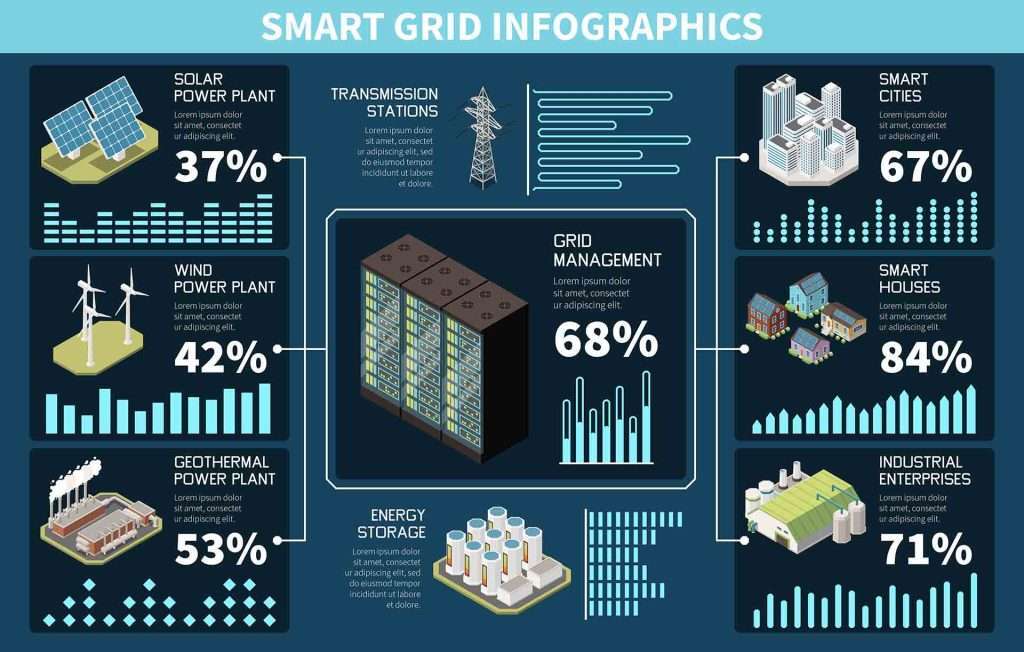
For the last century, the world ran on a simple model: a massive, centralized power plant sent electricity down hundreds of miles of wire to your building. It was a one-way street. But in recent years, that model is showing its age. Extreme weather, aging infrastructure, and rising costs have exposed the fragility of the centralized grid.
The solution: The Smart Microgrid with BESS.
You have likely heard the term “microgrid” thrown around in sustainability meetings or engineering proposals. But what exactly is it? Is it just solar panels on a roof? Is it a backup generator?
In short, a smart microgrid is a localized energy grid with its own control capabilities, which means it can disconnect from the traditional utility grid and operate autonomously. At the heart of this system lies the System magazynowania energii akumulatorowej (BESS), the critical component that turns intermittent renewable energy into a stable, 24/7 power supply.
In this guide, we will break down the anatomy of a smart microgrid, the indispensable role of magazynowanie baterii, and why businesses are rushing to build their own energy islands.
The Anatomy of a Smart Microgrid
To understand a smart microgrid with BESS, think of it as a miniature version of the main utility grid, but one that you own and control. It is composed of three main layers:
1. Distributed Generation ( The Source)
This is where the power comes from. While it can include diesel or natural gas generators, modern microgrids rely heavily on renewable sources like Solar PV arrays or small wind turbines. This provides the clean, cheap electrons.
2. The BESS (The Anchor)
Solar panels only work when the sun shines. Without storage, your microgrid fails the moment a cloud rolls in or the sun sets. The System magazynowania energii akumulatorowej (BESS) acts as the buffer. It stores excess energy generated during the day and deploys it at night or during demand spikes. It is the “fuel tank” of the modern era.
3. The Smart Controller EMS(The Brain)
This is what makes the microgrid “Smart.” The Microgrid Controller EMS is a sophisticated software and hardware system that manages the flow of energy. It uses Artificial Intelligence (AI) to predict weather patterns, analyze energy prices, and automatically decide whether to charge the battery, buy power from the grid, or disconnect entirely.
Why the BESS is the MVP of the Microgrid
You can have a microgrid without a battery (using diesel generators), but you cannot have a clean Lub efficient microgrid without one.
In a smart microgrid with BESS, the battery performs several critical functions that rotating generators simply cannot handle:
Grid Forming: When the main utility grid fails, the microgrid must create its own stable voltage and frequency (60Hz or 50Hz). The BESS, equipped with advanced “grid-forming” inverters, acts as the voltage reference for the entire local network, allowing your grid to stay online.
Smoothing Intermittency: If a cloud passes over your solar array, power output drops instantly. A BESS detects this drop in milliseconds and injects power to fill the gap, ensuring your machinery doesn’t glitch or reset.
Silent Operation: Unlike generators, the BESS has no moving parts. It provides resilience without the noise or emissions, allowing microgrids to be installed in hospitals, universities, and dense urban centers.
The “Smart” Factor: Islanding and Autonomy
The defining feature of a smart microgrid with BESS is the ability to “Island.”
Islanding is the process of physically disconnecting from the main utility grid during a blackout and continuing to power the facility using local assets.
In the past, this was a manual, clunky process. Today, smart controllers handle it automatically.
Imagine a summer storm knocks out the utility lines.
Detection: The smart controller detects the grid failure in less than 5~20 milliseconds.
Islanding: It opens the breaker at the Point of Common Coupling (PCC), isolating your facility for safety.
Stabilization: The BESS instantly takes over the load, preventing a facility-wide shutdown.
Management: The system calculates how much charge is left in the battery and automatically sheds non-critical loads (like dimming lights in hallways) to extend the runtime for critical operations (like servers or freezers).
All of this happens without human intervention.
The Economic Case: It Pays for Itself
While resilience is often the primary driver, the ROI of a smart microgrid with BESS is increasingly attractive. It isn’t just an insurance policy; it is a trading platform.
When the grid is functioning normally, the smart controller turns your microgrid into a profit center through:
Peak Shaving: Using stored battery power during the most expensive hours of the day to lower demand charges.
Energy Arbitrage: Charging the BESS when grid prices are low (overnight) and using that cheap power when grid prices are high.
Virtual Power Plants (VPP): Many utilities will now pay microgrid owners to export power back to the grid during regional emergencies, turning your resilience asset into a revenue stream.
The centralized grid of the past is struggling to keep up with the demands of the future. For commercial and industrial facilities, relying solely on a utility connection is a risk to business continuity.
A smart microgrid with BESS offers a path to energy independence. By combining the generation power of solar, the stabilizing power of batteries, and the intelligence of modern software, you can create a system that is cleaner, cheaper, and virtually immune to blackouts. It is not just about keeping the lights on; it is about taking control of your energy future.
Skontaktuj się z naszym zespołem today to model a custom microgrid solution for your facility.
Słowa kluczowe: Smart microgrid with BESS, battery energy storage system, microgrid islanding, grid forming inverter, distributed energy resources, commercial microgrid, energy independence, renewable energy storage.