
The Battery Revolution You Haven’t Heard About
In April 2026, CATL and HyperStrong signed the world’s largest sodium-ion battery contract—60 GWh over three years. That single deal represents more sodium-ion capacity than most industry analysts predicted for the entire decade.
Welcome to the inflection point.
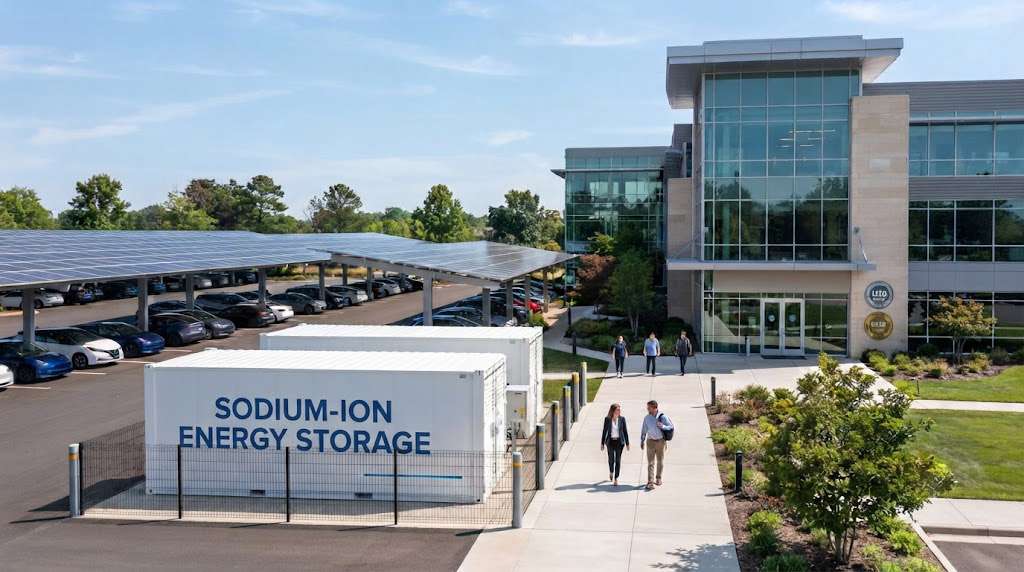
While lithium-ion has dominated headlines for years, the energy storage industry has been quietly building an alternative that solves lithium’s most stubborn problems. Sustainable sodium ion BESS is no longer a research project or a pilot demonstration. It is a commercial reality with real projects breaking ground across the United States, Europe, and Asia.
Here is why project developers, utilities, and Fortune 500 companies are making the switch.
The Problem with Lithium’s Success
Lithium-ion battery storage works. And its the leading BESS solution in the market.But in some enviroments switch to sodium ion batteries.
Lithium extraction in Chile’s Atacama Desert consumes 65% of the region’s water supply. Cobalt mining in the Democratic Republic of Congo carries serious ethical concerns. Nickel processing generates toxic waste that communities must live with for generations.
Supply chains are concentrated. Over 70% of lithium processing happens in China. Cobalt refining is even more concentrated. When geopolitical tensions rise, battery projects stall.
Developers are also discovering that lithium-ion may not be the best fit for every application. In hot climates, cooling systems drain efficiency. In cold regions, lithium packs lose capacity. And after 8,000 cycles, most lithium systems need replacement—often before the solar farm they serve has reached its end of life.
This is where sodium-ion enters the picture.
Why Sodium Changes Everything
Sodium is the sixth most abundant element on Earth. It is found in saltwater, soda ash, and minerals that exist in virtually every country. The United States has enormous soda ash deposits in Wyoming. Europe sits on salt domes that could supply the continent’s storage needs for centuries.
That abundance translates to price stability. When lithium prices tripled between 2021 and 2023, sodium-ion stayed affordable. The raw materials for sodium-ion cost roughly 50% less than lithium-ion equivalents.
But abundance alone is not enough. The technology needed to work.
Lower Carbon Footprint and Ethical Sourcing
Recent life-cycle assessments published in early 2026 confirm that sodium-ion batteries achieve greenhouse gas emissions comparable to lithium-ion—with the potential to become significantly lower as manufacturing scales.
The difference lies in the supply chain.
Sodium-ion batteries contain zero cobalt. They use aluminum instead of copper for current collectors. They do not require lithium carbonate extracted from brine operations that deplete aquifers. For companies tracking Scope 3 emissions, this is a material difference.
Ethical sourcing is equally compelling. Project owners no longer need to explain why their storage systems depend on conflict minerals. They can point to sodium, iron, and manganese—elements available from stable, transparent supply chains in countries like the United States, Australia, and Brazil.
Temperature performance adds another sustainability dimension. Sodium-ion systems maintain over 80% capacity at -20°C without external heating. In hot environments, they tolerate 60°C without active cooling. That means less energy wasted on thermal management over a 25-year project life.
Corporate ESG-Driven Deployments
ESG reporting has moved from voluntary to mandatory for many corporations. The EU’s Corporate Sustainability Reporting Directive requires detailed disclosure of environmental and social impacts. California’s climate disclosure laws impose similar requirements on companies doing business in the state.
Sodium-ion storage helps companies check multiple boxes.
In 2026, Peak Energy delivered its first grid-scale sodium-ion units to U.S. utilities, securing multi-gigawatt-hour supply agreements in the process. General Motors announced partnerships for sodium-ion stationary storage, targeting industrial and data center applications. CATL’s TENER Sodium platform has moved from announcement to deployment, with commitments already signed across Europe.
These companies are not chasing hype. They are building resilient, bankable assets.
The safety profile of sodium-ion also supports ESG goals. Thermal runaway thresholds are higher than lithium-ion. Systems can be shipped at zero volts, simplifying logistics and reducing fire risk during transport and installation. For data centers, hospitals, and industrial campuses, this safety advantage can lower insurance premiums and shorten permitting timelines.
Recycling and Circular Economy Advantages
One of the most overlooked advantages of sodium-ion is its end-of-life story.
Lithium-ion recycling is improving but remains complex. High-nickel cathodes require energy-intensive processes. The economic case depends on recovering expensive metals. When prices drop, recycling stops making financial sense.
Sodium-ion takes a different approach. Its cathodes use abundant materials like iron, manganese, and phosphate compounds. Recovery is simpler and less energy-intensive. Aluminum current collectors are straightforward to reclaim. The entire system lends itself to circular design.
Early pilot recycling facilities report that sodium-ion packs can be processed with lower energy input and higher material recovery rates than comparable lithium systems. As dedicated recycling infrastructure scales alongside manufacturing, the closed-loop potential becomes even more attractive.
For project developers, this means end-of-life liability shrinks. Instead of a costly dismantling burden, sodium-ion offers a potential revenue stream from recovered materials. That shift changes the financial modeling of storage projects—and makes them easier to finance.
Growing Demand from Green Investors
Money is following the technology.
Green investors are scrutinizing battery chemistry as part of their due diligence. They understand that lithium-ion’s supply chain risks translate to financial risks—price volatility, regulatory exposure, and reputational damage. Sodium-ion offers a hedge against all three.
Market projections place sodium-ion at 5-10% of global energy storage deployments by 2030, with some analysts predicting higher penetration in cold climates and price-sensitive markets. More importantly, the technology is attracting the kind of patient capital that looks beyond the current cycle.
Data center operators are a key driver. The AI boom has created unprecedented demand for reliable, sustainable backup power. Sodium-ion’s safety profile, temperature resilience, and long cycle life make it an attractive option for facilities that cannot afford downtime or fire incidents.
Independent power producers are also taking notice. When pairing with solar farms that last 25-30 years, a battery that reaches end-of-life after 15 years leaves a mismatch. Sodium-ion’s 15,000-cycle capability and 20 to 25-year service life align far better with renewable generation assets.
Green banks, climate funds, and ESG-focused lenders are responding. Projects that include eco friendly sodium battery storage increasingly qualify for preferential financing terms, lower insurance premiums, and faster permitting approvals.
What 2026 Is Already Showing Us
The numbers tell the story.
In the Netherlands, Moonwatt commissioned the first distributed sodium-ion BESS paired with a ground-mounted solar plant. The system delivers 12,000 cycles and uses passive cooling that draws zero auxiliary power, cutting energy losses by up to 25%.
In the United States, manufacturing facilities for sodium-ion batteries are under construction. European integrators are committing gigawatt-hour capacity. China’s sodium-ion production lines are scaling beyond pilot phase.
This is not a technology waiting for a breakthrough. It is a technology that has already broken through.
The Path Forward
As 2026 progresses, the energy storage conversation is shifting. Developers are asking different questions:
What happens to this battery in 25 years? Where did the materials come from? What does this do to our ESG ratings? Can we finance this through green bonds?
Sodium-ion provides strong answers to all these questions.
It offers a lower carbon footprint and ethical sourcing that passes scrutiny. It delivers the safety and performance that utilities and data centers require. It supports circular economy goals that matter to regulators and investors. And it comes with the bankability that project finance requires.
The twin foundations vision that CATL’s leadership articulated—sodium and lithium together—is becoming reality. For many applications, sodium-ion is no longer the alternative. It is the default. Where NextG Power also leading the market.
Your Next Step
If you are evaluating storage for a renewable project, data center, industrial facility, or corporate sustainability portfolio, sodium-ion deserves a place on your technology shortlist. The performance data is available. The supply agreements are being signed. The financing is there.
The question is no longer se sodium-ion works. It is quando you will deploy it.
Talk to us who are already delivering sodium-ion projects. Review warranty terms that match your project timeline. Map out the recycling pathway before you install. And make 2026 the year your storage truly becomes sustainable.
Keywords: sustainable sodium ion BESS 2026, eco friendly sodium battery storage, sodium ion battery energy storage, low carbon BESS, ESG energy storage, sodium ion recycling, circular economy batteries, green investor energy storage, ethical battery sourcing, sodium ion grid storage 2026, CATL TENER, Peak Energy sodium ion, sodium ion deployment, renewable energy storage, sustainable battery solutions