
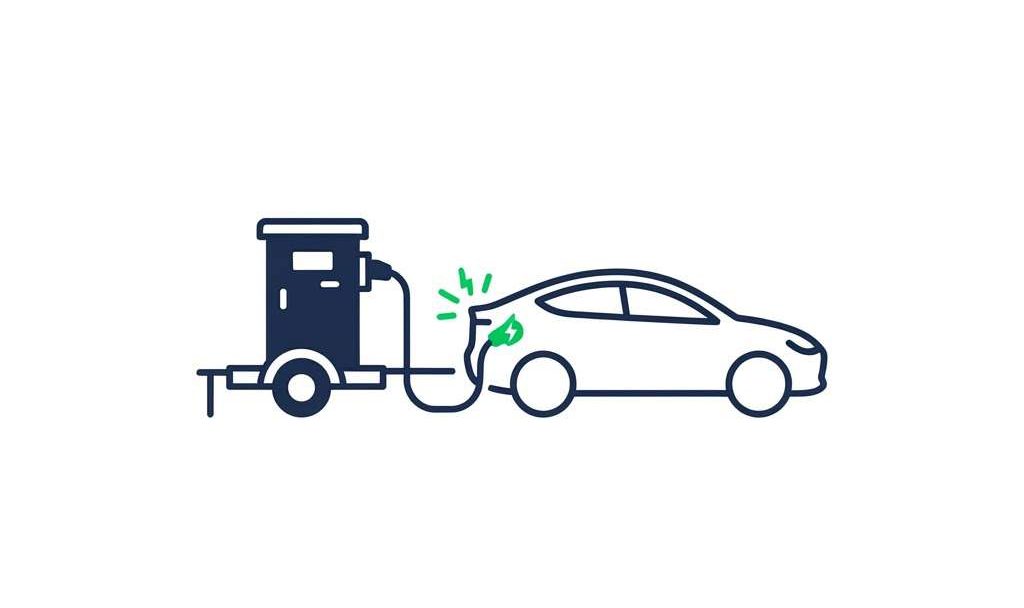
The numbers tell a stark story. For every new public charging point installed globally, approximately 2.5 new EVs hit the road. In dense urban areas and remote industrial zones, the ratio is even worse. Utilities are overwhelmed with connection requests, transformer shortages are common, and permitting delays stretch into years.
Mobile EV charging stations bypass this entirely. They arrive ready to charge, require no permanent infrastructure, and can be redeployed as demand shifts. This isn’t about replacing fixed chargers—it’s about solving problems fixed chargers can’t address:
Peak demand management: Why build for your busiest week when you can supplement with mobile units?
Temporary sites: Construction projects last 18-36 months—too short for permanent installs, too long to rely on diesel.
Emergency response: When hurricanes or floods knock out power, mobile chargers restore mobility.
Fleet transition: Phase in EVs without committing to depot-wide electrification before you’re ready.
Beyond Power Output: What Actually Matters in 2026
Power specs are easy to compare. But in 2026, operational intelligence separates effective solutions from expensive paperweights.
Energy Arbitrage Capability
Smart mobile stations aren’t just discharging—they’re buying low and selling high. With time-of-use pricing widening in most markets, units that can charge during off-peak hours (2-4¢/kWh) and discharge during peak demand periods (35-50¢/kWh) effectively pay for themselves. The MEV series’ intelligent energy management system automatically optimizes this cycle.
Grid-Interactive Mode
The best mobile stations now operate in three modes:
Island mode: Fully off-grid, using stored energy
Grid-assist mode: Supplementing limited grid capacity with stored power
Export mode: Feeding excess energy back during peak pricing
This flexibility transforms a charging asset into a revenue-generating energy asset.
Multi-Gun Intelligence
Four guns aren’t simply “better” than two—it depends on your operation. The updated MEV-A series offers both configurations, but the intelligence behind power allocation matters more. Dynamic load balancing ensures each vehicle receives optimal power based on:
State of charge (lower SOC vehicles get priority)
Departure time (vehicles leaving soon charge faster)
Battery temperature (protecting battery health)
This isn’t just software—it’s algorithmic energy management that maximizes throughput without compromising safety.
The Hidden Costs of “Cheaper” Solutions
The mobile charging market has attracted newcomers offering lower upfront prices. Here’s what gets sacrificed:
| Recurso | Premium Solutions (MEV Series) | Budget Alternatives |
|---|---|---|
| Battery cells | Tier-1 LFP (prismatic) | Lower-grade pouch cells |
| Thermal management | Active liquid cooling | Passive air cooling |
| Fire suppression | Aerosol system with sensors | Basic extinguisher |
| Enclosure rating | IP54 + C4 corrosion coating | IP43 (indoor only) |
| Operating range | -10°C to 50°C | 0°C to 40°C |
| Comunicação | Modbus + OCPP ready | Proprietary only |
The cost difference? A budget unit that fails in summer heat or winter cold isn’t cheaper—it’s a write-off. And without integration capabilities, it becomes an isolated asset that can’t participate in smart charging networks.
Real-World Impact: Where Mobile Charging Wins
Case Study: Regional Delivery Fleet
A 50-vehicle delivery fleet in Texas faced 9-month wait for a depot upgrade. They deployed four MEV-A400418 units instead:
Economia de custos: $185,000 avoided in grid upgrade fees
Charging availability: 92% uptime (vs. projected 65% with public station reliance)
Operational impact: 0 vehicles missed routes due to charging availability
Energy cost: 28% reduction using off-peak charging
Within 18 months, the units paid for themselves through avoided costs and energy arbitrage.
Case Study: Music Festival
A 3-day festival expected 2,000+ EV attendees. Traditional approach: temporary diesel generators costing $15,000 in fuel + emissions penalties.
Solução: Six MEV-C240270 units
Energy cost: $2,800
Charging capacity: 1,200 EVs served over 3 days
Marketing value: “Zero-emission event” enhanced sponsor appeal
Redeployment: Units moved to construction site immediately after
MEV-A vs MEV-C: Choosing the Right Series for Your Operation
Both series are fully mobile, transportable solutions. The choice comes down to your specific charging demands:
MEV-A Series (High-Capacity Operations)
| Model | Saída | Storage | Guns |
|---|---|---|---|
| MEV-A400418 | 400kW | 418kWh | 2 × 200kW or 4 × 100kW |
| MEV-A320522 | 320kW | 522kWh | 2 × 160kW or 4 × 80kW |
Best for: Large fleet depots, busy public charging zones, major events, and operations where multiple vehicles need simultaneous charging. The 4-gun option maximizes throughput, while larger battery capacity supports more sessions between grid recharges.
MEV-C Series (Compact & Agile)
| Model | Saída | Storage | Guns |
|---|---|---|---|
| MEV-C160261 | 160kW | 261kWh | 2 × 80kW |
| MEV-C240270 | 240kW | 270kWh | 2 × 120kW |
Best for: Smaller operations, tight deployment spaces, weight-restricted locations, and applications where compact footprint is a priority. These units are easier to transport and position while still delivering serious charging capability.
Both series support 200-1000Vdc output, compatible with all modern EVs including 800V architectures. Both feature liquid cooling, Modbus/OCPP communication, and the same uncompromising build quality.
2026 Trends Reshaping Mobile Charging
Vehicle-to-Grid (V2G) Readiness
Mobile stations are increasingly being deployed as grid resources during emergencies. With bidirectional capability, connected EVs can discharge through the mobile station to power critical loads—turning your charging asset into backup power for your facility.
Autonomous Deployment
Self-propelled charging pods are moving from prototype to production. While NextG Power’s MEV series remains trailer-based for reliability, automated docking and self-positioning features are coming to future releases.
AI-Powered Demand Forecasting
The latest energy management systems use machine learning to predict charging demand patterns, automatically optimizing energy storage levels based on historical usage data.
Enhanced Thermal Management
As charging speeds increase, thermal management becomes critical. NextG Power’s liquid cooling technology maintains optimal battery temperatures even during sustained high-rate discharge, preserving cell life and ensuring consistent performance in extreme environments.
Making the Decision: Framework for Selection
Don’t start with specs. Start with your operational profile:
What’s your demand volume?
High throughput, many vehicles → MEV-A with 4-gun configuration
Lower volume, space-constrained → MEV-C series
What’s your charging urgency?
Need fast turnaround → Prioritize higher per-gun output
Flexible timing → Multi-gun options may serve better
What’s your growth trajectory?
Expanding fleet → Ensure parallel operation support (both series support this)
Stable fleet → Right-size from day one
What’s your energy strategy?
Grid-dependent → Focus on time-of-use optimization
Solar/wind integration → Ensure renewable input compatibility
What’s your maintenance capacity?
Onsite technician → Advanced diagnostics
Limited resources → Remote monitoring and support
Why NextG Power Leads the Mobile Charging Market
In 2026, the question isn’t whether you need mobile EV charging. It’s how you’ll justify not having it when competitors are charging their fleets while yours waits.
Mobile EV charging stations have moved from experimental to essential. They’re not replacements for permanent infrastructure—they’re the bridge that lets you operate today while building for tomorrow.
NextG Power’s MEV series represents the mature end of this evolution: proven Tier-1 LFP battery chemistry, intelligent energy management, and deployment flexibility that adapts to your actual needs—not the other way around. Every unit is built with new, premium-grade cells and uncompromising quality standards that deliver consistent performance over the full service life.
Whether you need the high-capacity MEV-A series for demanding operations or the compact MEV-C series for agile deployment, NextG Power delivers the performance, safety, and reliability your operation deserves.
Want to see which series fits your operation? NextG Power offers site assessments and ROI modeling tailored to your specific application. Contate-nos for a consultation.
Keywords: mobile EV charging station, portable EV charger 2026, battery energy storage EV charging, NextG Power MEV series, off-grid EV charging, fleet electrification solution, temporary EV charging, high power portable EV charger, mobile charging infrastructure, V2G ready charging