
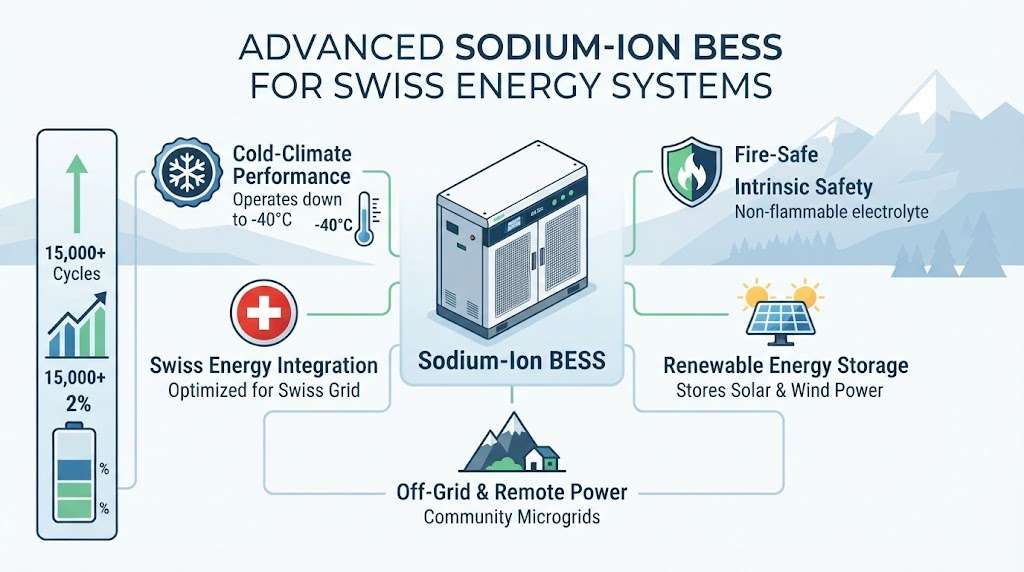
Switzerland’s energy transition is accelerating at pace. With ambitious renewable targets, dense urban centers, and some of Europe’s most challenging alpine climates, the choice of sistema de armazenamento de energia de bateria (BESS) technology matters more than ever.
Lithium iron phosphate (LFP) has dominated recent Swiss installations, yet sodium-ion chemistry is quietly positioning itself as a formidable contender for 2026 and beyond.
For Swiss project developers, facility managers, and energy consultants, sodium-ion BESS solutions offer compelling advantages where cold temperatures, fire safety, and supply-chain resilience are non-negotiable priorities. This article examines why the technology fits the Swiss context, compares it head-to-head with conventional LFP, highlights real-world applications, and explores emerging projects and economics shaping adoption.
Why Sodium-Ion Fits Switzerland
Switzerland’s geography and energy landscape create distinct demands that sodium-ion technology addresses naturally and effectively.
Superior Low-Temperature Performance
Swiss winters regularly push outdoor temperatures well below freezing, especially in mountain cantons like Graubünden, Valais, and Uri, as well as higher-altitude valleys and alpine pass regions. Traditional lithium-ion cells suffer significant capacity loss and reduced charge acceptance in cold conditions, sometimes losing 20-30% of usable capacity at –20°C.
Sodium-ion chemistry performs markedly better at sub-zero temperatures due to its different ion intercalation behavior and advanced electrolyte formulations. Many sodium-ion cells retain a higher percentage of rated capacity at –20°C compared with standard LFP, substantially reducing the need for aggressive battery heating systems that consume auxiliary energy and reduce overall system efficiency.
This characteristic is particularly valuable for Swiss alpine solar PV installations, where winter generation potential is significant but storage performance has historically been compromised.
Enhanced Thermal Stability and Safety
Thermal stability represents another practical differentiator. Sodium-ion cells generally show higher thermal runaway onset temperatures and release less energy when subjected to stress. For dense urban sites in Zurich, Geneva, or Basel, alpine resorts, or critical infrastructure located near residential areas, this improved safety profile can materially simplify permitting processes and reduce insurance premiums.
Data centers, which house expensive equipment and operate with zero tolerance for fire risk, are taking note. The inherent safety advantages of sodium-ion are already attracting major Swiss data center operators.
Abundant Materials and Geopolitical Resilience
Material availability further strengthens the case for sodium-ion adoption. Sodium is abundant, widely available, and geographically distributed across Europe and globally. Key cathode and anode materials can be sourced from iron, manganese, and other common elements with significantly lower geopolitical concentration risk than cobalt or even some lithium supply chains.
European manufacturing interest is growing substantially. Several European cell manufacturers are planning production capacity that could serve the Swiss market by the late 2020s, aligning with Swiss preferences for shorter, more transparent, and resilient supply chains.
Current Swiss and European Context: Emerging Projects
2026 is proving to be a pivotal year for sodium-ion in Switzerland, with concrete projects demonstrating commercial viability and accelerating adoption.
Inlyte Energy and NTS Colocation AG (Bern)
A landmark partnership between US-based Inlyte Energy and Swiss data center operator NTS Colocation AG is deploying iron-sodium battery storage across NTS facilities. The collaboration begins with a 600 kWh pilot installation at NTS’s Bern data center, targeted for commissioning at the end of 2026, with a roadmap to deploy up to 2 MW of capacity by 2028.
For NTS, which operates Tier IV-certified data centers in Zurich and Bern powered by 100% renewable energy, sodium-ion represents a strategic move toward a “diversified energy architecture” that goes beyond traditional UPS and diesel generators. Niklaus Hug, CEO of NTS, emphasizes that sodium-ion storage “offers inherent safety, long-duration discharge capability, and long asset life aligned with data center infrastructure.”
This project demonstrates confidence from sophisticated Swiss infrastructure operators and provides a reference point for broader adoption.
Phenogy’s C&I Solutions (Lucerne)
Swiss-headquartered Phenogy, based in Root in the canton of Lucerne, is driving sodium-ion adoption in the commercial and industrial (C&I) sector. Their PHENOGY 1.1 system—a 50 kW/100 kWh C&I cabinet—was a finalist for The smarter E AWARD 2026 and targets peak load management, self-consumption optimization, microgrids, emergency power, and EV charging integration.
Phenogy’s systems leverage air cooling, reducing auxiliary power demands, and offer cycle life exceeding 10,000 cycles—surpassing many Li-ion C&I systems. Their demonstration system has been operating in Bremen since 2025, validating the technology in real-world conditions, and the company is well-positioned to serve the Swiss market with locally-based development and support.
The Broader European Picture
Across Europe, pilot projects and early commercial deployments are increasing. Major cell manufacturers are announcing production capacity expansions, while policymakers are recognizing sodium-ion’s potential to diversify storage technology portfolios and reduce strategic dependencies. Switzerland’s regulatory environment and engineering expertise create a fertile ground for adoption.
Performance at Sub-Zero Temperatures and Safety Advantages
Laboratory and early field data indicate that well-designed sodium-ion cells maintain usable capacity and power capability at temperatures where LFP systems require significant heating. Charge acceptance in cold conditions is often superior, allowing better utilization of excess solar generation on clear winter days.
Safety testing typically shows higher thermal stability thresholds. This does not eliminate the need for proper system design, fire suppression, and monitoring, but it can materially reduce the severity of worst-case scenarios. For Swiss regulators and insurers accustomed to strict standards, these characteristics are increasingly relevant and can translate into lower insurance premiums and simplified permitting.
Ideal Applications for Sodium-Ion BESS Switzerland
Sodium-ion BESS Switzerland systems suit several distinct segments where their unique characteristics deliver maximum value:
Residential and C&I in Colder Cantons
For homes and businesses in higher-altitude regions with harsh winters, sodium-ion provides reliable year-round performance without heating systems that reduce efficiency and increase operational costs.
Infraestrutura Crítica
Hospitals, data centers, mountain railway facilities, and emergency services benefit from high safety, long-duration backup, and reliable cold-weather operation. The Inlyte-NTS data center project exemplifies this application.
Urban Sites Prioritizing Fire Safety
Urban rooftops, mixed-use developments, and dense downtown locations where fire risk is a primary concern benefit from sodium-ion’s inherent thermal stability.
Mobile and Containerized Solutions
Sodium-ion’s wide operating temperature range and safety profile make it suitable for containerized, transportable storage units used in construction sites, events, or temporary microgrids in remote alpine locations.
In each setting, the reduced need for heavy thermal management and inherent safety characteristics can lower both capital and operating expenses.
NextG Power Sodium-Ion Offerings
NextG Power has introduced sodium-ion All-in-One systems and liquid-cooled cabinet solutions specifically engineered for European climates and Swiss requirements.
All-in-One Systems
The All-in-One units integrate battery, inverter, and energy management system (EMS) in a compact footprint suitable for residential and light C&I applications. They are optimized for cold-climate reliability and designed for straightforward integration with Swiss photovoltaic systems.
Liquid-Cooled Cabinets
Liquid-cooled cabinets target larger commercial and utility-scale installations, offering precise thermal control that further enhances cold-climate reliability and enables higher energy density configurations.
Both product lines are designed for seamless integration with Swiss PV systems and existing EMS platforms. Communication protocols and grid-code compliance packages are available to support local connection requirements. Early performance data from similar European deployments suggest solid round-trip efficiency and stable operation across a wide temperature range.
Project Economics vs. Conventional LFP
While large-scale Swiss sodium-ion reference plants are still limited, pilot installations and parallel European projects demonstrate the economic logic and competitive trajectory.
Direct Cost Comparison
Sodium-ion currently trades some energy density for better low-temperature behavior,higher cell cost than LFP now but lower raw-material cost potential in the coming years. Upfront system pricing is becoming competitive as cell costs decline, and cost parity with LFP is projected by 2030.
Total Cost of Ownership Advantage
For stationary applications, the total cost of ownership (TCO) picture can favor sodium-ion:
Higher Cycle Life: 15,000+ cycles vs. LFP’s 6,000-12,000 cycles extends asset life
Reduced Auxiliary Load: Minimal heating requirements in cold climates save energy
Simplified Safety Infrastructure: Lower fire risk can reduce insurance premiums and fire-suppression requirements
Material Cost Stability: Reduced exposure to lithium and cobalt price volatility
When to Choose Sodium-Ion vs. LFP
| Factor | Sodium-Ion | LFP |
|---|---|---|
| Cold-Climate Performance | Excellent; minimal capacity loss at -20°C | Moderate; requires heating below 0°C |
| Safety (Thermal Runaway) | High inherent stability | Good, but requires active monitoring |
| Energy Density | Lower; larger footprint | Higher; more compact |
| Ciclo de vida | 15,000+ cycles | 6,000-12,000 cycles |
| Material Supply | Abundant, low geopolitical risk | Lithium and graphite supply concentration |
| Cost Trajectory | Approaching parity, likely lower by 2030 | Currently lower, but volatile |
Simple Decision Framework
Choose sodium-ion when low-temperature performance, fire safety, or supply-chain resilience ranks highest
Prefer LFP when maximum energy density in a warm indoor environment is the dominant requirement and cost is already optimized
Consider hybrid approaches for larger sites that can allocate different chemistries to different duty cycles
Outlook for 2027–2030
Between 2027 and 2030, sodium-ion is expected to move decisively from pilot to early commercial scale across Europe. Several trends will accelerate adoption:
Growing European Manufacturing: Announced cell production capacity expansions will serve regional demand, reducing logistics costs and carbon footprints.
Regulatory Tailwinds: The revised EU Energy Efficiency Directive requires data centers to disclose fossil fuel use, pushing operators toward cleaner backup solutions like sodium-ion.
Declining Costs: As production scales, cell prices will decline, making sodium-ion increasingly cost-competitive.
Swiss Expertise: Swiss project developers who gain experience now will be better positioned as the technology matures and local service ecosystems develop.
FAQ
Is sodium-ion ready for commercial Swiss projects in 2026?
Yes. Early commercial products are available, and pilots like Inlyte-NTS in Bern are expanding. Full bankability for large projects will continue to develop through 2026–2028.
How does cycle life compare with LFP?
For typical stationary duty cycles, modern sodium-ion cells deliver competitive or superior cycle life, with 15,000+ cycles. Exact figures depend on depth of discharge and temperature profile.
Can sodium-ion systems integrate with existing Swiss PV and EMS?
Yes. Leading offerings support standard communication interfaces and local grid codes, enabling straightforward integration with existing installations.
When should I choose sodium-ion over LFP?
Prioritize sodium-ion for cold outdoor sites, high safety requirements, alpine applications, or projects where material abundance and lower geopolitical risk are strategic priorities.
What are the main limitations of sodium-ion today?
Energy density is currently lower than LFP, requiring larger physical footprint for equivalent capacity. However, this trade-off is acceptable in most stationary applications and is improving with technology development.
A Practical Option for Swiss Projects
Sodium-ion BESS technology is no longer purely experimental. Its cold-climate performance, safety profile, improving economics, and growing project portfolio make it a practical, competitive option for many Swiss projects starting in 2026.
Whether you are planning a residential installation in a cold canton, a C&I system to optimize self-consumption, or critical infrastructure with strict safety requirements, sodium-ion deserves serious consideration alongside conventional LFP.
The technology is here. The projects are live. The economics are improving. The question is no longer whether sodium-ion will play a role in Switzerland’s energy transition—it’s how quickly Swiss project developers and operators will seize the opportunity.
Ready to explore sodium-ion for your Swiss project? Entre em contato com a NextG Power today for a technical consultation on site conditions, system sizing, and integration pathways tailored to your specific requirements.
Keywords: sodium-ion BESS Switzerland, sodium-ion battery energy storage Switzerland, cold-climate BESS Switzerland, sodium-ion vs LFP Switzerland, NextG Power sodium-ion, Swiss BESS 2026, alpine battery storage, low-temperature battery performance, fire-safe energy storage Switzerland, sodium-ion residential C&I, European sodium-ion manufacturing, BESS critical infrastructure Switzerland, NTS Inlyte Bern, Phenogy sodium-ion, Swiss energy transition, sodium-ion cycle life, sodium-ion cost comparison