
Why Lithium-Ion Fails When the Temperature Drops
As energy systems expand into colder regions, a critical engineering flaw becomes painfully apparent: conventional lithium-ion (Li-ion) batteries fail in the cold. While they perform admirably at 25°C, performance falls off a cliff at -10°C. The electrolyte thickens, ion movement slows, and internal resistance spikes. The result is a significant loss of usable capacity (often 20-40%) and a complete inability to accept charge at freezing temperatures without risk of lithium plating—a process that permanently damages the cell and creates a fire hazard.
For years, the solution was expensive thermal management. Heavy-duty heaters, insulation blankets, and energy-hogging BMS systems were required to keep Li-ion batteries operational. This not only reduces overall system efficiency by diverting power to maintain temperature but also adds significant capital expenditure (CAPEX) and maintenance headaches.
Sodium-Ion: The Physics of Cold Tolerance
This is where sodium ion low temperature BESS fundamentally changes the game. The secret lies in the chemistry. Sodium ions possess a weaker Lewis acidity than lithium, allowing them to move through the electrolyte with less friction. Additionally, sodium has a smaller Stokes radius in common electrolytes, meaning it requires less energy to shed its solvent shell and intercalate into the anode when temperatures plummet.
Commercial data validates this advantage. In 2026, CATL’s “TENER” Sodium Energy Storage System is already field-validated, demonstrating stable performance in conditions that would cripple traditional LFP batteries. The result is a BESS that maintains high charge acceptance and high discharge power without the need for aggressive pre-heating cycles.
Superior Performance in Sub-Zero Environments
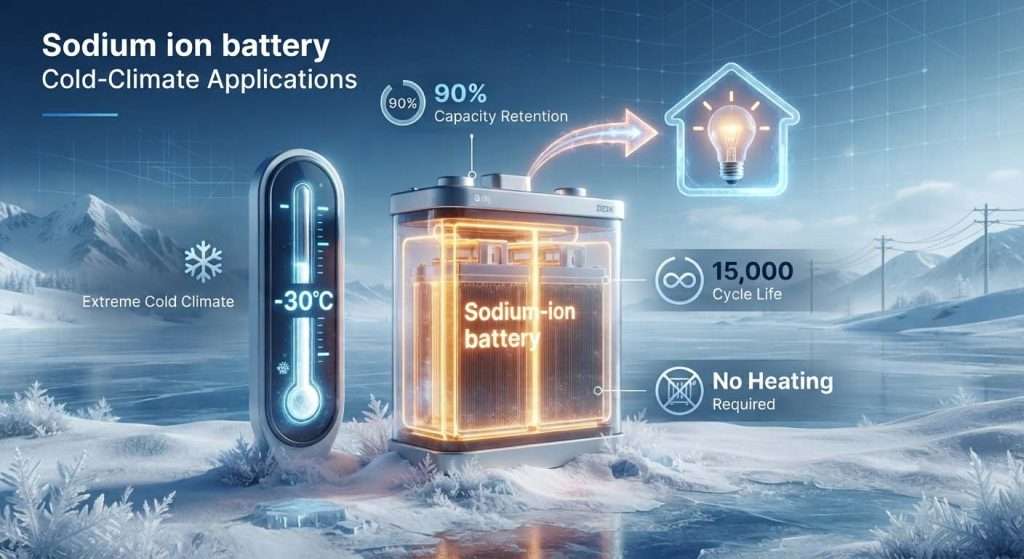
The primary value proposition of the sodium ion low temperature BESS is its reliable operation in extreme cold. While Li-ion often derates by 30% or more at -20°C, sodium-ion systems are designed to maintain over 90% of their room-temperature capacity down to -20°C, with some newer pouch-cell designs delivering usable energy down to -50°C.
This inherent cold tolerance provides two immediate benefits:
Higher System Efficiency: Because the battery doesn’t waste energy keeping itself warm, more of the stored power goes to your load. Round-trip efficiency (RTE) remains high even in freezing temperatures.
Simpler System Design: You can replace complex, failure-prone active heating systems with passive thermal management. This simplifies the system architecture and reduces the total cost of ownership (TCO).
Applications in Northern Regions and Cold Storage
Northern Microgrids
From the wind-swept coasts of Scandinavia to the remote villages of Alaska, storing renewable energy is crucial for energy independence. However, winter winds often blow hardest when temperatures drop below -30°C. A sodium battery cold climate application allows these communities to store wind power effectively and discharge it during peak demand, replacing expensive diesel transport and reducing carbon footprints.
Cold Storage Warehousing
Refrigerated warehouses present a unique opportunity. These facilities are consistently maintained at freezing temperatures. Installing a traditional Li-ion battery inside or adjacent to these spaces requires constant heating. A sodium-ion BESS can operate naturally within that environment. This reduces the parasitic load of the storage system and allows the battery to double as a revenue-generating asset for peak shaving during cold energy market hours, without sacrificing performance.
Low-Temperature Starting and Discharge Capability
For critical infrastructure, “starting” is just as important as storage. Power plants, data centers, and emergency response units require batteries that can provide sudden, high-current pulses on demand. At low temperatures, the high resistance of Li-ion batteries makes high-rate discharges dangerous.
O sodium ion low temperature BESS 2026 excels at cold cranking. The lower internal resistance at low temperatures ensures that these systems can deliver high-power pulses instantly. Comparative testing shows that sodium-ion packs can deliver similar or superior starting pulses at -5°C compared to lead-acid batteries, and they far surpass Li-ion in continuous discharge at -30°C without requiring a “ramp up” warm-up period.
Use Cases for Remote and Harsh Climates
Remote mining operations in Canada, research stations in Antarctica, and telecom towers in the Himalayas require “set-and-forget” power solutions. Transporting maintenance crews to these sites is costly and dangerous.
The reduced need for active thermal management makes sodium battery BESS ideal for these locations. Beyond performance, sodium-ion offers superior safety compared to high-energy NMC lithium batteries. The chemistry is more stable and resistant to thermal runaway, offering a higher safety margin in isolated environments where firefighting capabilities are limited.
Furthermore, the supply chain is robust. Sodium is globally abundant, so the dramatic price swings affecting lithium carbonate don’t apply here, making the financial model for long-term projects more predictable.
The Future is Clear
We are entering an era where cold climates are no longer a barrier to energy storage. Advances in electrode and electrolyte design mean that by 2026, sodium ion low temperature BESS is not a “future technology”—it is a commercially available, bankable asset. Whether you are looking to reduce diesel dependency in a northern town or ensure backup power for a critical cold-chain facility, this technology offers a superior return on investment by eliminating the inefficiencies and costs of thermal management.
Don’t let the cold dictate your energy strategy.
Unlock the full potential of your renewable assets in harsh environments. Request a technical feasibility study for sodium-ion BESS cold climate applications today and secure your power supply for the next 15~20 years.
Keywords: sodium ion low temperature BESS 2026, sodium battery cold climate applications, sodium-ion BESS, low temperature battery storage, cold climate energy storage, sub-zero battery performance, sodium ion battery 2026, remote area energy storage, cold storage battery systems, harsh climate BESS