
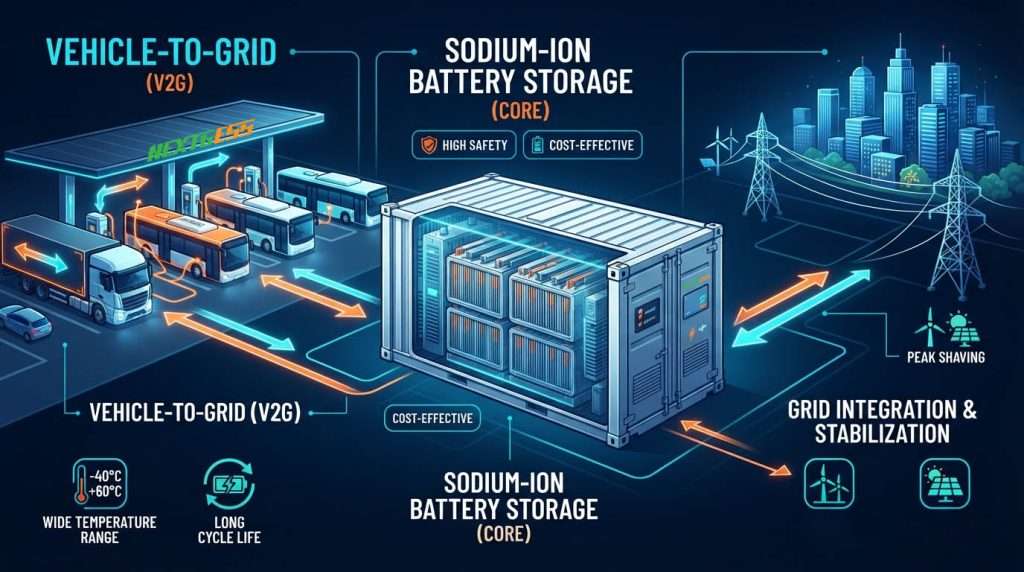
The energy transition is no longer just about putting more electric vehicles on the road. It’s about turning those vehicles—and the batteries that support them—into active participants in the grid. In 2026, sodium ion V2G BESS is emerging as a practical tool for fleet operators running electric trucks and buses. These systems pair the growing number of bidirectional-capable commercial vehicles with stationary sodium-ion storage to create flexible, revenue-generating energy assets.
Unlike earlier battery chemistries that prioritized energy density for passenger cars, sodium-ion technology shines in applications that demand long cycle life, wide temperature tolerance, and strong safety. When combined with vehicle-to-grid capability, it opens new possibilities for fleet depots, transit operators, and logistics companies that need reliable power while looking for ways to offset operating costs.
The Cost Reality in 2026
A clear-eyed look at sodium-ion economics is essential. Currently, sodium-ion batteries cost more per kilowatt-hour than lithium iron phosphate (LFP) batteries, the incumbent technology for commercial applications . The manufacturing cost of sodium-ion is estimated to be at least 30-50% higher than LFP at present , primarily because LFP benefits from massive economies of scale and decades of manufacturing optimization . As one industry analyst puts it, “the LFP oversupply” has driven prices to lower now making it “really tough” for sodium-ion producers to compete purely on cost .
However, the trajectory is shifting rapidly. The world’s leading battery manufacturer, CATL, forecasts that sodium-ion battery production costs will reach parity with LFP batteries by the end of 2028 . Raw material costs for key components like hard carbon anodes are projected to nearly halve between 2026 and 2028 .
The key takeaway for fleet operators: While sodium-ion may carry a higher upfront cost today, the rapid cost decline curve—combined with its longer cycle life and lower total cost of ownership—makes it a strategic investment for depots planning for the long term .
Integration with Electric Truck and Bus Fleets
Electric truck and bus fleets spend large portions of the day parked at depots. That downtime is exactly when energy can move in both directions. Sodium-ion battery energy storage systems installed at these sites act as a buffer and a bridge. They can charge from the grid or on-site renewables during off-peak hours, supply power to vehicles when needed, and discharge back to the grid or support local loads during peak periods.
For transit buses, the pattern is especially favorable. Many routes follow predictable schedules with long overnight layovers. School bus fleets often sit idle during summer months and weekends, creating extended windows for grid services. Medium- and heavy-duty trucks follow similar depot-based patterns in last-mile delivery and regional haul operations.
Sodium-ion BESS complements these vehicles because it handles frequent cycling better than many lithium-based systems, with cycle lives reaching 15,000 charge/discharge cycles . This durability matters when a system is expected to charge and discharge daily for fifteen to twenty years. Operators can size the stationary storage to cover depot peak loads, provide backup during outages, and still leave capacity available for V2G participation .
Bidirectional Energy Flow Capabilities
True V2G depends on bidirectional energy flow—power moving from the grid to the vehicle (or storage) and back again. Sodium ion V2G BESS supports this in two complementary ways.
First, the stationary system itself can operate as a high-cycle energy reservoir. Sodium-ion chemistry offers wide-temperature performance—a key advantage for fleets operating in extreme climates . Lower auxiliary power needs for thermal management further improve round-trip efficiency compared with some lithium systems that require active cooling.
Second, when paired with bidirectional chargers on the vehicles, the overall setup creates a distributed resource. Vehicles can discharge limited energy during high-value periods and then recharge from the sodium-ion BESS or the grid under more favorable conditions. The stationary storage smooths the interaction, reducing stress on both the vehicle batteries and the local distribution network. Fleet operators gain the ability to respond to price signals or utility requests without compromising the next day’s route requirements.
This combination is particularly useful for sites with constrained grid connections. Instead of upgrading transformers or feeders to handle simultaneous high-power charging of an entire fleet, the sodium-ion system absorbs and releases energy at controlled rates, delivering more flexible operations and lower infrastructure costs.
Ancillary Service Participation
Grid operators need fast, reliable resources for frequency regulation, spinning reserves, voltage support, and peak shaving. Fleets equipped with sodium ion V2G BESS are well positioned to supply these ancillary services.
Because commercial vehicles often park in the same locations for predictable hours, aggregators can treat a depot as a virtual power plant. The stationary sodium-ion storage provides the bulk capacity and rapid response, while the vehicle batteries add additional flexible power when available. Frequency regulation markets, in particular, value the ability to respond within seconds. Sodium-ion systems have demonstrated the necessary power characteristics for these services, and their long cycle life makes repeated small discharges economically viable.
Safety and thermal stability of sodium-ion chemistry also reduce some of the operational concerns that have slowed V2G adoption with other battery types. Lower risk of thermal events makes utility and insurance stakeholders more comfortable with large-scale bidirectional programs at commercial sites .
Fleet Operator Economics
The business case for sodium ion V2G BESS in 2026 is a balancing act between current costs and long-term value.
The Cost Side: Today, sodium-ion carries a premium over LFP. The lack of scale and lower energy density (20-40% less volumetric energy density than lithium-ion) translates to higher cell packaging and manufacturing costs per kWh . However, this gap is projected to close by late 2026, and by 2027 total system costs are expected to reach parity .
The Value Side: Sodium-ion offers benefits that directly improve fleet economics:
Longer cycle life reduces the frequency and cost of battery replacements
Wide temperature tolerance lowers thermal management costs and reduces range degradation in extreme weather
Revenue from ancillary services creates new income streams from parked assets
Reduced exposure to lithium and cobalt price volatility provides more predictable long-term costs
Energy arbitrage—buying low and selling or using high—provides one revenue stream. Demand charge management offers another, especially for fleets with high peak loads during simultaneous charging. Over a ten- to fifteen-year horizon, the combination of lower operating costs and new revenue streams can meaningfully improve total cost of ownership compared with unidirectional charging alone.
Looking Ahead
Sodium ion V2G BESS is not yet the cheapest option on the shelf, but it is rapidly becoming the smartest long-term choice for fleets that value durability, safety, and operational flexibility. As CATL and other manufacturers scale production, the cost gap is expected to close by the end of 2026, opening the door to widespread commercial adoption .
Fleet managers, energy managers, and sustainability teams now have a clearer picture of how these systems can work together. The technology is commercially available, the use cases are proven in early deployments, and the economic logic is improving with scale. The next step is matching specific fleet operations with the right combination of vehicles, chargers, and sodium-ion storage.
If your organization operates electric trucks or buses and is exploring ways to turn parked assets into revenue generators while supporting grid reliability, Contate-nos and start evaluating sodium ion V2G BESS solutions tailored to your depot and route profiles today.
Keywords: sodium ion V2G BESS, sodium battery fleet applications, sodium-ion BESS, vehicle-to-grid fleets, electric truck V2G, electric bus energy storage, bidirectional charging fleets, ancillary services V2G, fleet operator economics, sodium ion stationary storage