
The Ultimate Guide to Slashing Your Business Electricity Bill with C&I Battery Energy Storage
If you manage the energy budget for a factory, manufacturing plant, shopping center, or any commercial or industrial (C&I) facility, you know the sting of opening a monthly electricity bill. It’s not just about how much energy you use; it’s about متى you use it. For many businesses, nearly 50% of their electricity costs can come from a few hours of peak usage each month.
This is where Commercial & Industrial أنظمة تخزين طاقة البطاريات (BESS) are revolutionizing energy management. By intelligently storing electricity and deploying it at strategic moments, these systems are proven to reduce overall electricity costs by up to 60%. Let’s break down how.
Decoding Your Electricity Bill: The Two Cost Culprits
To understand the savings, you must first understand the two main drivers of a high C&I electricity bill:
Demand Charges: This is often the biggest opportunity for savings. Your utility measures your peak power demand (in kilowatts, kW) during a 15-30 minute interval each billing cycle. They charge a premium rate for that peak, which sets your “demand charge” for the entire month. One spike in operation can cost you thousands.
Time-of-Use (TOU) Rates: Electricity is more expensive during “on-peak” hours (e.g., weekday afternoons when the grid is strained) and cheaper during “off-peak” hours (e.g., nights and weekends).
أ C&I battery storage system is designed specifically to attack these two cost centers.
Strategy 1: Peak Shaving with BESS – Your Financial Shield
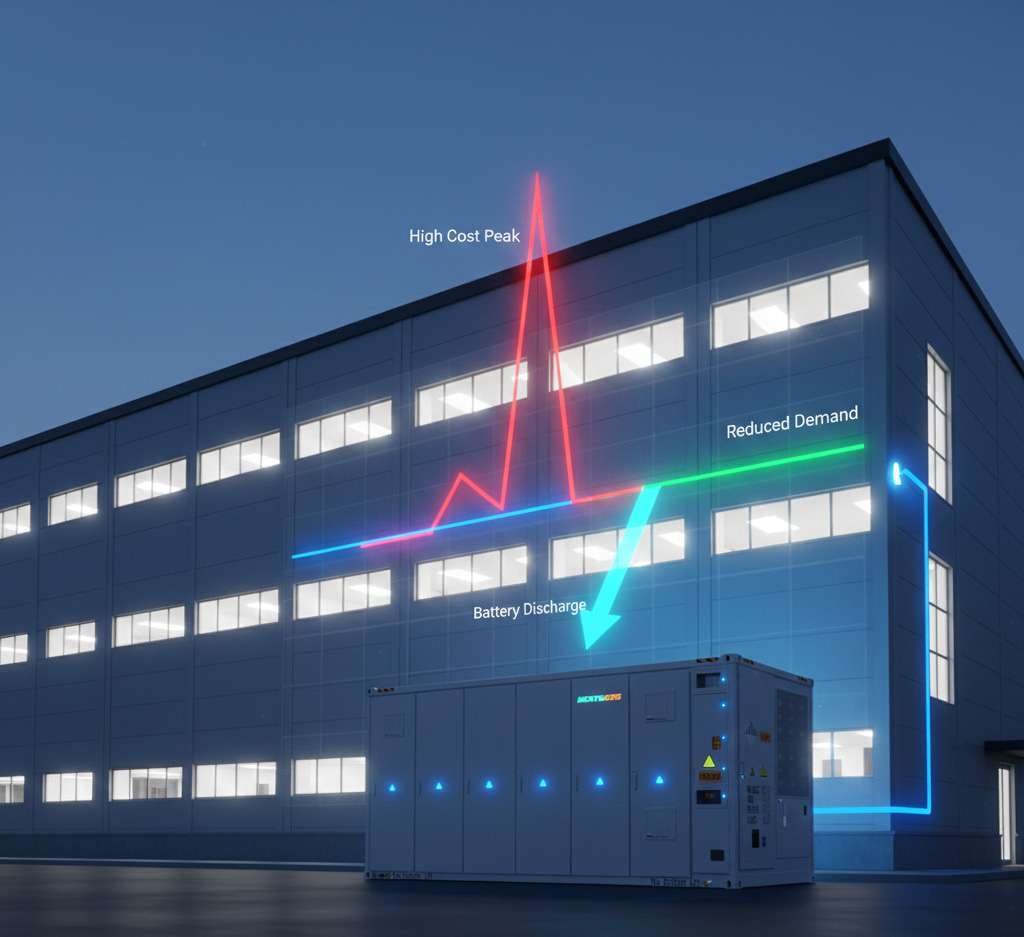
Peak shaving is the primary strategy for demand charge reduction. Here’s how it works with a battery system:
Your facility’s energy management system, integrated with the بيس, constantly monitors your power draw from the grid. When it detects that your usage is climbing toward a new peak that would trigger a higher demand charge, it instantly discharges the battery to supplement your power needs. This “shaves” the peak off your grid consumption.
Result: You avoid setting a new, costly peak. By consistently flattening your load profile, you can permanently lower your demand charges, often by 20-40% or more.
Strategy 2: Mastering Time-of-Use Arbitrage Economics
TOU arbitrage turns price differences into profit. The concept is simple: charge low, discharge high.
Your بيس automatically charges from the grid during low-cost, off-peak hours. Then, during expensive on-peak hours, it discharges to power your operations, allowing you to avoid buying costly grid electricity. This isn’t just saving pennies; in regions with high price spreads, the economics are compelling.
Real-World Case Studies: The Proof is in the Savings
Manufacturing Factory: A mid-sized plant with high, intermittent loads from heavy machinery faced monthly demand charges over $50,000. By installing a 500 kW / 1,000 kWh BESS for peak shaving, they reduced their peak demand by 30%. Annual Savings: $180,000. The system paid for itself in under 3 years.
Regional Shopping Mall: With peak demand driven by simultaneous HVAC, lighting, and customer traffic on hot afternoons, the mall’s TOU rates were crippling. A 1 MW BESS now charges overnight and discharges during the 4-9 pm peak period. Annual Savings: $95,000. The project achieved a 4-year ROI.
Cold Storage Warehouse: Operating 24/7, this facility had less TOU variability but very consistent, high baseload demand. The battery was programmed for sophisticated peak shaving, ensuring compressors and refrigeration never created a demand spike. Annual Savings: $120,000. Payback was achieved in just 2.5 years due to local high demand rates.
Typical ROI: Why the Investment Makes Cents
The financial case for C&I energy storage is stronger than ever. Typical return on investment (ROI) periods are between 2–5 years, with several factors accelerating payback:
High Demand Charge Rates: Utilities in areas like California, parts of the Northeast, and Europe impose very high $/kW charges.
Large TOU Spreads: Where the difference between off-peak and on-peak energy rates is wide (often exceeding $0.20/kWh), arbitrage delivers greater value.
Incentives: Federal tax credits (like the ITC in the U.S.), state grants, or utility rebates can significantly reduce upfront capital costs.
After the payback period, the savings drop directly to your bottom line for the 15+ year lifespan of the system. It becomes a long-term, revenue-generating asset.
The Strategic Advantage Beyond Savings
While cost reduction is the primary driver, C&I battery storage also provides:
Backup Power: Critical operations can continue during short-term grid outages.
Sustainability Goals: Enables greater use of on-site solar and reduces your carbon footprint.
Grid Stability: Some utilities offer additional revenue for participation in grid services programs.
Is Your Business a Candidate for Major Savings?
If your electricity bill shows high demand charges and you operate under TOU rates, you are an ideal candidate. The first step is a detailed analysis of your past 12-24 months of utility bills to model your potential savings.
Ready to see exactly how much you could save? اتصل بنا today for a free, customized savings analysis based on your utility data.
الكلمات المفتاحية: C&I energy storage cost saving, peak shaving BESS, demand charge reduction battery, commercial battery storage, industrial energy storage, electricity bill reduction, TOU arbitrage, battery ROI, demand charges, peak shaving, C&I BESS, energy cost savings