
The era of “just add fans” is over. As utility planners finalize their 2026 capital budgets, one question keeps surfacing: How do we pack more megawatt-hours into less land without roasting our batteries?
The answer has arrived. Liquid cooled LFP BESS systems are not a niche upgrade — they are rapidly becoming the baseline specification for competitive utility tenders. Lithium iron phosphate (LFP) chemistry already offers industry-leading safety and cycle life. But air cooling, the default for nearly a decade, simply cannot keep up with the heat generated by today’s high-throughput, high-density utility projects.
This guide explains why liquid cooling is no longer optional for high density LFP-Batteriespeicher, how it solves three critical pain points (space, heat, and efficiency), and what real-world 2026 deployments look like.
Why 2026 Changes the Rules for Utility Storage
Three converging forces make liquid cooling mandatory for new projects this year:
Larger LFP cells — 314 Ah, 560 Ah, even 1,000 Ah prismatic cells generate concentrated heat. Air cannot extract it fast enough without roaring fans that consume 3–5% of plant power.
Longer duration — The market has shifted from 2-hour to 4- and 6-hour systems. Sustained discharges create steady-state thermal loads that air struggles to manage.
Tighter real estate — Interconnection queues are long; substation footprints are fixed. Developers must triple capacity without expanding fence lines.
Liquid cooling solves all three simultaneously.
Advantage #1: Space-Constrained Grid Sites Finally Have a Solution
Land is the silent killer of storage economics. A 200 MWh air-cooled system might require 3–4 acres, complete with wide aisles for hot-air exhaust, setback distances from equipment, and oversized HVAC units. Try fitting that into a repurposed industrial site or an existing substation.
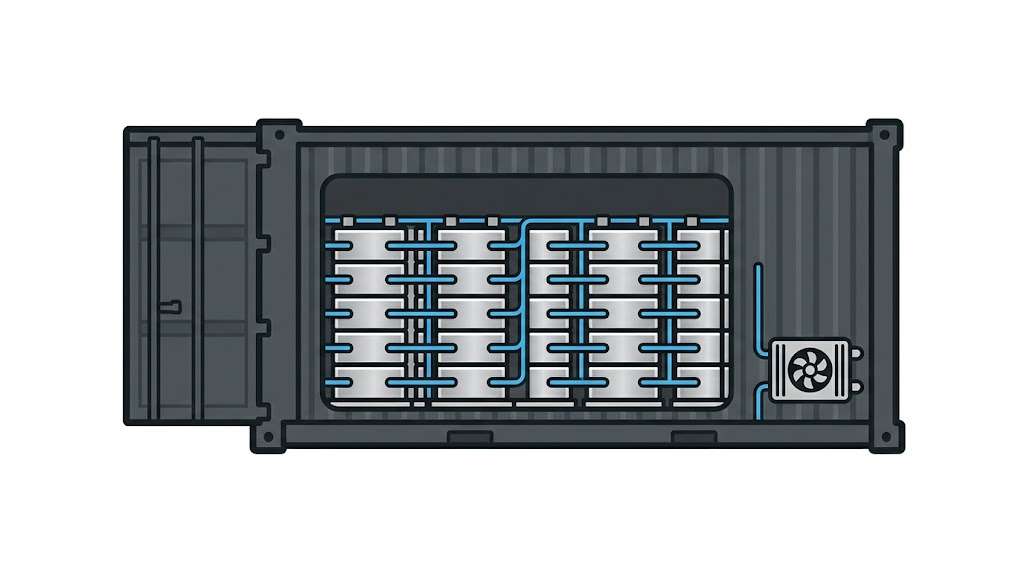
Liquid cooled LFP BESS changes the geometry. Because liquid transfers heat roughly 25x more efficiently than air, you can pack cells within millimeters of each other. Cold plates or dielectric fluid channels pull heat directly from module surfaces, then route it to a compact radiator array.
Real-world density gain: A standard 20-foot ISO container that holds 2.5–3 MWh with air cooling regularly reaches 5-7 MWh with liquid cooling — a 2–3 times increase. For a 100 MWh project, that translates to much more fewer acres of land, avoiding $500k–$3M in site acquisition and civil work.
Advantage #2: Superior Thermal Management for Large Systems
Heat is the enemy of lithium-ion cells. Every 10°C increase above 25°C roughly halves cycle life. Worse, temperature differences between cells cause imbalance — some cells age faster, forcing premature replacement of entire racks.
Air-cooled systems typically show 8–10°C variation between the hottest and coldest cells under load. That imbalance can reduce system capacity by 15–20% after just 3 years.
Liquid cooling reduces cell-to-cell variance to ±2°C or better. For high density LFP-Batteriespeicher, this delivers:
Extended cycle life: LFP warranties are moving from 6,000 to 12,000+ cycles with liquid cooling.
Higher sustained C-rates: 1C continuous without derating, essential for frequency regulation.
Lower parasitic loss: Variable-speed pumps consume 1.5–2.5% of plant power vs. 3–5% for fans.
Safer operation: Uniform temperatures prevent localized hot spots that precede thermal events.
One ERCOT operator running 150 MW of liquid-cooled LFP reported cell spread of just 1.8°C after 18 months of daily peak shaving. Their air-cooled sister site, same location, showed 7.4°C spread and 9% higher degradation.
Advantage #3: Energy Density and Efficiency Benefits That Crunch the Numbers
Let’s talk LCOS (levelized cost of storage). Liquid cooling improves every variable:
| Metric | Air-Cooled LFP | Liquid Cooled LFP |
|---|---|---|
| Volumetric density | 180–220 kWh/m² | 280–320 kWh/m² |
| Round-trip efficiency | 83–86% | 87–91% |
| Parasitic cooling load | 3–5% | 1.5–2.5% |
| Warranted cycles | 6,000-8,000 | 8,000–12,000 |
| Peak C-rate (sustained) | 0.5–1C | 1C |
For a 500 MWh, 4-hour project over 12 years, those efficiency and cycle-life gains add up to $8–12 million in net present value — easily justifying the modest upfront cost premium for liquid cooling.
What to Specify in Your Next RFP
If you’re evaluating vendors for 2026/2027 deployment, demand these three technical guarantees:
Cell delta-T under load: ≤3°C at 1C continuous (measured at module level).
Parasitic cooling power: ≤2% of rated power at nominal 25°C ambient.
Serviceable circuits: Isolated cooling loops per rack or per container — no draining the entire system for one module swap.
Also verify the coolant type. Dielectric fluids (synthetic esters) eliminate leak risks but cost more. Water-glycol is cheaper but requires deionization and regular maintenance. Both work; choose based on your O&M model.
For 2026 Utility Planners
Air cooling had its run. But for liquid cooled LFP BESS projects demanding high density, long life, and low LCOS, the physics are clear. Liquid cooling enables 40–60% more capacity in the same footprint, cuts parasitic losses by half, doubles effective cycle life, and keeps cells within a 2°C band under full load.
The utilities winning 2026 interconnection slots and tenders are already specifying liquid cooling as mandatory, not optional. Those who wait will find their projects underbid or unbuildable.
Don’t let outdated thermal design cap your project’s potential. Kontaktieren Sie uns today to request a free density analysis for your site today.
Schlüsselwörter: liquid cooled LFP BESS 2026, high density LFP battery storage, utility-scale BESS 2026, containerized LFP storage, thermal management for battery storage, high density utility projects, LFP BESS liquid cooling, LCOS optimization, ERCOT battery storage, 2026 energy storage trends3