
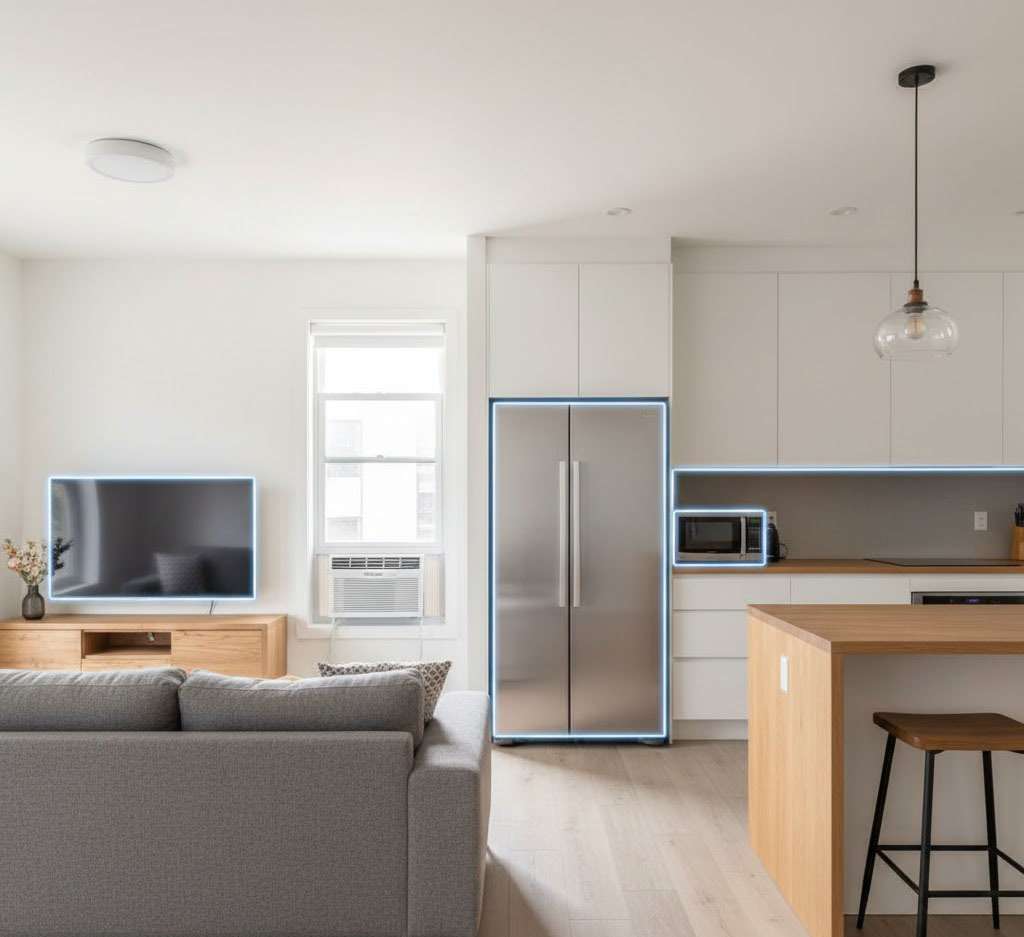
Do you ever look at your electricity bill and wonder where all that power is going? The answer lies in the silent, daily hum of your home appliances. Understanding appliance wattage is the first step to taking control of your energy consumption, whether you’re looking to shrink your utility bills, size a solar system correctly, or prepare for a backup generator.
This guide will demystify the power needs of your most common devices, showing you exactly how those watts translate into real-world costs and how you can start saving money.
Home Appliance Wattage Chart
Before we dive in, here’s a quick-reference chart for the typical appliance wattage of common household items. Remember, wattage (W) is the instantaneous power draw. To calculate energy cost, you need kilowatt-hours (kWh): Watts × Hours Used ÷ 1,000 = kWh.
Example: A 1,500 W space heater running for 3 hours consumes 4.5 kWh.
| Appliance | Wattage Range (Watts) | Key Notes |
|---|---|---|
| TV | 50–400 W | Varies greatly by size & tech; OLED uses more. |
| Refrigerator | 100–800 W | Runs 24/7, but cycles on/off. |
| Air Conditioner | 500–3,500 W | Central AC systems are the biggest energy users. |
| Microwave Oven | 600–1,200 W | High power, but typically used in short bursts. |
| Electric Oven | 2,000–5,000 W | Demands high power for extended periods. |
| Washing Machine | 400–1,400 W | Uses more if it has an internal heater. |
| Clothes Dryer | 1,800–5,000 W | One of the top energy consumers in a home. |
| Dishwasher | 1,200–2,400 W | Most energy is for heating water and drying. |
| Space Heater | 750–1,500 W | Can significantly increase winter energy bills. |
A Closer Look at Major Appliance Wattage
How Many Watts Does a TV Use?
Average Wattage: 50–400 W
Your television’s hunger for power depends heavily on its size and display technology. Modern LED and LCD screens are remarkably efficient, while older plasmas were power-hungry.
32” LED TV: 30–70 W
50” LED TV: 100–150 W
65” 4K OLED TV: 150–250 W
Pro Tip: Activate the “Eco” or “Energy Saver” mode in your TV’s settings. This simple change can reduce its appliance wattage by up to 30% without a noticeable drop in picture quality.
How Much Power Does a Refrigerator Use?
Average Wattage: 100–800 W (Averages 150-250 W with cycling)
As an appliance that never truly rests, your refrigerator is a cornerstone of your home’s energy profile. Size, age, and efficiency rating are the main factors.
Mini Fridge: 100–250 W
Standard Top-Freezer (18 cu. ft.): 300–500 W
Large French Door Model (25+ cu. ft.): 500–800 W
Upgrading to an ENERGY STAR® certified model can make a substantial difference, as they are designed to use at least 9% less energy than standard models.
How Many Watts Does an Air Conditioner Use?
Average Wattage: 500–3,500 W
Air conditioners are often the single largest contributor to summer energy bills. The type of AC unit you have dictates its power draw.
Window AC Unit: 500–1,500 W
Portable AC Unit: 1,000–2,000 W
Central AC System: 2,000–3,500 W
Smart Strategy: Pair your AC with a programmable thermostat and seal windows and doors to prevent cool air from escaping. This can improve efficiency and slash your cooling costs by up to 20%.
How Much Electricity Does a Microwave Use?
Average Wattage: 600–1,200 W
While a microwave has a high appliance wattage, its short run-time keeps its overall impact manageable.
Compact Microwave: 600–900 W
Full-Size Microwave: 1,000–1,200 W
Used for 10 minutes daily, a microwave adds roughly 5-6 kWh to your monthly bill—a small cost for a major convenience.
From Watts to Dollars: Calculating Your Energy Bill
Electricity bills are measured in kilowatt-hours (kWh). The formula to find an appliance’s cost is straightforward:
Watts × Hours Used × 30 Days ÷ 1,000 × Electricity Rate ($/kWh) = Monthly Cost
Let’s calculate with an example:
Your 1,200-watt microwave runs for 10 minutes (0.17 hours) each day. Your electricity rate is $0.16/kWh.
1,200 W × 0.17 hrs × 30 days ÷ 1,000 = 6.1 kWh
6.1 kWh × $0.16 = $0.98 per month
6 Smart Strategies to Reduce Your Energy Consumption
Invest in ENERGY STAR: When replacing old appliances, choose ENERGY STAR models for maximum efficiency.
Eliminate Phantom Loads: Use smart power strips to completely cut power to electronics in standby mode, like TVs and game consoles.
Optimize Thermostat Settings: A few degrees adjustment, especially when you’re asleep or away, can lead to significant savings.
Wash Smartly: Run your dishwasher and washing machine with full loads and use cooler water settings when possible.
Maintain Your Appliances: Clean refrigerator coils and AC filters regularly to keep them running efficiently.
Shift Your Usage: If you’re on a time-of-use plan, run high-wattage appliances like dryers and dishwashers during off-peak hours.
How Many Solar Panels Do You Need to Power Your Home?
If you’re considering solar, understanding appliance wattage is crucial for sizing your system. Here’s a sample calculation based on common usage (assuming 400W panels):
| Appliance | Daily Use | Avg. Power | Daily Energy | Panels Needed* |
|---|---|---|---|---|
| TV (50″ LED) | 5 hours | 120 W | 600 Wh | ~1 panel |
| Refrigerator | 24 hours | 200 W | 1,600 Wh | ~1 panel |
| Window AC Unit | 8 hours | 1,200 W | 9,600 Wh | ~6 panels |
| Microwave | 12 min | 1,200 W | 240 Wh | <1 panel |
| Total | ~12,040 Wh | 8-10 panels |
**Panel output varies by location, roof angle, and sun exposure. Estimates based on 1.5 kWh/day per 400W panel.*
The Long-Term Savings of Solar Power
Going solar is one of the most effective ways to combat rising energy costs. The average U.S. homeowner saves between $1,500 and $2,000 annually, adding up to tens of thousands of dollars over the system’s lifetime. With incentives like the 30% federal tax credit, the payback period can be as short as 6-8 years. After that, the energy your system produces is essentially free for the rest of its life.
Solar plus Batteriespeicher to maximize your inverstment and go energy independance.
Frequently Asked Questions
Why do some appliance labels only show volts and amps?
You can easily calculate the appliance wattage yourself using the formula: Watts = Volts × Amps. A device labeled 120V and 6A uses 720 W.
Which appliance uses the most electricity?
Heating and cooling appliances are the biggest users. Central air conditioning systems, electric water heaters, and clothes dryers typically top the list.
Do smart appliances save energy?
Yes. Features like remote monitoring, energy usage reports, and automated eco-modes help you identify waste and reduce consumption without extra effort.
What is a “phantom load”?
Also called “vampire power,” this is the energy sucked by devices that are “off” but still plugged in, like phone chargers and entertainment centers. It can add up to 10% to your annual bill.
Can solar panels power all my home appliances?
Absolutely. A properly sized solar system can generate enough electricity to run your entire home, from your refrigerator and AC to your TV and computer, granting you true energy independence.
Schlüsselwörter: appliance wattage, home energy use, electricity bill, power consumption, watts, kilowatt-hours, kWh, energy efficiency, solar panels, save electricity, refrigerator wattage, air conditioner wattage, TV wattage, microwave wattage, phantom load, ENERGY STAR,battery storage