
Your neighbor’s house might hum along at 500 watts. Yours might spike past 25,000. Both are “normal” for California — and that gap is exactly why this question has no single answer.
Here’s what most people miss: the number that matters isn’t your average. It’s your peak. That’s what determines whether your panel trips, your generator stalls, or your battery covers you through a Public Safety Power Shutoff.
Let’s break it down.
The Short Answer
The average California home draws about 690 watts continuously — roughly 16.5 kWh per day. Nationally, the average is about 1,180 watts. We use less power here, but we pay roughly twice as much per kWh. NextG Power have full solutions for your solar storage applications.
Two definitions before we go further:
A watt measures power at one instant — the rate of flow.
A kWh measures energy over time — 1,000 watts running for one hour.
Your utility bills you in kWh. Your battery and generator are limited by both. A refrigerator might run at 150 watts but demand 1,200 watts for a second when the compressor starts. That startup spike — surge watts — is what breaks undersized backup systems.
Why California Uses Less Power Than Most States
Fuel choice, mostly.
According to the EIA’s 2020 Residential Energy Consumption Survey, 64% of California homes heat with natural gas, and only 20% use electricity. Space heating accounts for just 4% of a typical California home’s electricity use.
Strip out gas heat, gas water heating, and coastal mildness, and the remaining electric load is modest. That’s why California averages 503 kWh per month against 863 kWh nationally.
Average Watts by Utility Territory
Where you live changes the math.
| Utility | kWh/Day | Average Continuous Watts |
|---|---|---|
| SMUD (Sacramento) | 23.0 | ~960 W |
| SCE | 16.6 | ~690 W |
| PG&E | 16.4 | ~680 W |
| LADWP | 15.9 | ~660 W |
| SDG&E | 12.0 | ~500 W |
Inland areas run more air conditioning. Coastal areas run less. An SDG&E customer uses roughly half the power of a SMUD customer — same state, different climate, different bill.
Climate Can Triple Your Load
PG&E’s summer baseline allowance — the power it considers essential — ranges from 5.9 kWh/day in its mildest territory to 19.2 kWh/day in its hottest.
That’s the difference between a home averaging 250 watts and one averaging 800 watts, before you turn on anything discretionary.
Here’s the twist most people don’t see coming: as California homes electrify, winter becomes the new peak. An all-electric home with a heat pump and electric water heater can receive up to 26.7 kWh/day in winter. Summer AC is no longer the worst case.
Where the Watts Actually Go
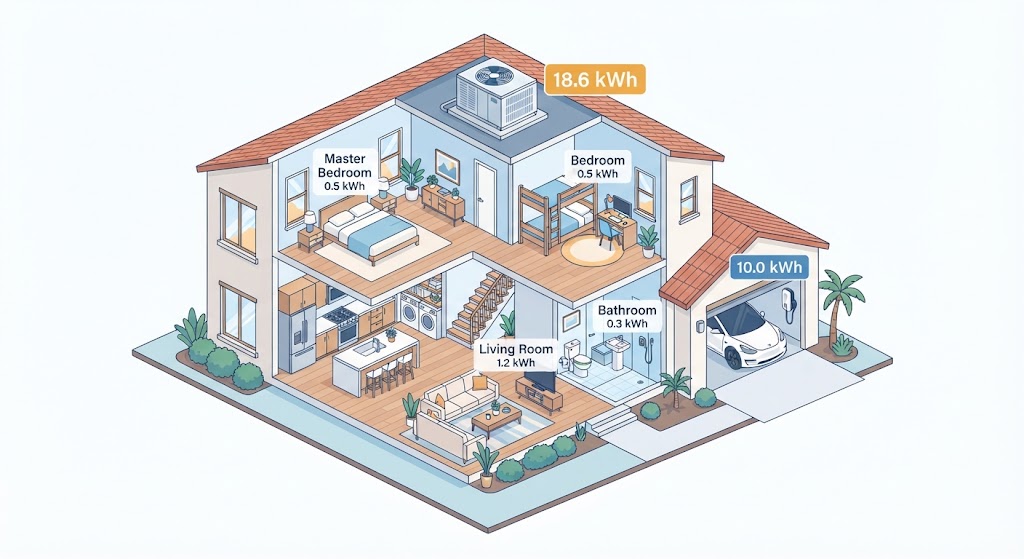
A gas-heated California home without AC or an EV draws about 15 kWh/day. Here’s the breakdown:
| Load | Daily kWh |
|---|---|
| Central AC (3-ton, summer) | 18.6 |
| Level 2 EV charging (35 mi/day) | 10.0 |
| Kitchen (induction + oven) | 3.9 |
| Kitchen (gas range) | 3.5 |
| Laundry (washer + electric dryer) | 3.0 |
| Home office | 1.3 |
| Living room | 1.2 |
| Second fridge/freezer | 1.0 |
| Each bedroom | 0.5 |
| Bathroom | 0.3 |
Notice something? A single summer AC day or one EV commute outweighs every other room combined.
Then there’s the load nobody counts. An NRDC study of 70,000 Northern California homes found an average of 164 watts always on — standby electronics, chargers, appliances that never fully sleep. That’s 3.9 kWh/day. In a mild-climate home, standby alone can be a quarter of your bill.
Peak Watts: When Everything Fires at Once
This is where sizing decisions get made.
| Load | Running Watts | Surge Watts |
|---|---|---|
| Refrigerator | 132–192 | 1,200 |
| Furnace fan | 600 | 1,000 |
| Lights | 600 | 600 |
| Laptop/router/charging | 200–250 | 200–250 |
| LED TV | 120 | 120 |
| Microwave | 1,500 | 1,500 |
| Central AC (3-ton) | ~3,100 | ~6,200 |
| Electric dryer | 5,400 | 6,750 |
| Electric water heater | 4,500 | 4,500 |
| Level 2 EV charger | 7,200 | 7,200 |
| Clothes washer | 1,200 | 1,200 |
| Dishwasher | 216 | 540 |
Totals:
Essentials only: ~1,760 running, 2,800 at startup
Essentials + microwave: ~3,260 running, 4,300 at startup
Essentials + central AC: ~6,360 running, 9,500 at startup
Everything at once: ~25,000 running, ~28,000 at startup
Can Your Panel Handle It?
A 100-amp panel supplies 24,000 watts maximum — about 19,200 watts continuous under the 80% rule. A 200-amp panel supplies 48,000 watts, or 38,400 continuous.
The “everything at once” scenario doesn’t fit on 100 amps. That’s why electrification in California usually starts with a panel upgrade or smart load management. California’s 2025 building code already requires new homes with service over 125 amps to be battery-ready.
Time-of-Use: When You Run Matters as Much as How Much
Running essentials plus AC from 4–9 p.m. uses about 32 kWh.
SCE TOU-D-4-9PM: ~$18.45 on-peak vs. ~$10.80 off-peak
PG&E E-TOU-C: ~$16.60 at the summer peak rate
Same kWh. Nearly double the cost. Pre-cool before 4 p.m., run laundry in the morning, charge the EV after midnight — and you move the same energy into cheaper hours. A battery does this automatically, which is a major reason 57% of California solar systems installed in 2024 included storage.
Sizing a Battery or Generator
Essentials need 2,800–4,300 watts of starting capacity. Add central AC and you need ~9,500 watts at startup and over 6 kW continuous.
Tesla Powerwall 3: 13.5 kWh usable, up to 11.5 kW continuous. Runs essentials ~7–8 hours at full draw. Handles a 3-ton AC if the LRA rating fits. One unit covers ~82% of an average California home’s daily use.
Enphase IQ Battery 5P: 5 kWh, stacks in 5 kWh increments. Good for essentials-only homes.
Backup isn’t just about storms. PG&E called multiple PSPS events in 2025. If you’re in a fire-risk zone, size for at least a full day of essentials.
How to Calculate Your Own Numbers
Multiply each appliance’s nameplate watts by daily hours, divide by 1,000, and add. Then check against your utility’s hourly usage data — available for PG&E, SCE, and SDG&E customers.
How Much Solar Covers It
An average California home at 16.5 kWh/day needs roughly 3.5–4 kW of solar (assuming 4.2–4.7 kWh per kW daily). A SMUD-area home at 23 kWh needs 5–5.5 kW. Adding an EV adds 2–2.5 kW.
FAQ
How many watts does a house use per hour?
A California home averages about 690 watts, or 0.69 kWh per hour.
How many watts does a 2,000 sq ft house use in California?
Less about square footage, more about climate. A coastal gas-heated home may sit near 690W; the same house inland with AC can double on hot days.
Can a 100-amp panel run a house?
Yes, for a gas-heated home. It usually can’t also carry a Level 2 EV charger, electric water heater, and induction range simultaneously.
Can a 5,000W generator run a house?
It covers essentials (~4,300W startup with microwave) but not a 3-ton AC, which pushes startup near 9,500W.
Knowing how many watts to run a California house lets you size solar, batteries, and panels correctly — and avoid nasty surprises when the next heat wave or shutoff hits. Book your free home energy assessment today and get a watt-by-watt plan built for your utility and climate zone.
Contact us for more information.
Keywords: how many watts to run a California house, California home power consumption, average watts California home, kWh per day California, peak watts house California, solar for California home, battery backup California, 100 amp panel upgrade, EV charger watts, central AC watts California