
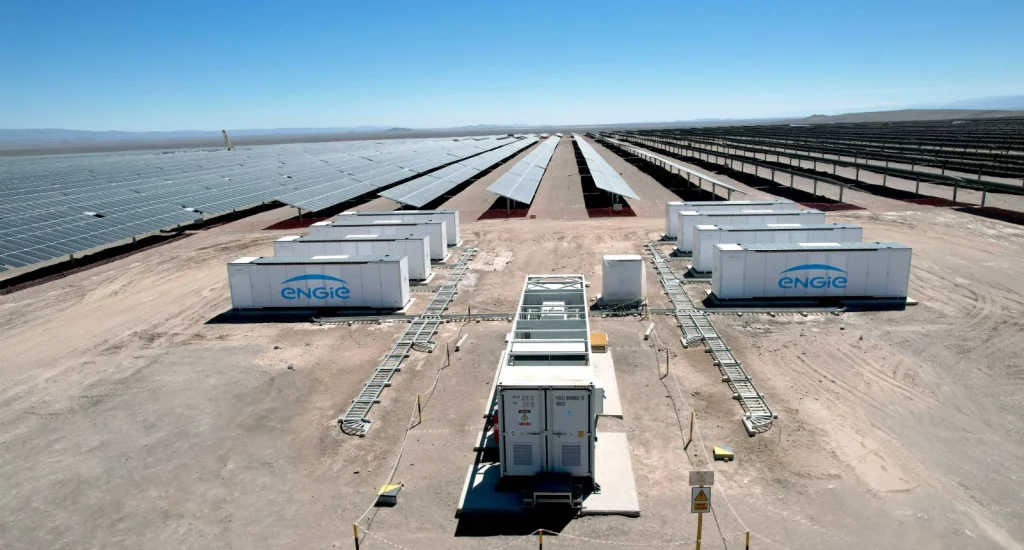
If you have been watching the energy markets south of the equator, you already know 2026 is not just another year for renewable energy. It is the year Latin America stops apologizing for intermittency and starts monetizing it. The twin engines of this transformation? Chile and Brazil. And the common thread weaving them together is battery energy storage systems (BESS).
From the blinding, relentless sun of the Atacama Desert to the drought-stricken hydropower reservoirs of São Paulo’s backyards, the region is deploying storage at a pace that makes the rest of the world take notes. We are not talking about pilot projects anymore. We are talking about grid-scale survival and profit.
Let’s break down why solar curtailment storage Latin America is no longer a technical footnote—it is the most exciting investment thesis of the decade.
The Atacama Desert Curtailment Crisis: Too Much of a Good Thing
Chile’s northern desert is a solar dream. The Atacama receives the highest solar radiation on the planet. For years, developers raced to install PV plants, turning the region into a solar powerhouse. But there is a catch no one wanted to talk about: the grid cannot handle the midday surge.
Every sunny afternoon, solar farms produce more electricity than the transmission lines can carry. The result? Curtailment. Operators are paid to shut down perfectly functional panels because there is nowhere for the electrons to go. In 2023 alone, Chile curtailed over 1.5 TWh of solar energy—enough to power a mid-sized city for months. By 2026, without intervention, that number was projected to triple.
Enter the Chile BESS market. Instead of turning off the taps, developers are now plugging in massive batteries. The model is brutally simple: during the curtailment hours (typically 11 AM to 3 PM), when power prices crash to zero or even negative, BESS assets charge for free. Then, as the sun sets and the Santiago evening demand peaks, they discharge at premium prices.
This is not science fiction. It is happening right now. In 2026, the Chilean government fast-tracked permitting for storage assets co-located with existing solar farms. The bottleneck has shifted from building panels to building batteries. And the early movers are already seeing internal rate of returns that would make an oil executive jealous.
Night Arbitrage Models: Turning Darkness into Dollars
The smart money in Chile is on a specific strategy: night arbitrage. During the day, solar is abundant and cheap. But from 6 PM to 10 PM, when people return home, turn on air conditioners and cook dinner, thermal generators (gas and coal) fire up. Prices spike.
A 200 MW BESS facility in the Antofagasta region can charge for four hours during curtailment at $0/MWh (free energy) and discharge during the evening peak at $120–150/MWh. Do the math. That single facility clears millions per month. And because Chile’s spot market is transparent and liquid, these arbitrage opportunities are bankable.
What makes 2026 different? Duration. Early lithium-ion projects used one-hour or two-hour batteries. Today, the Chile BESS market is deploying four-hour and six-hour systems. Why? Because the curtailment window is widening. And the evening peak now extends later as electric vehicle adoption rises in Santiago.
This is the elegant solution to solar curtailment storage Latin America has been waiting for: use the waste to kill the peak. No new transmission lines. No natural gas imports. Just smart timing and electrochemistry.
Brazil Hydro Drought + Rural Grid Stabilization: When the Rains Don’t Come
Now fly 3,000 kilometers east to Brazil. The problem here is the mirror opposite of Chile’s. Brazil gets 60% of its electricity from hydropower. For decades, that was a blessing. Cheap, clean, and dispatchable. But climate change has turned that blessing into a liability.
The 2024–2025 drought was the worst in 90 years. Reservoirs in the Southeast and Midwest dropped below 20% capacity. The government was forced to fire up expensive, polluting diesel and natural gas plants. Electricity prices went through the roof. And rural communities—especially in the Northeast and the Amazon basin—suffered blackouts because the long, weak distribution lines couldn’t handle the stress.
Here is where BESS does something that no other technology can: grid stabilization without fuel. In 2026, Brazil is deploying storage not just for arbitrage, but for resilience. Rural cooperatives are installing containerized BESS units at the end of long feeders. When a hydropower plant ramps down due to low river flow, or when a storm knocks out a transmission tower, the batteries kick in within milliseconds.
But the real innovation is pairing BESS with distributed solar in off-grid communities. Instead of trucking diesel 500 kilometers into the jungle, installers drop a 1 MW solar array, a 4 MWh BESS, and a smart controller. The result? 24/7 clean power at half the cost of diesel. The Brazilian Development Bank (BNDES) has earmarked over $2 billion for exactly this kind of project through 2028.
Mining ESG Requirements (Copper/Lithium): The Silent Driver
Now let’s talk about the elephant in the room: mining. Chile and Brazil are resource giants. Chile produces nearly 30% of the world’s copper and is the second-largest lithium producer. Brazil is a top producer of iron ore, niobium, and graphite. And every single one of these mines has a problem.
International buyers—from Tesla to Apple to Volkswagen—now demand ESG-compliant supply chains. That means Scope 1 and Scope 2 emissions must fall. For a copper mine in the Atacama, where diesel generators run 24/7 to power haul trucks and processing plants, emissions are a liability.
The solution is elegant: hybrid microgrids with BESS. A copper mine installs solar panels on its tailings pond, pairs them with a 20 MWh battery, and displaces 70% of its diesel consumption. The battery smooths out the solar variability and provides reactive power to keep sensitive equipment online. The mine lowers its carbon footprint, secures a green certification, and sells its copper at a premium to ESG-conscious buyers.
Lithium miners are even more aggressive. They need huge amounts of water and heat for evaporation ponds. By adding BESS and solar, they can run electric boilers during the day using curtailed solar energy, reducing both natural gas use and water consumption. In 2026, this is no longer a nice-to-have. It is a license to operate.
The Chile BESS market is directly benefiting from this mining boom. Every major mine in the north is either tendering or building a storage project. And because mines have high load factors and long planning horizons, they offer the kind of bankable off-take agreements that project financiers love.
The Big Picture: Why 2026 Is the Inflection Point
So why does this all matter now? Because three trends are converging.
First, battery prices have fallen below $100/kWh at the cell level, making four-hour storage cheaper than a new gas peaker plant in both Chile and Brazil. Second, both countries have passed clear regulations—Chile with its capacity payment law and Brazil with its distributed generation framework—that reward storage for multiple value streams (arbitrage, frequency regulation, and resilience). Third, climate volatility is no longer a “what if” scenario. It is a quarterly earnings risk.
When you combine solar curtailment in Chile with hydro droughts in Brazil, the answer is not more transmission lines or more dams. The answer is distributed, modular, fast-responding batteries. That is the promise of solar curtailment storage Latin America in 2026.
What Happens Next
If you are a developer, you are already scouting co-location sites in the Atacama. If you are a miner, you are replacing diesel with megawatt-hours. And if you are a utility in Brazil, you are shaving peak demand with batteries hidden in rural substations.
The era of treating solar and wind as “free but unreliable” is over. With BESS, they become firm, dispatchable, and highly profitable. Chile has solved its curtailment crisis not by building less solar, but by building more storage. Brazil is surviving its droughts not by praying for rain, but by stacking electrons in steel boxes.
Latin America BESS 2026 is not a forecast. It is a construction site. And the smartest money in energy is already on the ground.
Contact our team and find your next storage opportunity today.
Keywords: Chile BESS market, solar curtailment storage Latin America, night arbitrage models, Atacama curtailment crisis, Brazil hydro drought, rural grid stabilization, mining ESG requirements, copper lithium storage, BESS 2026 Latin America, solar plus storage Chile