
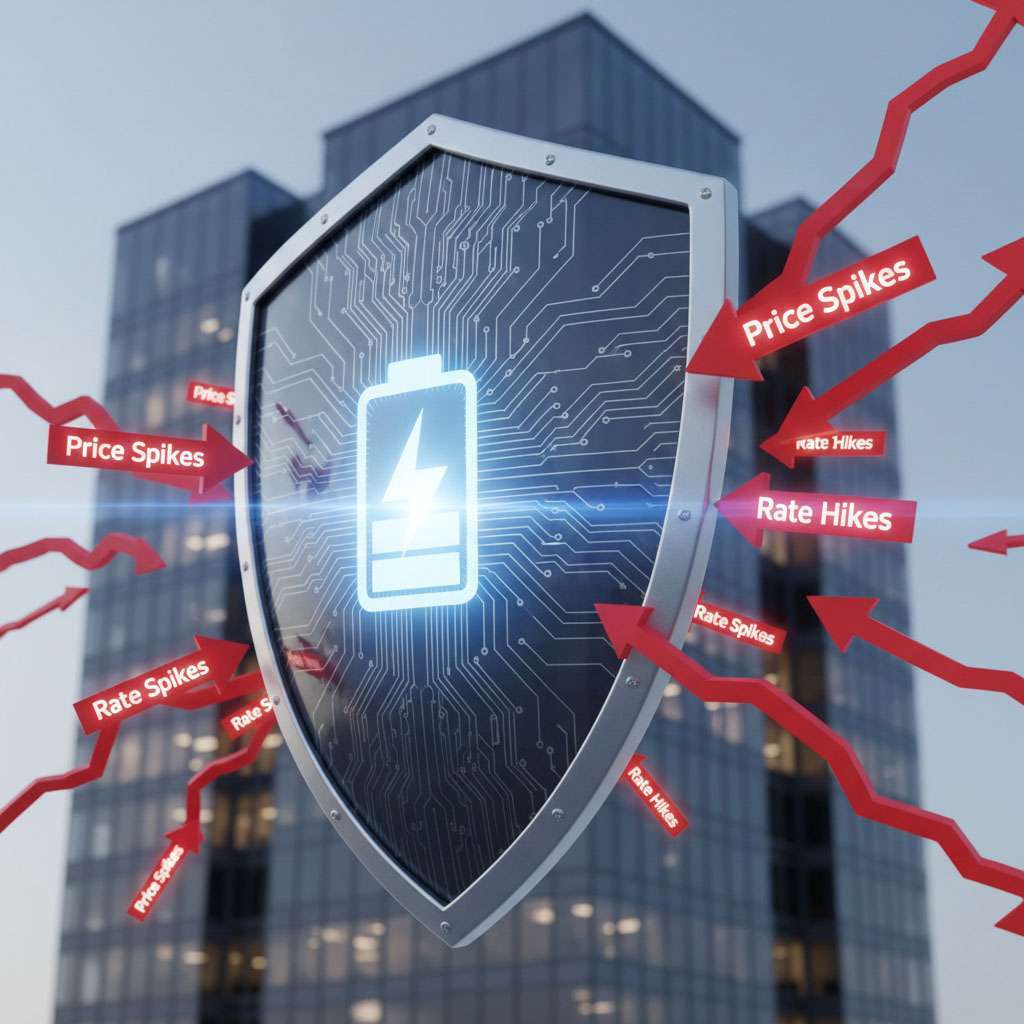
For financial and operations leaders, the quest for budget certainty often feels like a battle against unseen forces. While you can forecast sales and manage labor, one critical line item remains stubbornly unpredictable: your energy bill. In an era of aggressive utility rate structures, volatile energy costs represent a direct threat to your bottom line. However, a powerful solution exists that reframes this challenge. Strategic peak shaving, enabled by a Battery Energy Storage System (BESS), is more than an efficiency project—it’s a strategic financial instrument. It provides essential energy price volatility protection and serves as a cornerstone of modern operational risk management.
The Unavoidable Risk: Understanding Modern Utility Rate Volatility
The landscape of utility pricing has fundamentally shifted. The widespread adoption of dynamic “Time-of-Use” (TOU) rates is no longer a pilot program; it’s the new reality. Utilities are not only widening these critical peak windows—often stretching from late afternoon into the evening—but they are also dramatically increasing the price multipliers. Seeing on-peak rates that are three to five times higher than off-peak rates is becoming common.
This volatility isn’t a minor inconvenience; it’s a substantial financial risk. Running a manufacturing line, data server, or commercial HVAC system during these periods exposes your business to extreme cost penalties. The core issue is uncertainty. How can you accurately budget, forecast profits, or secure financing when a primary operational cost is subject to such wild, pre-defined swings? This inherent risk demands a strategic, insured response.
Locking in Your Cost: The Mechanics of Financial Certainty
This is where peak shaving transitions from a facilities management tactic to a CFO-level strategy. A BESS acts as a financial buffer against these market-driven price spikes. The system’s operation is elegantly simple yet financially powerful:
Charge at Low Rates: Overnight or during super off-peak periods, the battery charges from the grid at the lowest available wholesale or retail rates.
Discharge at High Rates: During the utility’s declared expensive on-peak window, your facility automatically draws power from the stored battery energy, avoiding the grid completely.
The outcome is transformative: you effectively cap your maximum cost per kilowatt-hour during peak times. By flattening your demand curve, you neutralize the threat of the highest tariff tiers. This delivers unparalleled budget certainty, turning energy from a volatile variable into a stable, controllable expense. This is the essence of using physical infrastructure for financial energy price volatility protection.
Dual-Function Resilience: The Ultimate Risk Mitigation Package
The most compelling argument for viewing a BESS as an insurance policy lies in its inherent dual functionality. The same asset providing daily financial risk management also serves as a critical business continuity asset.
When the grid fails—whether due to storms, wildfires, or infrastructure issues—your energy reserve instantly becomes a source of backup power. This seamless transition from money-saver to operations-saver means you are mitigating two critical business risks with a single investment: the risk of exorbitant costs and the risk of debilitating downtime. For sectors like healthcare, food production, or critical manufacturing, this combination isn’t just valuable; it’s indispensable. It’s a comprehensive risk mitigation package.
Reframing the Investment: From Cost Center to Risk Management Tool
It’s time to evolve the conversation around Battery Energy Storage. Moving beyond simple ROI calculations, a forward-thinking organization views a BESS as a strategic risk mitigation tool in its corporate portfolio.
Consider your other insurance policies. You pay premiums to hedge against potential fires, lawsuits, or disruptions. A BESS for peak shaving is a premium that hedges against a guaranteed event: volatile and rising energy costs. It directly addresses utility rate risk, insulating your balance sheet from future regulatory changes and unpredictable demand charges. It is an investment in long-term operational and financial stability.
In a world of constant change, the ability to control and predict core costs is a formidable competitive advantage. Deploying a BESS for peak shaving isn’t just about buying hardware; it’s about purchasing budget predictability, operational resilience, and strategic control.
Stop leaving your energy budget exposed to volatility. Contact us today to design a BESS strategy that provides the ultimate energy price volatility protection for your business.
Keywords: energy price volatility protection, BESS risk management, peak shaving, battery energy storage system, risk management, time of use rates, TOU rates, demand charge management, backup power, operational resilience, budget certainty, risk mitigation, utility rate risk, energy cost control, battery backup, financial planning, energy insurance