
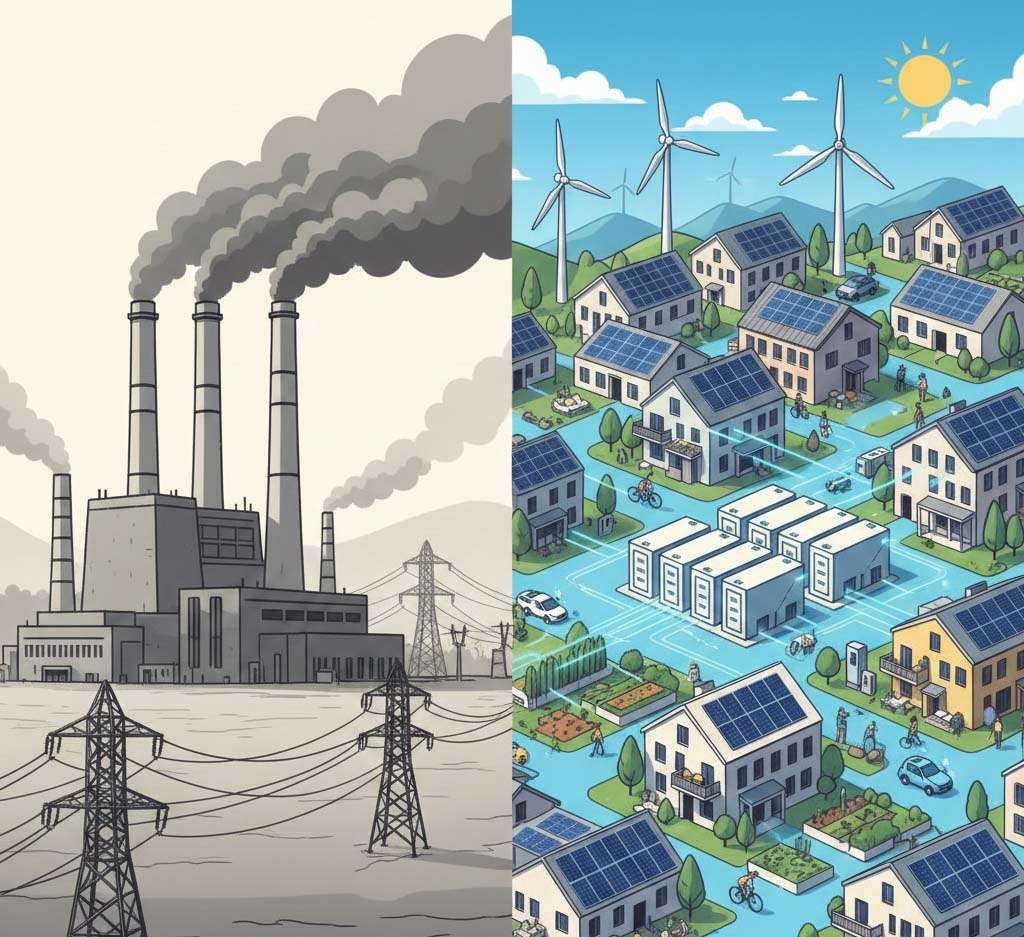
The Decentralized Power Revolution: Reshaping America’s Energy Grid
The U.S. energy landscape is undergoing a profound transformation, moving away from a century-old model of centralized power. Three powerful forces—corporate ambition, plummeting technology costs, and enabling federal policy—are converging to accelerate a decentralized power revolution. This isn’t a distant future concept; it’s happening now, creating a more resilient, sustainable, and consumer-driven grid.
From Niche to Norm: The Evolution of Private Power
For decades, onsite generation was a costly endeavor reserved only for the largest industrial players. The foundational spark came from the Public Utility Regulatory Policies Act of 1978 (PURPA), which first opened the door for non-utility generation. However, the high capital required for private generators kept the practice niche.
The game-changer has been the dramatic and sustained fall in the cost of Distributed Energy Resources (DERs) like solar PV, wind, and battery storage. Technological innovation and mass manufacturing have turned DERs from a premium option into a financially savvy one. What was once only viable for heavy industry is now within reach for a vast array of commercial and industrial businesses, fundamentally expanding the market.
The Corporate Catalyst: ESG and Economics Align
This shift isn’t just about economics. Major corporations like Amazon, Apple, and Google are leading the charge, driven by a powerful dual mandate:
Economic Sense: Locking in long-term, predictable energy costs and hedging against utility price volatility.
ESG Imperative: Meeting ambitious Environmental, Social, and Governance goals by directly sourcing clean, renewable power for their operations.
Corporate procurement has become a primary driver for new renewable energy projects, proving that sustainability and shareholder value can go hand-in-hand. This corporate demand signals to the market and policymakers that decentralization is both a strategic and a responsible path forward.
Policy Unleashing Potential: The Role of FERC Order 2222
While technology and corporate will set the stage, federal policy is now unlocking the full potential of decentralization. The landmark FERC Order 2222 is a cornerstone of this revolution.
This groundbreaking rule tears down traditional barriers by allowing aggregations of DERs—from a factory’s solar array to a portfolio of commercial batteries—to compete in regional wholesale electricity markets (RTOs/ISOs). It democratizes the grid, enabling these distributed assets to provide valuable services, increase competition, and enhance overall grid reliability. By creating a clear monetary value for DERs, Order 2222 turbocharges their adoption.
A Balanced, Resilient Energy Future
The convergence of these trends is undeniable: U.S. power markets are becoming more decentralized. This doesn’t mean the end of centralized power plants, but rather the rise of a smarter, more balanced hybrid system.
In this new paradigm, millions of distributed assets work in synergy with the traditional grid. This creates a system that is:
More Resilient: Less vulnerable to single points of failure.
More Efficient: Reduces transmission losses and optimizes local generation.
More Sustainable: Accelerates the integration of renewable resources.
The direction is set. Powered by innovation, corporate leadership, and visionary policy, the decentralized power revolution is building a more robust, inclusive, and clean energy future for America.
Связаться с нами for more information.
Keywords: decentralized power revolution, DERs, distributed energy resources, FERC Order 2222, corporate ESG, power markets, private generation, energy decentralization, federal energy policy, grid resilience, renewable energy, PURPA, wholesale electricity markets, RTO, ISO, sustainable energy.